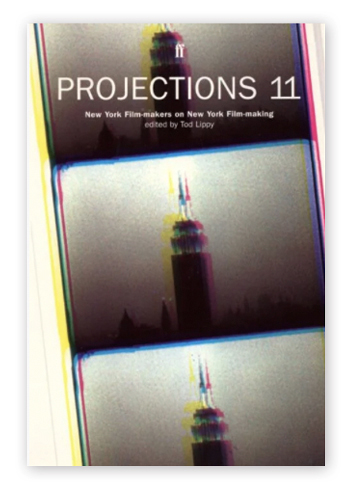
Originally published in Projections 11: New York Film-makers on New York Film-making (London: Faber & Faber, 2000), pp. 123–138

Tod Lippy: You arrived here from Europe in 1949. Was there much of a film scene at that point?
Jonas Mekas: Half a century ago, New York, amazingly, was pretty busy film-wise. People today think that everything began in the sixties, but that’s not really true. The very first evening I arrived here I went to the New York Film Society, run by Rudolf Arnheim and somebody else—they had monthly screenings somewhere in the West Twenties—and I saw a double bill of The Cabinet of Dr. Caligari and Epstein’s Fall of the House of Usher.
As I began to get to know New York better, I discovered there were many places to see films. Of course there was the Museum of Modern Art, which was basically a university of cinema, where you could see all the old silent films, the European avant-garde from the twenties and thirties. And if you were more avant-garde–oriented, Amos Vogel’s Cinema 16 was the place to go. They were screening films at the Needle Trades Center on 24th Street between 7th and 8th, and on Sunday mornings at 11:00 at the Paris Theater on 58th. That was our church. If you were of the left persuasion, a Trotskyite, you went to the Club Cinema on 6th Avenue, near 10th Street, and you could see Kameradschaft, or documentaries displaying solidarity, etc., and meet other people of the same persuasion after the film. There was music, dancing, even some cookies... [Laughs.]
Then there was somebody by the name of Peter Hollander, who ran a little distribution company for independently made films—“experimental” they called them in those days—which was called Kinesis. He’s now in Boston, working in television. He was across 47th from, you know, “Where Wise Men Fish”—
Gotham Book Mart?
Right. He was on the second floor. Emile de Antonio also had his first office there, and so did Lewis Jacobs. Then, if you wanted to see silent films of all different formats—not just 35 millimeter or 16 millimeter, but things like 19 millimeter, which they were using at the beginning of the century—you went to the Theodore Huff Society, run by Bill Everson, Herman Weinberg and Bill Kenly, who was also a manager/programmer of 5th Avenue Cinema, where I first saw Blood of a Poet. He premiered Hans Richter’s 8x8 there in 1956. Anyway, all the old-timers were at the Theodore Huff Society, as well as some younger people—Bill Everson was still very young, he had just come from London. That was on Tuesday nights, usually.
So it was already very busy, as you can see. And I could probably think of others. For instance, Gideon Bachmann started his Film Study Group around that time. I met him there and began helping him with programming, writing notes. We showed things there like von Sternberg’s Salvation Hunters, with Sternberg present.
In the spring of ’53 I started my own screenings series at Gallery East, which was right around the corner on Avenue A and First Street—I did not move very far, as you can see. And that fall, my brother Adolfas, George Capsis and I started Film Forum, and that continued for a couple of years. And if you go to 1954, Richard Leacock, Sidney Meyers, Lionel Rogosin, and Shirley Clarke were all starting to buzz around. Some of them were still making documentary shorts, but others were making their first features.
Maya Deren was quite active in this period, too, right?
Maya Deren’s most productive period was already over, between ’43 and ’46. By 1950, she already had her classic works completed. But, she got very involved in other ways. In 1953, filmmakers in New York decided to organize themselves, create their own association. Meetings took place once a month or so among twenty or so filmmakers, where we’d discuss how to organize ourselves. We’d also show at least one film each time. After six or seven meetings—and a lot of arguing—an organization was created, called the Film Artists Society. It was created and basically ended at the same time. In the last meeting, Maya Deren showed one of her films, and Lewis Jacobs jumped on it, tore it to pieces. She was so angry, she stormed out. And it’s strange, because Jacobs had been one of the first to write about her seriously in a very important catalog edited by Frank Stauffacher and Hans Richter for the San Francisco Art Institute. But then he attacked her.
You had an antagonistic moment with her early on as well, didn’t you? You’d written a piece criticizing the whole experimental movement in a 1955 issue of your magazine Film Culture—
Yes, yes. I heard from her lawyer immediately after it came out.
What was the piece about?
It was in Film Culture #3. I need to say that I was at this point still pretty naïve; I’d arrived from postwar Europe, and had seen nothing before I got here because you really couldn’t see avant-garde cinema in Europe at that time. So I did this survey in 1955, where one of the points I made was that American avant-garde cinema was totally pervaded by homosexuality. [Laughs.] I didn’t realized I’d touched such a sensitive spot. Later, you know, when I began seeing more, understanding who was doing what, meeting people, of course it all became very, very normal to me. But in that essay I presented it as something negative, instead of just making an observation, or presenting it as a fact, which it was.
I recall you likening this moment to “Saint Augustine before his conversion.”
Yes, I had my conversion and then recanted, so to speak. But for a couple of years after that, Maya and I definitely avoided each other—you know, we’d move to opposite sides of the street when we saw each other. [Laughs.] But then, my brother and I had a jeep, and very often we’d help her move her equipment around, and help her set up, and eventually we ended up being very good friends.
There’s a very funny sequence in your film Lost Lost Lost, which starts with a title card reading “Raising Money for Film Culture,” and then cuts to an image of you with arms outstretched, a hat in each hand. How did you finance the magazine? People have continually remarked on your ability to miraculously come up with funds…
Parker Tyler once told me that some people thought that because Adolfas and I came from Eastern Europe, we must have been paid by the Soviets to spy here, and that’s where our money came from…Anaïs Nin though so, too.
Andrew Sarris said there were rumors that you were actually funded by the CIA—
Oh. [Laughs.] Very few people realized that I had a series of full-time jobs, working steadily since a week after I came to New York. I started working in factories, places like that. Between 1952 and 1959, when I decided to become really independent, I worked at Graphic Studios on 22nd Street, where we did the preparation for the Spanish-language version of Life magazine. So I was quite well-paid. But for the first two years I was a delivery boy, so I found out everything about the city. We also did some work for Newsweek. I knew all the girls there, I mean, all the secretaries. That’s one good thing about being a delivery boy.
Did that give you the necessary knowledge to produce a magazine?
That experience I already had. When I was 18, I was the editor of a weekly provincial newspaper in Lithuania, and then a year later I was editing a weekly literary newspaper. So I had a lot of experience already. But my work at Graphic Studios gave me money, which all went into Film Culture, and filming, and other projects.
What inspired you to start the magazine?
Well, there was nothing much in the way of film publications. At that time, the only serious one was Sight and Sound—we’d get all the back issues at Gotham Book Mart. There was also Sequence, also from England. And of course there was Cahiers du Cinema, and occasionally, University of Southern California would put out The Hollywood Quarterly. But in New York, there was only Films in Review, which has improved over the years a little bit, but at that time their interest was only in the most conventional commercial cinema.
When did you recruit Andrew Sarris?
Very soon—the second issue, I think. His first review was of The Country Girl, which he didn’t like. Roger Tilton, who made Jazz Dance, a film with Richard Leacock, was teaching at Columbia, in the School of Journalism, I think, and he said to me after he’d seen the first issue of the magazine. “Oh, you must need more writers. I know two crazy students. One, Eugene Archer, just demolished Battleship Potemkin, and the other, Andrew Sarris, just demolished Cabinet of Dr. Caligari.” So I met them and I liked them both, and immediately engaged them.
What was the circulation of the magazine?
At that point I don’t think we published more than 1,000 copies. Our highest circulation, probably in 1966, was 4,000. We got a distributor in New Jersey, Bernhard DeBoer, who helped small magazines like ours, and he planted it all around—in university bookshops across the country, that kind of thing. My brother was the businessman of the magazine.
And of course in 1959, the New American Cinema group began their meetings, and we became the voice for them.
How did “the group” come about?
It was in the air; it came from thin air, really. All I know is that Lewis Allen and I called the first meeting. I remember clearly how the filmmakers cooperated. Lew was working for the Whitehead Theater, and he had an office in midtown, so that’s where we had our first meeting. It was Shirley Clarke, Lionel Rogosin, Emile de Antonio, Dan Talbot, and somehow that meeting originated among us.
Bogdanovich was also involved, wasn’t he?
Yes, Bogdanovich, also. Actually, that reminds me of another one of our “universities” in this period, which was of course 42nd Street. In the fifties, 42nd Street from one end to the other was full of movie houses. I mean, there were something like 20 theaters. You could watch movies all night, see five or six different Westerns, or anything—if you didn’t like one you’d go into another. And that’s where Andrew Sarris, Peter Bogdanovich and I spent a lot of our time. There was a Horn and Hardart cafeteria on 42nd between Seventh and Eighth, and you could sit and have coffee and eat cheap donuts. That’s where Peter told me about his first script, which became Targets. His original idea was a film about a movie buff who just went to see movies, and was always fantasizing—there was very little plot there.
Wasn’t he also a camera operator on your film Guns of the Trees?
No, I wanted him for my lead actor. I actually have screen tests of him; I still have the footage somewhere. I don’t remember why I decided against using him.
Right around the time of the founding of the group, you wrote a rather infamous attack on Cassavetes’s second version of Shadows in your “Movie Journal” column for The Village Voice. What motivated that?
It’s difficult for people who have not seen the first version to understand my reaction to the second version. In truth, even in its second version, Shadows is still quite a remarkable film. But I can see it only with the memory of the first one. What he did with the second version is due in large part to Nikos Papatakis, who saw the first version and got the idea that if John could just make it a little less “amateurish,” edit out some scenes to “shape” it more, he would be able to get a distributor. He managed to persuade Cassavetes to do that, thought I think Cassavetes accepted that, because from his other work that followed you can see that was more or less what he wanted, anyway.
But the first version was much more open. It was like jazz. The second version introduced completely new scripted scenes, like the one at the Museum of Modern Art, and morality sort of creeps into it. I was so disappointed, because the first version was more free, more contemporary as an experience, and it had so much more poetry.
Cassavetes dismissed it by saying he’d fallen too much in love with his Arriflex.
After that, we didn’t talk for about ten years. The last time I saw I him, I asked him where the footage for the first one was, and he told me he had sent all the materials, the work print, to some film school for the students to fool around with. I contacted the university, but they had nothing left by then.
While you were in the midst of editing Film Culture, writing your “Movie Journal” column for the Voice, and organizing the New American Cinema Group, you were also programming at the Charles Theater, right?
Yeah. We showed a lot of auteur kind of Hollywood films, like later Fritz Lang and Edgar Ulmer. Also some more rare Hollywood films, like those of Douglas Sirk. And we opened Ron Rice’s The Flower Thief, Stan Brakhage’s Anticipation of the Night—
Which Amos Vogel had rejected for Cinema 16 distribution.
Right. That led to the founding of the Film-maker’s Cooperative, in ’62.
The Coop was founded by you and who else?
Mostly with my brother, Adolfas. I mean, let’s face it, a good number of us discussed the need for it already in 1960, ’61. We felt there should be another distribution venue besides Cinema 16 and Kinesis. Brandon, also, distributed some avant-garde films, by Harrington and Markopoulos, for example. And there was Radim, run by Rosalind Kossof—she distributed Tim Davis and Ellen Bute. But all these distributors were very choosy, and limited, and some filmmakers were very unhappy that they weren’t taken by any of them. And why? Because the content was changing, improvisational styles were coming in, and neither Brandon nor Amos Vogel, nor any of the existing distributors, felt that this was “cinema.” So a point came where we decided—myself and my brother took the initiative—to do something about it. We called a meeting specifically to establish our own distribution center. In a way that came out of the New American Cinema group. Several people—my brother, myself and Emile de Antonio—were appointed to investigate distribution possibilities. There was another committee to explore production possibilities, and one to explore censorship. As a result of our investigation, we suggested at a meeting of the Group that the only solution was to do it ourselves.
So on January 7, 1962, we called a meeting at my loft at 414 Park Avenue South, and about 20 filmmakers attended. Amos Vogel was there, too, and tried to persuade us not to form our own distribution center because it would “destroy the avant-garde.” “There’s no place for two distributors,” etc. etc. [Laughs.] But the decision was unanimous. I mean, at this meeting he was facing a dozen filmmakers whose films he had refused. But even with ones—like Brakhage and Markopoulos—he did distribute, he only handled some of their films.
So that is more or less what happened. Film-makers’ Cooperative was created. My loft became the Coop office for the next three years. I was sort of pushed into the corner in my own place. We published a catalog, and it grew very fast.
And there was absolutely no exclusion?
No. None at all. We established three or four basic principles: No films would be rejected. The film was your membership card to the Coop. In the catalog, all of the films were listed alphabetically; none would be preferred. The Cooperative would be governed by filmmakers themselves, and the actual administrative work would be done by a person who was hired by the filmmakers. All decisions were made by the filmmakers, and all income—except for the percentage needed to run the Coop, also decided by the filmmakers—would go to the filmmakers. So everything was by the filmmakers and for the filmmakers.
It seems like this policy of non-exclusion carried into the “open screenings” you spearheaded—
Yeah. At the Charles Theater, in 1961, I began doing these open houses for filmmakers—that’s where it all started.
What was the atmosphere like at them?
They were quite well attended. We also started midnight music concerts. Sun Ra gave his first New York concerts at the Charles. Bob Downey—we screened his first films there. Stanley’s Bar was around the corner, where everybody gathered before and after. It was a very active, exciting period.
Did you literally have people coming in off the streets with cans of film?
Yeah. There were actually several people who ended up in Hollywood who first showed their films at an open screening. Brian De Palma was screening there, and bragging about being the only good filmmaker—“Brakhage is nothing; he doesn’t know how to make films.” He was very pompous.
But for the Charles Theater, a lot of credit has to go to two young men, Walter Langsford and Edwin Stein. Stein was a psychiatrist, and Longsford is still around, working in publicity, I think. They had rented the theater as a commercial place for, like, two years, but it didn’t do well in that neighborhood. Now it’s some kind of Adventist Church or something. Anyway, they were very open to all kinds of film. They had people like Jack Smith selling tickets, and the guy who later became one of the biggest people in that humor magazine, you know, “Who, me?”—
Mad magazine?
Yes. He used to write his stuff in the ticket booth; he was our ticket seller. Forgot his name.
When did you first see Jack Smith’s films?
Well, in 1961, on Avenue A and 9th Street—or was it 7th?—there was a movie theater that had recently closed, and one could climb up on the roof of it. That’s where much of Flaming Creatures was shot. But we didn’t see the footage until the next year, when Tony Conrad strung all the rolls together. And we screened it first one midnight at the Bleecker Street Theater, which Lionel Rogosin had opened, I think, in 1957. When we created Film-maker’s Cooperative we used Bleecker Street for some of our midnight screenings. And that was where we screened Flaming Creatures for the first time.
That wasn’t the screening at which you were arrested?
No, it was after that. The Bleecker’s managers threw us out after that screening. I still have the letter; they told us they would lose their audience if we continued our series there. [Laughs.]. So then we made a deal with the Gramercy Arts Theater on 27th Street, which became Film-maker’s Showcase, an offshoot of the Coop. That’s where we screened all of Andy’s early works, like Sleep, Kiss and Eat—all the early ones opened there. Also Kenneth Anger’s Scorpio Rising, and Markopoulos’s Twice a Man.
Can you talk about the Flaming Creatures incident a little more? It seems like such a defining moment in experimental film history.
Well, in those years—1961, 1962, 1963—every film shown publicly had to be submitted to the State Education Department’s Division of Motion Pictures, which, in reality, was a board of censorship. And if they didn’t like something, you had to cut it out. We decided that we were not going to submit our films to them. This is right around the time Lenny Bruce was arrested—that kind of thing was happening everywhere. It was a very, very touchy period for a couple of years. And it was only because of Lenny Bruce and the Flaming Creatures case that everybody began talking and writing about it, and all of those restrictions gradually faded out over the next several years.
Which screening caused all of the problems?
It was at the Bridge Theater on St. Mark’s. The place was used mostly for theatrical performances, but occasionally some film screenings, or mixed-media events, took place. That particular evening we screened a Kuchar film, Andy Warhol’s footage of Jack Smith filming Normal Love, and Flaming Creatures. It was raided by the police, and all three films were seized; we never got them back. Ken Jacobs, his girlfriend, Florence (now his wife), Jerry Sims and I were arrested.
And then you were arrested again several weeks later for showing Genet’s Un Chant d’Amour, right?
After the Flaming Creatures arrest, everybody said, “Why would you let yourself be arrested for such a ‘bad’ movie as Flaming Creatures?” So I thought to myself, “Okay, I’ll permit myself to be arrested for something else that you might not be able to say is a bad movie.” I mean, at that time, The Balcony was playing—this was Genet we were talking about. So two weeks later, I made arrangements for a screening of Un chant d’amour at the Writer’s Stage on 4th Street. That time I had packed a sandwich in my pockets, because I knew I was going to be arrested. A chicken sandwich. And of course I was arrested, and of course at the trial the prosecuting attorney was also smart: He dismissed the second case—the Genet—because he realized he had a much better case with Flaming Creatures. Anyway, I ended up with a two-month suspended sentence.
But I had my chicken sandwich in my pocket. They took me to the Tombs, and there was a Black guy in the next cell, and I started eating, and he looked hungry so I gave him half of the chicken. Later—like two years later—I was walking somewhere and this guy ran into me, remembered me. “You gave me a chicken sandwich in the jail!”
How did you meet Andy Warhol?
Well, as I said, my loft became the Film-maker’s Cooperative office for a couple of years. It was a very, very busy place. Filmmakers would come by to screen what they’d shot the day before, that kind of thing. It became so talked about that everybody was there. Salvador Dali, Allen Ginsberg, Robert Frank—everybody. And most of the time I didn’t even know who was there; they were just sitting on the floor and watching movies and laughing. And then one day, Naomi Levine, a filmmaker and painter, said to me, “Come to my birthday party. There’ll be lots of interesting people there, like Andy.” I said, “I don’t know Andy.” And she said, “You don’t know Andy? But he’s been sitting in your loft for months watching movies!” Then of course when I met him, I recognized him. So my loft was Andy’s first movie university. Of course, he also saw Hollywood movies. Soon after I met him he shot his first film, Sleep, and a series of three-minute Kisses which he called “leaders,” or trailers. I showed them all at the Film-maker’s Showcase.
I was looking again the other day at your film Scenes from the Life of Andy Warhol, and was so struck by the sequence of close-ups of all the people around a table at a bar at one point in the film—Barbara Rubin, Ginsberg, Gerard Malanga, all the others. Everyone exuded this sense of entitlement—in all the best senses of the word—as if they were absolutely certain of their significance at that particular moment in time.
Well, there was energy in the air. We were just very, very busy, each one in our own area. We were obsessed, possessed. We didn’t think we were in a particularly unique period. We couldn’t step out of it and look at it from the side; that came later. But we were very busy, and there was a lot of intensity and energy, and that’s it.
In the later sixties, when you began organizing Anthology Film Archives and spearheaded the “Essential Cinema” collection, you got a lot of criticism from filmmakers for going against the non-exclusivity implicit in both the Coop and the open screenings...
In some of its principles, Anthology went against the Coop. We got a lot of flak. But, in a sense, there was no other way of doing it. Back in 1960, there had been only a dozen or so universities with film departments, but when in 1970 the AFI published their first guide to universities and colleges offering film courses, there were 1,200, with over 20,000 courses—in one decade, that’s how much it grew. You can imagine, then, how students at all of these places were insisting that they see not only Hollywood films, but also the current avant-garde. There was a lot written about it at this point in the press. So P. Adams Sitney and I would get calls constantly: “Who should we show? What should we order? “We have money for two programs; please prepare something for us.”
So we prepared once, we prepared twice, twelve times, thirty times, and finally we said, “Okay. That’s enough.” It was a waste of time. It wasn’t only that you were preparing the program; you were writing the notes, everything. That was when the decision was made to review the whole field and to prepare a list which we could then send out, and say, “Any film on this list has something unique and something special, and will indicate to you where the cinema is going.” So that is how the Essential Cinema collection came about—it grew out of a concrete need. And we decided we should include not only avant-garde, but general cinema that related to the concerns of the avant-garde—that’s how Eisenstein, Cocteau, Vigo, and a few others came to be included as well. And it would have continued to expand if our main sponsor, Jerome Hill, hadn’t died in 1973. All funds were cut off, and the project froze after we had chosen about 330 or so films. We planned to continue to infinity, but that didn’t happen. It remains a very sort of heroic, unfinished attempt.
That’s where the most dissatisfaction came from. Many of the filmmakers who didn’t end up being included had actually been postponed for later sessions, but then the project ended, and those filmmakers were left out in the cold.
Who was involved in making all of these decisions?
It started with P. Adams Sitney, Stan Brakhage, Ken Kelman, James Broughton and myself. Then after a year or so there was a clash between Brakhage and the rest of us, because he insisted that we all have veto power, which meant that we couldn’t make any progress. After several meetings, we’d ended up with, like, ten titles, and films were being excluded for ridiculous reasons, like one bad cut. Curtis Harrington’s film, On the Edge, was excluded for one cut. I mean, it was a bad cut, but the film is still a very fine film. Flaming Creatures was another one. So Brakhage left, and that’s when Peter Kubelka came in.
Did you have a space at that point for Anthology?
Yes, that’s why we went ahead. Again, it was Jerome Hill’s doing. An army buddy of his, Joseph Martinson, was chairman of the Public Theater, and they got the building the Public is still in, 425 Lafayette. There was one end on the ground floor that they had no money to do anything with, so Martinson asked Jerome, knowing he was a filmmaker and was very familiar with the avant-garde, if he thought he could use the space for a cinema. Jerome contacted me, and we discussed it and said, “Why not?” Jerome had inherited part of his parents’ railroad fortune, and his foundation, Avon, put up the money.
At that time, Peter Kubelka was in town. He was in charge of the United Nations film division. He had dreams of a very special “invisible cinema” theater, which I’d known about for a long time, so we arranged for him to design the “ideal theater”—egg-shaped, all black, and where each viewer could see only the screen. Jerome put up the money and it was built.
I was already determined to devote more time to my own filmmaking, so I’d decided not to run Anthology. I invited P. Adams Sitney to be the director of it, and he returned from Europe to supervise the construction and preparation. We opened on the first of December, 1970. But the job of running Anthology and dealing with all the temperamental personalities involved soon proved to be too much for Sitney. He couldn’t take it. He decided to just handle the library. He took care of all the paper archives—and he was there for many years. So I had no choice but to take over the directorship. I thought it will be only for a few years. But here I still am.
And then, a few weeks before we opened, Martinson dies. It was a rental situation, and it became immediately complicated with the Public. Although Joe Papp was very friendly, a very nice guy, he didn’t care about cinema. And then in 1973 Jerome dies. The people in charge of Jerome’s foundation thought the whole project was some kind of weird whim on Jerome’s part. So their support sort of trickled down to nothing. We moved out to 80 Wooster Street to the premises of the Film-maker’s Cinematheque, which I had purchased in 1967. It was the first SoHo cooperative; it was there, really, that SoHo started.
In the seventies, you became much more interested in archiving—
Not interested in it. Pushed into it, because of necessity. As soon as we opened Anthology, students would come and want to do research on the films, so we had no choice but to collect materials on all the films and filmmakers. P. Adams went to Rome, London, Paris, spending days and days in bookshops picking out rare books on film. Some of the books we have in the library here now from the twenties and thirties are so rare we have to be careful who we let into the space. Even so, some of them have disappeared. And usually they’ve been stolen by scholars, not by students. They consider themselves “authorities” on this and that, and “if anybody should have it, it should be me.”
When did you get involved with the preservation of films?
Preservation began when we decided that if we voted a film in, then we had to get the best possible print to show it. That involved a lot of searching. For instance, it took us two years to find an acceptable print of Man of Aran. We went to London, everywhere, and then we discovered that the negative was right here in New York. Then for other avant-garde films from the forties, you’d have to locate the artists’ families, etc. National Endowment was just taking its own first steps, and Chloe Aaron in ’71 mentioned to me that they were thinking of film preservation and suggested we ask for money. So that’s how the film preservation program began.
Have you collected mostly negatives?
Well, we have everything, positives and negatives. A lot of 16mm labs have been forced to close during the last 20 years, so we dragged a lot of material from them, mostly negatives. I don’t know, I thought we had like 15,000 films, but now we’re in the middle of indexing everything and counting, and it looks like we may have 20,000. Some of it is here, some in New Jersey. Maybe only one-third is indexed or catalogued. The rest we don’t know what it is at all. We have no archivist. All work is done by volunteers, under my supervision. And I have no time, so the indexing is going very slowly.
And we’ve discovered among the materials we’ve dragged from the street—from dumpsters, practically—originals of Yvonne Rainer, Robert Breer, Joan Jonas, Robert Frank. The labs just threw them out, and the filmmakers didn’t know. The same thing happened with Flaming Creatures. For years, Anthology kept the originals. Then Jack Smith took them back, and took them to some lab. Then he forgot which lab. [Laughs.] Whichever lab it was, it went bankrupt, and they dumped all of their materials into some film stock house, and it just so happened that the filmmaker Jerry Tartaglia was working there, cleaning stuff. He was working on one reel, and he started looking more closely at it—“This looks familiar…”—and he realized it was the negative of Flaming Creatures, so he took it to Jack. For years Jack kept telling people that I had stolen the film, and had it hidden in my “lobster” closet. [Laughs.]
When did you move to this building?
We opened to the public in 1989, but it took us practically ten years to fix it up—we’d bought it in 1979. As soon as we purchased the building from the city—it had been a courthouse before—and began the renovation, other people started to do the same. We were surrounded by ruins here when we bought it.
What are your facilities like?
We have two theaters, one seventy seats, one 200. Mostly the avant-garde goes into the seventy, because it attracts smaller audiences. We have video in both the theaters, so it’s very open, and very flexible. A lot of variety.
One crucial element here is that, unlike, say, MoMA—which, due to their particular financial setup, has to program far ahead of time—we’re very open. Since we don’t have any money, and nobody’s funding us in any more substantial way, we can’t make plans. We only schedule two months ahead, so we can very easily accommodate anybody who’s passing through town, for instance. You know, whether it’s a particular filmmaker or a national group from Algeria, or Turkey, who decide they’d like to have little festival here. We can always accommodate them.
The way programming works is we always have the Essential Cinema repertory going, but then we also have one or two little festivals. For instance, next March and April there will be a Greek film festival, and there will also be a Cuban film festival. And there’s something else. There are outside curators who come in, some for one-night or weekend shows, some who take one night a week for several months. New filmmakers, documentary filmmakers, various special-interest groups, and of course, the avant-garde. I know of no other such place where all the branches of cinema are represented. We try not to permit ourselves to be focused on any one thing.
What is your role these days? More supervisory?
I’m sort of like a conductor. I orchestrate, I coordinate. I have different curators, different helpers. I still supervise all the people who are involved in programming; it’s still my responsibility.
You’ve talked about how much you’ve managed to do with little or no money—
Yeah—we still owe about $330,000 to the banks for the original loans when we renovated the building. That’s $30,000 in just interest alone every single year. You know, we could put that into programming, preservation. We get around $15,000 from National Endowment, but that’s peanuts. [Mekas takes a phone call; after he hangs up:] You see, that’s part of my hunting for money. I went to this place on Park Avenue for some occasion, and there were all these paintings on the walls, and stacked against the wall, and I said to the woman who owned it, “Is there one here that you don’t like?” [laughs] And she said, “Yes, to tell you the truth, there is one I’d like to get rid of, because I can’t show it to anybody.” She pulled out this George Grosz drawing from his erotic series, and gave it to me. I gave it to Sotheby’s to sell, and they estimated it at $8,000. But at the last minute they decided they couldn’t put it in the catalog, because it would offend some of their buyers. Anyway, the woman I just talked to found a buyer who will pay $5,000.
Speaking of money, I was interested to hear a comment of yours about how you thought grants were actually damaging, rather than improving, experimental film.
Yes, the grant system has destroyed, or at least contributed to the destruction of, the American avant-garde. I used to meet Paul Sharits, for example, and ask him, “What are you doing?” and he would tell me what he was working on: “Oh, I’m making this film, and doing that....” And then, when the grants started flowing in, around 1970, I’d see him and ask the same question, and he’d say, “Nothing. I didn’t get any grants this year.” Filmmaking became dependent on money.
If you take the American avant-garde cinema at the point of 1966, when the grants first came in, the whole body of classic avant-garde of the fifties and sixties was already there, with no grants, no money, nothing. Kenneth Anger, Brakhage, whoever you want to name—it was all there. And then after ’66, the field was flooded by all those who make films solely because they can get money. So it’s very questionable whether it was a favorable development or not. The democratic distribution of grant moneys—so much to blacks, so much to whites, so much to Asians.… I’m not so sure I believe in democracy, in art. Unless we are talking about “applied” film-making.
That reminds me of a comment you made about democracy and art not going together. Do you still believe that?
Yes. You can’t plan art; you can’t institutionalize it. I’ll give you an example—I received a catalog recently from a contemporary art museum in Lithuania, in Vilnius, and there were statements by some artists and the director. “Our main problem remains the limited support we receive from the Ministry of Culture.” They’re blaming the mediocre art on the Ministry of Culture! [Laughs.] I mean, not to say that institutions like the NEA, or state arts councils, haven’t allowed more people to be exposed to certain things—for instance, allowing orchestras to be created all over the place, or things like that. But you can’t subsidize the creation itself. Like the movements: Nobody planned Dadaism, or Cubism, or Pop Art, or Fluxus.
Do you think that there has been a significant decline in experimental film here in the U.S. since the late sixties?
There is a revival in the last five years, mostly in Super-8 film-making. There’s a lot going on, not only here but in Europe. It’s like the last gasp of Super-8; I’m not sure people are even making the film stock anymore. I think it’s because with Super-8 one can still be irresponsible and do and try anything, thus something fresh happens.
Don’t you feel the same about video?
Video is so unpredictable; I think the problem with video is that videomakers are still too inhibited by cinema—they’re still making “films” with video.
So many of the motifs, gestures—even technical innovations—of experimental film have been strip-mined by mainstream culture for everything from MTV videos to TV commercials to narrative filmmaking. Don’t you find that depressing?
But it’s like using a dictionary. The vocabulary is there, and it’s used on television and everywhere else. It’s like with other vocabularies. You either write a poem with it or you write a press release. When you read a poem, you’re elated; you read an ad and you throw it away. This argument began in ’65 and ’66; I remember Gregory Markopoulos storming into the Coop one day after seeing something on TV: “They’re stealing from me! They’re stealing from Kenneth Anger!” I said to him, “They can’t ‘steal’ from you—no matter what they do it won’t be the same.” He wanted to sue them. [Laughs.]
Well, you have to assume that part of his frustration had to do with knowing the kind of audience the television program was getting was infinitely larger than the audience for his films. Do you think avant-garde cinema can ever hope for a broader audience?
No. No. No. That’s a dream. It’s like the difference in readership between poetry and prose. Prose is published in millions of copies, and poetry—even the most popular—never goes over 5,000. The content and the form determines the number of those interested in it.
I mean, Markopoulos and Brakhage both had Hollywood dreams. They wrote scripts, and Markopoulos even went there. He came back. Shirley Clarke persuaded Roger Corman to produce a film of hers. She went out there, and lasted, I think, two days. She wanted to do it her own way and she clashed with Corman. He didn’t fire her; she just left because she couldn’t work in that kind of environment. And that’s it. Brakhage made one paid film for promotion—an educational science-fiction film about somebody traveling inside the bloodstream. I can’t remember the title. He doesn’t distribute that one. It’s not such a bad film.
There are filmmakers in the past several decades—Bette Gordon, Lizzie Borden, Todd Haynes—who seem to have successfully negotiated between avant-garde practice and more traditional narrative cinema.
Yeah, but even if you go back to the sixties, you could say The Flower Thief or Queen of Sheba do the same. I think Ron Rice did it better; he didn’t “negotiate.” Or, as you say, you can look at the later work of people like Bette Gordon or Yvonne Rainer. All of this work gradually approaches more and more Sundance, and then Hollywood, but not quite—it still sort of remains within its own New York school of filmmaking. [We are interrupted by librarian Robert Haller, who pops in to tell Mekas that Lucasfilm has purchased an ad for the Anthology’s annual film preservation fundraiser brochure. As he leaves, Mekas laughs:] That’s where Hollywood comes in….
In any case, there was, and still is, this “middle” kind of cinema, which doesn’t fit into the avant-garde, and didn’t fit into Hollywood, “public” cinema because of its techniques and content. There were people like Shirley Clarke, Lionel Rogosin, my own brother, Adolfas, working at the same time as others in the New American Cinema Group. But when the Film-maker’s Cooperative was created, only the avant-garde stuck to it. De Antonio said, “No, this may be too limiting. I’ll look for bigger companies to distribute my films.” The same with Shirley Clarke, Rogosin and a good number of others. As the time went, and the Coop grew and developed and became known, they all said to me, “Hmmm. Maybe we should have joined the Coop…” I told them they made a horrible mistake. If they had joined at the very beginning, they could have succeeded. Now, gradually—individually, like lone sharks—they’ve all been destroyed by time. That generation is lost. I mean, De Antonio continued with limited distribution, but those who wanted to reach wider audiences, and make more narrative films, sort of destroyed themselves by not joining the Coop.
Actually, three days or so before Emile De Antonio died, he, Rogosin and I met at the Second Avenue Delicatessen, and we were planning to do a festival and catalog of that whole middle cinema. Then when Antonio died, Rogosin left for London…some day it may still happen.
Do you have your own personal Essential Cinema list?
I don’t. At the end of the millennium, I had a request from four or five publications to give them lists of ten or one, or whatever. I refused. I cannot reduce cinema—or music or literature—to one or ten. I’m much more open. I can maybe reduce the avant-garde to ten filmmakers, sort of, as a game, but not to ten titles. Absolutely not.
How does one look at an experimental film?
I think that one thing I should say about people who do surveys on, or write books about, the avant-garde, is that they all often make one similar mistake. They pay too much attention to the length of the film, what kind of techniques were used, how much money it cost. They don’t look at it from the formal angle. Cinema has to be taken like music or literature or any other art—as an art with different formal directions. Each form has its own content, and requires its own techniques—and in time it changes. Of course, even within narrative cinema, there are many subdivisions, many genres. But non-narrative forms—whether documentary, journalistic, or whatever—they all have their own histories. Cinema is a big tree. And it has to do a lot with form. There is not enough discussion of forms and styles in cinema.
To make clearer what I have in mind, we could go to music. There are different forms: symphony, quartet, song, etc. Schubert, for instance, is not put down for writing songs: actually, his songs are among the greatest of musical songs. But his symphonies are discussed and appraised within the form of symphony, not song. Same with quartets. If one writes a quartet and it comes out like a symphony or song, then something is wrong. All forms have their own rules, histories, etc. etc. Same in literature.
Only in cinema we still have a mish-mash. I mean, in the discussion of cinema, or even in the viewing of cinema. No film is discussed within its own form.
If you had a choice, would you rather be remembered as a filmmaker or as a figurehead/organizer, sort of a Clement Greenberg for American avant-garde film?
I do not have much choice. It depends on the group of people talking about me. For instance, to the Lithuanians, I’m only a poet. In fact, I have a book of poems coming out there this week. To the historians of cinema, I’ll probably be remembered as an organizer or inspirer of different directions. To independent/avant-garde filmmakers, again I will be something else. So it’s not up to me. It’s very simple—even now, in the US, mostly I’m a “maverick organizer” type. I’m not a filmmaker here at all. In Europe—like in France—in the first place I’m a filmmaker. It depends on the place and the time. I can’t push it; it will be what it will be. I’m too busy to think about it, especially now.
In Lost, Lost, Lost, a film about a feeling of displacement both specific—your experiences as a Lithuanian refugee—and general—the notion of the poet/artist as outsider—you ask in a voiceover as you’re driving a car, “What am I doing here?” After a moment, you say, “The landscape doesn’t answer me.”
Yes, that comes from the period when I was still pretty lost.
Do you still ever feel that way?
No, no, I just don’t ask those questions anymore—I learned they can’t be answered. And of course, I am not an outsider. I am totally in. Totally in cinema. Cinema is my home and my country.