Originally published in Scenario: The Magazine of Screenwriting Art, Vol. 2, No. 4 (Winter 1996), pp. 188–192, 234–238

How did you get into screenwriting?
Like most things, it was accidental. I was in the Marine Corps in World War II; I was hit twice, had malaria and dengue fever, and when I returned to the States, I didn’t want to go back to New York because of the climate. So I thought I’d go to California and try screenwriting. I was very lucky, because Dore Schary, who was head of MGM, was looking for someone who had been in combat to do a Marine picture. I found this out later, when my agent told me that when he spoke with Dore about me, Dore said, “Well, what the hell—can he write?” My agent said, “I don’t know, but he’ll give you something for real—and In two weeks you can fire him and get a writer.” And that’s how I started; instead of being fired after two weeks, I was there for 11 years.
That first picture, Take the High Ground, got you an Oscar nomination. Was Bad Day at Black Rock the next MGM project you became involved with?
Yeah, Black Rock was the next.
I understand that it’s based on a short story, “Bad Time at Honda,” by Howard Breslin.
It was a short, short story reflecting the usual values of the time and was printed, as I remember, in a magazine called The American, which went out of business before you were born. I happened to know the editor-in-chief, Sumner Blossom, because I worked with his son at Newsday. Anyway, If I used today’s standards, even in terms of a very short piece, the story was rather—what should I say—insignificant. It was so pat, so contrived, in the sense that the guy who comes to town with the medal is a private detective, and he’s one of these guys with moss on his teeth—one of these tough-talking pains in the ass, machismo oozing from his pores. And he kicks the bejeezus out of the whole goddamn town, throws the medal on the floor of the saloon and stalks out. That’s the story—it was, I don’t know, maybe 600 words.
We changed the place from Honda to Black Rock because John Wayne had just come out with a picture called Hondo, so we couldn’t use that name–nor did we particularly want to. At the time I was scouting locations for another picture in Arizona, and at one point we stopped for gas, and the sign on the post office said: “Black Rock.” [Laughs.] So I called Schary and said, “Why don’t we call the town Black Rock?” Also, one of the things that rather intrigued me about the idea of this story was the fact that it could very readily follow the three unities of time, place and action (two of which—time and place—resulted from a misreading of Aristotelian dramaturgy by a Renaissance critic) because it all happens within the span of 24 hours. So instead of “Bad Time,” I said, “Let’s make it ‘Bad Day.’”
Was Spencer Tracy always in mind for the lead?
What happened was, Dore called me in and said, “Take a look at this story. What do you think?” Both of us were incensed about what had happened to Japanese-Americans here in California—they were confined to what amounted to concentration camps. And there were other problems elsewhere: a Japanese-American potato farmer was lynched in New Jersey, and I recall somebody was killed in the state of Washington. So when this thing came up, I said, “Yeah, I’d love to do it.” And so I started. Dore asked me if I’d like to work with a director whose heirs, even at this late date, would prefer his remaining anonymous. Which is possibly unfair—I couldn’t stand the son of a bitch.
And I don’t think he liked me either; he was always trying to get me to change my name to Mitch. [Laughs.] l don’t like Millard, but what the hell, my parents gave it to me, I stick with it. On the other hand, he was a good journeyman director. So I go in to meet with him, and we’re talking for about two minutes and he picks up the phone, dials—I don’t know what the hell he’s doing—and I hear him say “Spence? Look, uh, Mill and I are working on this thing, but don’t expect too much because it’s a piece of shit.” [Laughs.] We’d only been working on it for like 15 minutes. So I turn to him and I say, “What the hell are you doing?” and before he can even answer, the phone rings again and it’s Schary. Tracy had called him immediately and said, “Here you got these two guys who tell me it’s a piece of shit, and you’re getting ready to offer the job to me. I want a meeting.” So, he’s coming in—immediately—to Schary’s office, and Schary wants the director and me to be there.
We get to Dore’s office and Tracy says, “Dore, what the hell is this all about?” And Dore made a terrible mistake—he decided to vamp the story. He starts telling Tracy this cockamamie tale about what the movie is going to be about, and Tracy’s frowning and looking at him [Laughs.]—he had this autistic gesture which he always used in pictures, where he’d sort of scratch his nose with his eyes closed, frowning, making faces. Finally, he says, “That’s the story?” and Dore said, “Yeah.” The director is silent, I’m silent, Charlie Schnee, who was the producer, is silent. Finally, Spence takes his hand off his nose and opens his mouth and says, “Get somebody else! People have said that I’m the best actor in America, what’re you giving me this shit for,” and he walks out. Then the fight started. Charlie Schnee, who was half the director’s size, invites him to step outside, and Dore is furious. Schnee quits, the director is fired, and I go back to my office and start packing up to go home—which wasn’t going to take a lot of time, because all I had there was a dictionary. The phone rings again—it’s Dore. He says, “Let’s do this thing. You write it, we’ll get a director, I’ll produce it.” So I sat down and wrote it in three weeks.
Wasn’t there another adaptation of this Breslin story floating around MGM by Don McGuire, who ended up with credit on the film?
Don McGuire brought the story to the studio; he did—what would you call it—a pre-draft, and it was pretty terrible. For some reason, Dore was annoyed with him—I don’t know what had happened—and his attitude was, to hell with him, he doesn’t deserve credit, he didn’t do anything, we’re not using any of his stuff, and so forth and so on. And I said, “Well, he brought it in.” Now, this makes me sound like some kind of goody-two-shoes, I don’t mean to be that way at all—this is actually what happened. I said, “Give him some kind of goddamn credit,” and so he got the credit “Adaptation by Don McGuire.” This became kind of annoying later because he claimed that he wrote Black Rock. But that’s beside the point.
Anyway, I get done with the damn thing, and now it’s a question of who we’re going to get to play the lead. So Dore takes a copy of the script and sends it to Tracy with a note saying, “This was done originally for you; you don’t want it, fine, we got Alan Ladd. But we thought you’d like to read the script.” So, about two hours later, Tracy calls and says, “Dump Alan Ladd—I want to do it!” which is really the way Dore had figured it, right?
So Alan Ladd wanted to do it also?
Not exactly. What happened was, when we thought that Tracy had said absolutely and definitely “no,” Dore proposed Alan Ladd for the lead. He called Ladd’s agent, who of course was Ladd’s wife, Sue Carol, who had been a beautiful actress as a young woman. Turned out that someone in the office who was sworn to secrecy said that Ladd and Sue were on vacation. And she could not, without losing her job, tell us where they were; they didn’t want to be interrupted. So we had no idea where the hell Alan Ladd was, but Dore said Ladd was going to do it, anyway.
So Tracy basically got duped into taking the role?
Yeah—and he was very good. He was great. Incidentally, it was Dore’s idea to give Spence’s character, Macreedy, a paralyzed arm—and it was a very good idea. He came up with that after the damn thing was written because he was sure that no actor could resist playing a cripple. All I could do was look at him—Jesus Christ—but I said, “What the hell, okay, fine.”
So did you still write that first draft with Tracy in mind to play Macreedy, or was there anyone else you used as a reference?
Writing a screenplay, as you know, is paradoxical. You have somebody in mind, but at the same time a little voice says “beware,” because anything can happen with an actor. So, no, I didn’t. It turned out that Schary had Tracy in mind because Spence owed him a picture, but I didn’t know that until after I’d written it.
Were there other changes after that first draft, besides adding Macreedy’s paralyzed arm?
The only thing I can really recall was that I had to add in a scene with speaking-part extras. Now, I don’t know what motivated that, but it was something about the Screen Extras Guild requiring that if you do a picture that costs a certain amount of money, you have to have at least four extra speaking parts. So we wrote in this scene with these four old joskins dressed as damn cowboys. John Sturges, the director, who came on after I’d finished this first draft, sat me down on the set at a table and said, “Give me, you know, a side of dialogue for these guys.” We never used it in the film, and it’s not in this draft.
Oh, another thing. Johnny came into my office one day and said, “Will you put in the number of honks the locomotive makes when it comes to town?” I said, “I don’t know how many honks the goddam thing makes.” He said, “Don’t you think we could find out?” I said, “Of course we can, but what the hell—“ He wanted ’em. So, I wrote in that the locomotive goes “honk honk honk”—or whatever I’ve got in the script. [Laughs.] Pictures. Jesus. What a business.
The screenplay is written in an almost novelistic style, with plenty of attention paid to directions that serve not only as instructions for the crew, but work on their own terms as prose. Have you done other kinds of writing?
I was in the newspaper business for a long while—that certainly didn’t do it. [Laughs.] I’ve never really done—other than newspaper work and screenplay work—any other kinds of writing. I always write like this; I like the idea of writing a screenplay that way.
It makes it a real pleasure to read.
Well, I remember one night, not too long ago—maybe a year ago—I was talking to a friend of mine, the playwright Arthur Laurents, and he had just finished a play which he asked me to read. In the play, there were a couple of situations in which a very minor joke in each case is made and the people onstage laugh like hell. And I said, among other criticisms of the play, “Arthur, that’s not a good idea. Let the audience laugh first. They’ll resent what amounts to a goddam laugh track.” And he said—quite rightly—to me, “That’s not the point. The point is, their laughter sets the tone of what I’m trying to get across.” That, in a way, is what I try to do in screenplays. I try to put in the script a kind of attitude, tone, response, reaction—the business I want a given actor in a given situation to have. That is mostly in terms of reading a script, not playing it. For example, before I give those pages to an actor on the set, I’ll scratch them out—let him figure it out—and then the director or perhaps me, because in my case I was always around, they come to me and I’ll give them some more advice. Yeah, so, I think that’s partly why I do it. Also, I get caught up in the writing. I love all this jazzy bullshit that I put in, which has no part in a screenplay, really, except as certain curlicues.
Did you use any kind of organizational system to write this?
With Black Rock, I just sat down and wrote. As I told you, the whole damn thing was done in three weeks. For some reason—I think this has to do with a feeling of insecurity when you’re just beginning—one of the characteristics you want to take on is speed. This seems to be an enhancement in getting you hired, in the sense that the sooner you get it done, the sooner the picture is made, the sooner money comes in, and the sooner you might get another job. So, I think that I was preoccupied with that. However, when I did Raintree County, good God, it was an intricate, complicated adaptation of a book that went over a thousand pages. So, the first thing I did was to put on cards what I wanted to use. The problem was that I liked the book so damn much I didn’t eliminate enough and put in too much even with the cards. The picture ran over three hours and it wasn’t very good, despite a hell of a fine cast. Anyway, you do all kinds of things. The only thing I no longer experiment with is a typewriter or a—what do you call ’em?—word processor. I use a pen...
You write in longhand?
Yeah, and then I have a guy who does this whole processing thing for me. He can read my writing, which is something I can’t even do after about a week.
When you were under contract at MGM, were you writing longhand and then giving it to a transcriber?
Yeah. My secretary. It’s almost as though I swore once I got out of the newspaper business that I’d never look at another goddam typewriter. I like writing with a pen. As a matter of fact, I think the less distance there is between you and a piece of blank paper, the better it works out.
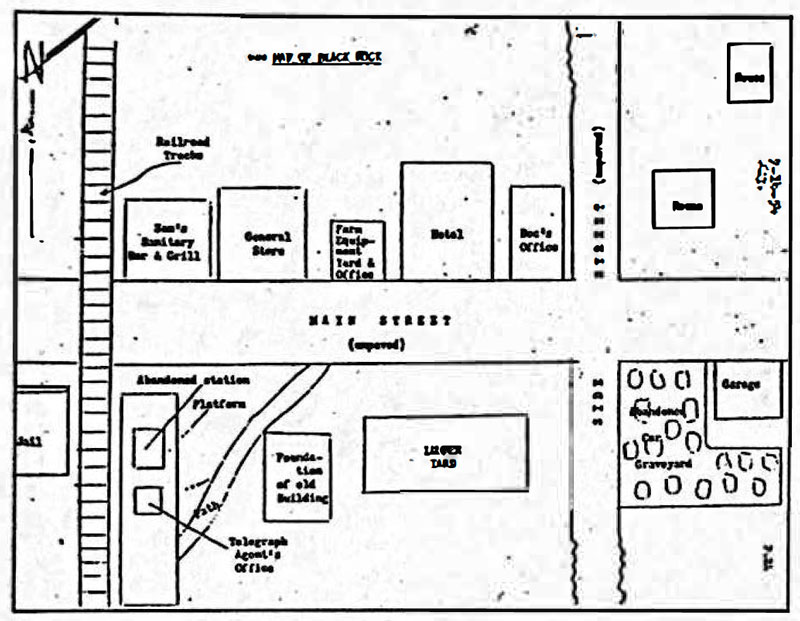
In this version of the script, there was also a map drawn of the town. Was that your handiwork?
Yeah. The thing was, the picture was not shot on location, except for those few exteriors where you had long run-bys. Some very competent guy in production found a spur of the Union Pacific, I believe, that we could use that was out in the California desert somewhere, because we needed a train track. But there was nothing there, other than the tracks, so we built false fronts—the whole thing when Tracy walks up the street. All the other stuff was done on the stage at MGM. Metro had a wonderful staff of guys—I guess they all do—who could put the stuff together.
Did you come up with the map before beginning to write so that you could better visualize the whole thing?
I never thought of drawing a map until I’d finished writing it.
Several people have posited that Bad Day at Black Rock can be seen as a kind of homage to High Noon, owing to their similar themes. I saw that film again recently and was amused to see the scene where the stationmaster, like Hastings in Black Rock, runs down the street in a panic.
You know, I don’t remember that. Well, you know, homage is a very nice word, a very civilized word, but what it means is stealing. [Laughs.] l wasn’t aware of that, although, subconsciously, I might have been, because I thought it was a hell of a good picture. The one thing, of course, that Black Rock does have in common with it is that it’s about a man standing alone, who comes into a very unfriendly place and finds not even a whisker or a flicker of a friendship. So, we had that in common.
More generally, could you talk about the film’s relation to the Western genre?
In Black Rock, there are a number of things I wasn’t conscious of until I’d finished writing it, or even many years after. A few years ago, for instance, I found myself at Johns Hopkins talking about the fact—and this is a fact—that your picture, play or novel is only as strong as your heavy—your villain. If your heavy isn’t strong, your hero, who goes up against him, is diminished. It’s not a challenge. Historically, in theater—Shakespeare used this—there were three types of heavies, best characterized, I think, by the guys who did early Westerns. They used a kind of verbal shorthand. There was the “Brain Heavy,” who was the power behind the throne, the man who held a position of authority in the community—a judge or a lawyer or a banker, something like that. Then there was the “Dog Heavy,” who would get off his horse, look around and go 10 blocks out of his way to kick a dog—he was the kind of sociopath who would shoot you just to see which way you fell. The third type was the “Cad Heavy,” the punk who wasn’t evil the way the Dog Heavy was; he just went along with the others. He was, as they used to say in a pre-Freudian age, “weak.” And usually, in a number of early Westerns, he’d get killed by a ricocheting bullet fired by the Dog Heavy. At times, he was the girl’s brother, who later metamorphosed in more sophisticated vehicles into the gigolo or some such thing.
But here’s the thing: I didn’t realize I was doing this with Black Rock. It was years later when I kind of figured out that, yeah, this works partly because of the strength of the three heavies: Smith [Robert Ryan], Hector [Lee Marvin] and Pete [John Ericson]. I remember one day during production, when they were changing the lights for a new setup, Spence sat down next to me. He had just done that scene with Bob Ryan at the gas station, and he said, “Does he scare you?” [Laughs.] I said, “Not particularly”—I’d known Bob Ryan for years, he was a fine man. Anyway, Spence says, “Well, he scares the hell out of me.”
One of the great things about the film is the high level of tension built up before Macreedy is finally pushed beyond the limits of his tolerance. How did you know when it was time for his confrontation with Coley Trimble?
You see, that’s the business about the futility of doing a book like How to Write a Screenplay—you’ve no idea. All I know is that at a certain point, it was about time.
And you always planned on having this climactic fight?
Yeah. The thing was that we had this lead actor who at that point was a bit old even to play a relatively junior officer in WWII. He was getting a bit pouchy, old Spence, and on top of that, Dore insisted that the character could have the use of only one arm. Now, what are you going to do with him? How are you going to get him out of this mess? I had heard about martial arts—although I didn’t even know there was such a name for them; I think we all used to call it judo back then. I don’t know whether it had ever been done before in pictures, but I figured it would be a way to give his character a shot somehow, and Spence made it work.
That fight scene is really written like a piece of choreography, and is followed fairly closely in the film version.
You see, John Sturges was good. For one thing, there was none of this auteur bullshit. He didn’t feel that he had to be in complete control. In those days, as a matter of fact, the director was a bit of a traffic cop who kept actors from bumping into each other. The guy who had the control was the producer. John made some very large contributions. One of the reasons they’re large is that nobody notices them. For instance, when I wrote the scene with Macreedy and Smith in front of the gas station, or the one in which Macreedy leaves the hotel room and walks toward the garage, I didn’t visualize where the camera would be. To hell with it, that was John’s business. What John did in every case—and I didn’t notice it until I saw the dailies—was, he had one heavy or another always standing above Tracy. Tracy’s always looking up at these guys—they tower over him. It’s so appropriate because, again, you feel it, but you don’t notice it. John was very good that way.
The first Cinemascope film—The Robe—was released in ’53, but it was still a fairly new process when you were writing Bad Day. You have quite a few passages of directions that talk about the vastness of the landscape; were you thinking about that wider ratio when you were writing this?
I don’t know a goddam thing about cameras. Or about film. I directed a picture and I still don’t know anything about it. A lot of people don’t. Sam Peckinpah told me once that he had no idea what end of a camera you shoot from, and he was a brilliant director. But no, that didn’t come into play while I was writing it.
As far as I understand, you were on set throughout the production of the film. Is that right?
Yeah.
Wasn’t that fairly unusual for a writer in the Hollywood studio system in the ’50s?
Well, what happened was, Dore was very active in Democratic politics, and was very much involved with Adlai Stevenson. By the way, I actually met Stevenson one time at Dore’s house, and went over and said, “Governor, you look great.” And he looked at me and said, “Millard, there are three periods in a man’s life: Youth, middle age, and ‘Governor, you look great.’” [Laughs.] Anyway, they were very close, and Stevenson had just about promised Dore the ambassadorship to Israel if he became president. So Dore wanted to train me to become vice-president in charge of production at MGM, and I let him know, in a kind way, that I didn’t want this—I didn’t know how to do it, and I would be very unhappy. Because of Dore, then, I was involved in any damn thing I wanted to be involved in. That was the result not only of Dore and my being friends; it also had to do with the fact that Dore had a thing for people who had been in combat. He’d never been in the service, and thought it was great to have somebody at MGM who’d been in the Marine Corps.
And Sturges was pretty much open to the idea?
Yeah. There was no problem—John and I became very good friends. I didn’t know him before that, but we became very good friends and remained very good friends until his death. And in other pictures after that, it was written into my contract that I’d be allowed to go onstage or on location if I wanted to.
So when you were on the set did you do any rewriting? What kind of input did you have?
In terms of anything that was meaningful, absolutely none. On Black Rock, there were no changes, there was nothing. On Raintree County, deep in the heart of wherever the hell we were—Kentucky and Mississippi and Louisiana, during a miserably hot summer—actors would do a scene and come over and ask me what I thought, but that wasn’t so much the case here.
Were you involved in editing at all?
I was only involved with one area of the editing. John at that point was very much preoccupied with High Noon. Remember in that film how it constantly cuts back to the clocks ticking? Well, as the train is coming into Black Rock, John kept shooting all this horseshit with clocks, and the stationmaster reacting with surprise to the fact that the train is stopping. But it goes on and on and on. You were about five minutes into the damn story before you had any idea what it was about. We sneaked a preview in Pasadena, and the audience hated it. Terrible cards. The first five minutes of a picture are very, very important. So, the question came up of what was wrong with it. And I said, “What’s wrong with it, John, is that it just takes forever to get started.” I said. “Give me a cutter.” So, I forget the guy’s name—he was a wonderful cutter—but I said to him, “Cut this stuff down! Take this stuff out,” which he did.
Well, the beginning of your script is slightly different from the film: there is a setup shot of the station and its sign, and then brief shots of each of the characters—as you put it in the directions, “’a probe of the town and its denizens.”
Before the train comes in?
Before the train.
You know, I don’t remember. I thought I only showed them reacting to the train, but I didn’t realize I showed the town beforehand.
That was something that obviously got switched around a bit, because in the film the first time we see the town’s inhabitants they’re reacting to the Streamliner pulling in.
For a very good reason. The basic element in any screenplay, novel, poem, whatever, is its emotional content; actors onscreen should react. Richard Burton once told me that Elizabeth Taylor taught him how to be a movie actor. She said, “Acting for the movies is reaction. You listen and you react.” Well, that’s what happened. But just to show a bunch of people lounging around scratching their balls, that doesn’t help any. I had something in mind, which is what we talked about: setting the tone. But you’ve got to get to the chase as soon as the picture starts.
There’s also, in your script—more so than in the final film—some very kitschy signage in many of the scenes’ backgrounds, like “God Bless America” and “Smile” in the scene in which Pete tells Macreedy that all the telephone lines are busy when he’s trying to call the police.
That was a way of injecting an ironic moment or two without taking time, because it was background. You couldn’t see all of the signs onscreen because they couldn’t get close enough.
Along those lines, there’s a scene in this script after Tim’s humiliating conversation with Smith where he takes down a photograph of himself and Smith from years before, showing his being deputized. That was not in the film.
I think it was a good idea to take it out, because when you think about it, it’s a repeat. The audience already knows it. What are you going to do—get sentimental with these bums, for Chrissake? No, I think that was a good idea. They were probably John’s ideas, or they might have been Schary’s. But whatever it was, you know, I haven’t felt any absolute need to have a monopoly on whatever the hell is onscreen. All the monopoly I want is what is on the page. That’s my job.
What about the fact that, in the script, Macreedy has this trick where he lights matches with one hand? In the film he uses a lighter. What happened there?
What happened was, I thought it would be kind of interesting if he were to light a match by rubbing it between his thumb and the friction pad, and it would also emphasize the fact that he only has the use of one hand. First day, I get a call from Spence—he says, “For Chrissake, Mill, I’m an old man, I got arthritis, I can’t do that; is it all right if I use a Zippo?” I said sure. Actually, again, it makes more sense. The other was theatrical. Any guy who smoked and who was in the Army had a Zippo. I still got a bunch of them myself.
Whatever happened to T.J., the kid who shows up periodically in the script carving a skull and crossbones into various surfaces. Were the scenes with him shot?
I thought, again, those added a kind of tonality. But it was irrelevant. Why bring in somebody who then disappears? Every actor has to have a part in whatever the hell you’re doing and it shouldn’t be tangential, it should be immediate and direct. The kid didn’t belong there.
There’s a scene with Macreedy and Smith that we were talking about earlier, at the gas station, in which you give Smith a wonderful speech about how the West is “used” by various groups—historians, writers, developers—to their own ends. How did you come up with that?
That was my old man.
Really? That was something your father had said?
Well, no, not verbatim. My father, alone with his Republicanism, was a romantic. Which is why, I suppose, he ran away from home in Gordonsville, Virginia, at the age of 14, to become a cowboy. And he would tell great stories, wonderful stories and the feeling of those, their impact, obviously hit me, and I guess I unconsciously added that in while I was writing.
In the script, when Doc delivers his speech to Macreedy about the people who come out and try farming, mining and whatever else in their misguided attempts at prosperity, he has a series of props he points to, like the topographic map and a nugget of ore, which weren’t used in the film.
Oh, right! Walter Brennan, who played Doc—and who was a good actor—couldn’t do both at the same time. For some reason he was having trouble that day, so we let him concentrate on lines.
What happened to the page or two of dialogue between Liz and Macreedy in the jeep on their way to meet up with Smith?
Again, it’s awful late to go into all of that exposition.
In the film, we go right from Spencer Tracy coming up to Bob Ryan after he’s hit him with the Molotov cocktail to him driving into town in Smith’s station wagon. In your script, there is a bit of dialogue between Smith and Macreedy there, and between Macreedy and Doc, Tim and Pete, in the following scene, that was cut out. What happened there?
That’s cut in the movie?
In the movie it goes straight from—
Where did you see the movie?
On videotape.
That’s why. Some of this stuff that you mention is in the original film. It was cut for television, and you get that version on videotape. It’s very difficult to get the original cut.
How much footage would you estimate was lost?
Altogether, maybe four minutes. But it’s meaningful. When I say I don’t remember, it’s because I remember it the other way.
More generally, this film, as you already mentioned, came out of a desire on your and Dore Schary’s part to address rather hot-button political issues of the time, such as xenophobia and anti-communism. I’m thinking, for instance, of Smith’s speech about the “infiltration” of Black Rock.
That was a very conscious thing on my part.
Did you have resistance from the studio?
Well, at that time, the people who made up the executive branch at MGM were a preponderantly reactionary group. They were also scared shitless because of the blacklist and what was going on. However, the most potent personality of the bunch—the brightest, the best-educated (although it was all self-education), the most liberal—was Dore. Also, after the Waldorf meeting, he overcompensated for his guilt about capitulating, and at the same time tried to make peace with his vaulted ambition. Dore had a reputation for “liberal” pictures.
He’d been at RKO before that, where he’d made socially conscious pictures like Crossfire, right?
That’s right.
Could you talk a bit more about your experiences working during the blacklist? I understand that you fronted for Dalton Trumbo—one of the Hollywood Ten—on Gun Crazy.
Well, I’ll give you the brief version about that. During the blacklist, Trumbo and I shared an agent. I’d only met Trumbo once, at a bar which we had both separately wandered into during a boring meeting of the Writers Guild. I remember it because there was a drunk standing next to Trumbo who asked us, “What’s with that noise in the next room?” And I don’t know whether it was I or Trumbo, but one of us said, “It’s a meeting for the Writers Guild.” He says, “The Writers Guild for what?” I say, “Pictures.” And even though it sounds like a joke, I swear the guy said, “You mean they write that stuff?” So that’s how I met Trumbo. Anyway, my agent calls me one day and says, “Look, Trumbo has a shot at a job—he needs the money—and he asked if he can use your name.” I said, “Well, let me think it over.” And he says, “We’re in a hurry, what do you mean think it over?” I said, “For Chrissake, I want to talk to my wife about it—I got two children—this could be a problem.” So I talked to my wife about it and the next day I said, “I’ll do it.” [Sighs.]
I hesitate because it’s still very painful, that whole period. I was named in Red Channels. They only had two things on me, both of which were pretty silly. The lesser of the silly things was the fact that these two ex-FBI guys found out I had circulated a petition among Guild members for Albert Maltz—also one of the Hollywood Ten—asking for signatures so that Albert could buy back a book he had sold to Fox which the studio had deep-sixed once he was blacklisted. He had an opportunity to resell the thing in England and have it made into a movie. But it didn’t do any good; they wouldn’t sell it back to him. So that was one thing they had on me: I was a bad boy because I had circulated this paper for this guy they said was a Communist.
The other thing they had on me was much wilder. My father’s name was Fred Kaufman, and they told me that he had been a card-carrying member of the Communist Party who had organized a railroad strike in Seattle in, like, 1914 or something. And I knew that was bullshit because my father was a card-carrying Republican, and furthermore, being a cowboy, he hated railroad people. So I went to a lawyer in downtown L.A. who was representing the Hollywood Ten and asked him to help me out. He said, “Well, we can find out about this—give me a day.” He calls back within 24 hours and says, between laughs, “It’s true that a guy named Fred Kaufman organized a railroad strike, and it’s probably true, from what I’ve learned, that he was a member of the Communist Party, but the strike in question was organized by the Pullman porters, and this guy was black.” So I went back to Eddie Mannix, an executive at MGM, and said,”You sons of bitches, I’m going to sue your ass off. l ’m suing you for five million dollars.” Of course it was all dropped and I went back to work and that was the end of the damn thing.
You’ve just finished a book about screenwriting. Do you think there are general rules you have to follow?
There are rules for everything, including screenwriting. They’re simplistic, as they must be, because as soon as you know what the hell you’re doing, you’ve got to ignore the rules. My wife was telling me about a book she had heard of which is out now that says you have to have this on page nine and you have to do this on page 14—something like that. And that the “first act”—which is in itself, of course, a rather artificial division—should be 35, 42 pages, whatever, which is ridiculous. Billy Wilder, who probably knows more about screenwriting than any man alive, said he would never write a book about that sort of thing because he feels that you either have it or you don’t, just the way it is with novelists. As Somerset Maugham once said, “There are three rules for writing a novel. Unfortunately, nobody knows what they are.” But there are certain things that you can put forth to help young people, to encourage them. The fact is, the more experience you get, quite normally and naturally, the less you listen—no reason you should. But if kids want encouragement I see no reason why they shouldn’t be guided in what might be the right direction. But the only thing a writer really has, I suppose, is a certain uniqueness. Unless he holds on to that, there’s a large chance of his becoming a commercial hack.
Any particularly good writer-related anecdotes from the old Hollywood you’d like to share?
There are thousands of them. One that comes to mind: At Warner Bros., a bunch of people were sitting around the writers’ table and Jack Warner walks by. One of the writers says to him, “Hello, Mr. Warner.” He nods gruffly and the guy says, “How are you?” Warner says, “I’m terrible.” The guy says, “Well, what’s the matter?” Warner hesitates for a second and then says, “I’ll tell you what’s the matter. We got this goddam epic shooting in Arizona with Errol Flynn. We got 10,000 extras out there, everybody’s ready to shoot, it’s costing us a billion dollars a second”—or something like that—“and Flynn doesn’t show up. Not only that, but nobody knows where he is.” He fumes a little more, then he says, “That son of a bitch. I picked him up in Australia when he was a goddam beachcomber, a thief, a bum! And what did I do? I made him a star—I taught him how to fence, I taught him how to ride a horse! I made him rich! And now when I need him, he doesn’t show up!” He starts looking around the room, and one of the writers there was a very handsome young man who had had a failed career as an actor—he was a good writer. So Warner looks at him and asks, “What’s your name?” The guy tells him and he says, “I can make a star out of you. I could make you rich. You’d be a household word, everybody would know you, you’d be important. And what would happen? One day, we’d be shooting in Arizona with 10,000 people and you, you son of a bitch, wouldn’t show up! You’re fired!” And he fired the guy.
(The interview with Millard Kaufman was conducted by Tod Lippy at Kaufman’s home in Los Angeles.)