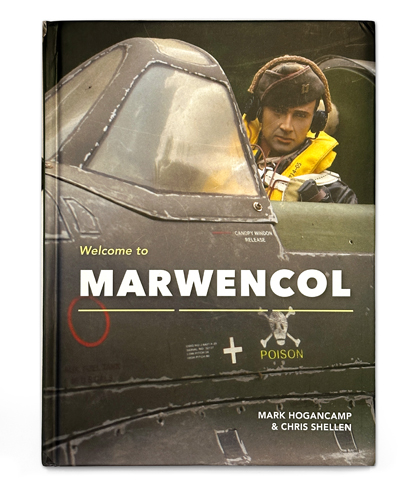
Originally published in Welcome to Marwencol (New York: Princeton Architectural Press, 2016) pp. 14–15

In 2005 I was at a party in the West Village when a friend of mine, David Naugle, said he had something he wanted to show me. Taking me aside, he pulled out his laptop and began scrolling through scans of astonishing photographs: striking, cinematic images of military figurines and Barbie dolls—or wait, were they actual people?—waging pitched, bloody battles, socializing in a bar, or simply engaging in everyday activities, such as driving, petting a dog, or cuddling a teddy bear.
I was transfixed: who made these? David told me it was a neighbor of his, Mark Hogancamp, whom he had first noticed walking back and forth on Route 213 in Upstate New York, pulling a scale-model military jeep along the shoulder of the road. I turned to David and said, “Have you shown these to anyone else?” When he said no, I had only two words for him: “Please don’t.”
A few weeks later, I went with David to meet Mark at his place upstate. I instantly understood where the intensity of vision so apparent in these gripping photographs came from: Mark was focused on, and immersed in, every aspect of an imaginary town he had constructed from scratch and was now documenting with an old 35mm camera.
Mark gave us a tour of this town, Marwencol—the church, Pocket Full of Posies, and, inside his house in a spare bedroom, the Ruined Stocking Catfight Club. He proudly pointed out every item on and behind the bar, from tiny handcrafted signs, letting patrons know that catfights were staged, to a variety of barware, each glass and pitcher modified by Mark to appear as realistic as possible. By the time we left, I was exhilarated and deeply moved—a response I have encountered only rarely in the hundreds of visits to artists’ studios I’ve made over the years.
The beauty of doing a small, nonprofit arts magazine on your own is that everything can happen very quickly—there aren’t layers of editors, art directors, and publishers to pitch to and wait for a green light from, and there is greater flexibility with deadlines, space constraints, and many other pitfalls common in commercial publishing. We ran Mark’s “Marwencol on My Mind”—featuring fifteen of his photographs, along with an interview of Mark by David—just a few months later, in Esopus 5 (fall 2005). It remains one of the pieces in Esopus of which I am most proud. It’s a little too easy to group Mark with other respected contemporary artists who incorporate dolls into their photo-based work, such as Laurie Simmons and David Levinthal.
What makes Mark’s photographs so unique is the utter lack of irony he employs in his utilization of Dragon Models Limited military figurines, Barbie dolls, and movie action figures. There is no distance between Mark and these subjects, no wink-wink moment between him and the viewer. The fact that we invest so heavily in his work is not only a testament to Mark’s fertile imagination, obsessive attention to detail, and exquisite visual sensibility; it is a testament to his own emotional investment in Marwencol and the lives of its ever-expanding group of inhabitants.
To me, Mark is the ultimate artist: completely devoid of cynicism and utterly immune to the machinations of the art market, he reserves all of his energy and ambition for the work itself. He is one of the few creative people I know who views his practice as not only fulfilling but also totally sustaining.
Through Marwencol, Mark has regained his cognitive faculties, reengaged on his own terms with a world that all but tossed him aside, and graced that world with a truly unique vision. We are all better for having experienced Marwencol through his eyes.—Tod Lippy