Originally published on Hey Hot Shot! website, August 9, 2010

Family members of artists are no strangers to sacrifice. We’re all familiar with stories about long-suffering spouses and children who are forced to give up any semblance of a stable life (or, in extreme cases, life itself) in the name of art. And more than a few parents have found themselves—warts and all—used as “material” in work by their children (think François Truffaut’s 400 Blows, or John Cheever’s The Wapshot Chronicle, or—moving into the world of photography—Larry Sultan’s Pictures from Home).
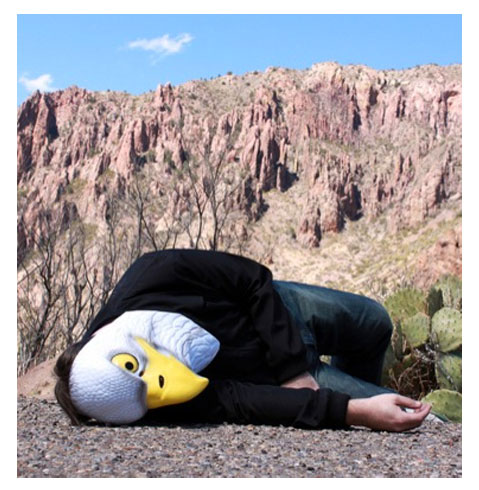
At first glance, Nigel Grimmer’s “Family Roadkill” series takes this notion of familial sacrifice to a literal extreme. For the series, which he began working on in 2000, Grimmer photographs the seemingly lifeless bodies of his parents, siblings, and other relatives crumpled along the sides of roads around the world.
There is a twist, however: each “victim” is asked to don a joke-shop animal mask before Grimmer snaps the photo.
There’s a lot going on in this work. Grimmer forces us to think more critically about the artificiality of the family photo album, which is, after all, a compendium of unnatural poses and frozen expressions. He plays off human beings’ identification with and sympathy for animals—even cartoonish versions of them—while making us rethink our relationship to the flattened corpses of those we barely notice (except to swerve around). These strikingly beautiful photos—grim, yet wry; melancholic, yet hilarious—also elegantly navigate Oedipal issues and family power dynamics.
Most interesting to me, though, is the way Grimmer successfully subverts this longstanding notion of familial sacrifice. By obscuring his subjects’ faces, he affords them discretion, even anonymity. By using cartoon masks, he leavens what could be a ponderous, morose “statement” with pathos and wit. In essence, he has taken a process that can often be one-sided and exploitative and turned it into what feels like a true collaboration. (It’s impossible not to imagine this incredibly game—no pun intended—family having a blast working together on this project.)
I looked at a lot of terrific work while judging, but nothing else captured my attention—and rewarded my continued scrutiny—the way Grimmer’s remarkable photographs do.