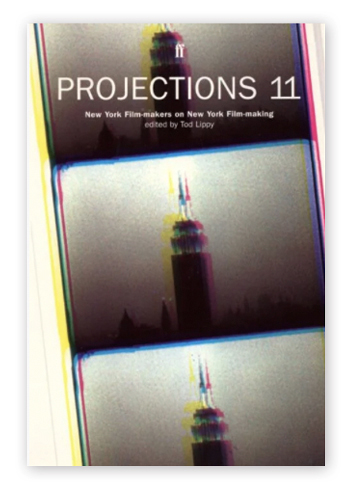
Originally published in Projections 11: New York Film-makers on New York Film-making (London: Faber & Faber, 2000), pp. 94–107

Tod Lippy: When did you move to New York?
Stacy Cochran: I came after college. I grew up in New Jersey—eleven miles from the city, but a world away… [Laughs.] As soon as I finished college I moved to New York and lived in somebody’s broom-closet for six months. When my boyfriend, Eric, finished school—he was a year behind me—he came down, we got married and started to have children. [Laughs.] No, that’s not really true. We did get married right away. And then I worked for a while at Children’s Television Workshop.
What were you doing there?
I wrote for a magazine for six- to ten-year-olds. It was sold on the newsstand, so we had to have a media cover. It was usually Michael Jackson and Ewoks or something and I’d have to make up some kind of feature story appropriate for six-year-olds, and then a game to go with it or something. I’d make up puzzles and contests.
When did you start making films?
I started writing scripts on my own while I was at CTW, and then when Eric got a job, I quit and started shooting little things I had written.
You were writing feature scripts?
I wrote one and I showed it to a friend, who said, “Why don’t you write something shorter so we can shoot it?” So I wrote a ten-minute thing called Cocktails at Six, and we shot that.
How did you find a crew?
This friend, Adam Merims, got the crew together with Tony Jannelli, a DP that I like a lot. I knew Tony. I had been volunteering at the International Film Festival Manhattan (IFFM) the year before—cutting cheese and pouring wine at a reception for something he shot—and I met him and we stayed friends. Between Adam and Tony, we pulled it together. We shot it in my parents’ apartment. The first day everybody showed up and there came this moment when all these people—well, there weren’t that many people, but to someone who had never shot a movie it looked like a lot of people—had crammed into my mother’s dining-room. All these guys standing there, waiting in total silence for me to direct the movie, I guess. It’s not that Tony and I hadn’t decided how to shoot it, but there’s still that performance moment. The movie was about a six-year-old, and she was standing there waiting, too, and I figured, “She’s the one I can deal with here.” So I went over and whispered to her. And she did what I said to do, and then everyone was working and it was fine. I still whisper to actors.
That seems so respectful.
I just hate that screaming across the room. The other thing I don’t like is talking to more than one actor at once.
What happened with the short? Did you show it anywhere?
I showed it at the next Independent Feature Project market. I can’t really remember what else I did with it. I had a little distributor and she sold it to a couple of places and it showed at some other festivals, too. I remember it showed in Uppsala, Sweden.
So you got a sense of the whole filmmaking thing.
I also got a sense of what I didn’t know. So I thought, “Well, maybe I should just go to film school, because I don’t know what to do next.” I couldn’t afford to keep buying film for myself to learn, so I decided to go to Columbia.
Why not NYU?
Why not NYU? It was right across the street from my apartment. And the thing about Columbia, at least at that time—I started in the fall of ’88—was that the facilities were shitty. But I kind of liked that, because I knew I wanted to be a writer, first, and then direct.
And Columbia is known for its emphasis on writing.
Partly because they don’t have the facilities to teach you anything else. The thing is, at NYU, I would’ve had to spend a lot of time working on other people’s films as boom operator or camera person or sound recordist—really long hours on other people’s movies. Which is okay, in theory, but I was pregnant at the time—I’ve always been pregnant. [Laughs.] So I knew that I only had a couple of months before I was going to have a teeny, tiny baby, and the deal at Columbia was they didn’t really care how technically proficient you were. They wanted you to write a lot and then to shoot—even with a camcorder—and then cut it yourself on tape, and do that over and over. Time was, as usual, very important to me, with the new baby and all of that, so I just bought a little VHS camcorder for myself. I couldn’t even deal with the equipment room and waiting on line or scheduling. We had these little directing assignments, and I could just go shoot it, cut it, and hand it in the next day. And for me that was better.
Who was teaching when you were there?
Ralph Rosenblum, Romulus Linney, Chris Kazan.
Milos Forman wasn’t there yet, was he?
He was there the year before me and the year after I left. But Emir Kusturica was there. At the time, I was out of my mind with excitement, because I had just seen When Father Was Away on Business, which I thought was one of the best movies I had ever seen. I really scrambled to get into his class. And he didn’t give a shit about me. You know, as much as you adore your teacher, at some level if he just looks right through you, your interest in him has to fade a little bit, self-centered as that sounds. It didn’t make me like his movies less, though, and I must say that he did tell me one thing that was very constructive. We had to shoot a thesis film, and he looked at all our scripts. I wrote this ten-minute movie about a guy who gets hit by lightning while he’s washing his car in the driveway. And Emir said, “Just make sure when you shoot it that the characters always have their feet floating a little bit off the ground.”
That’s great.
Yeah. And he was so right. And that was probably the only thing that anyone could have said that would actually mean something to me. I thought about it when I was shooting, and I still think it’s good advice. So in a way I guess it was worth all the frustration of being a complete nonentity in his room for a year and a half or whatever it was, because he actually contributed something beautiful to the whole process.
And this was Another Damaging Day?
Yeah.
Were you happy with it?
I don’t know. I can’t look at it. I get palpitations watching anything I’ve ever done. And Ralph Rosenblum was such a sweetheart—he got mad at me over that movie because he had suggestions that I ignored, and he never really forgave me. It played at the New York Film Festival, which was kind of fun, and he was standing on the sidewalk afterwards, still mad at me.
What did it play with at the festival?
The Sting of Death. A Japanese movie.
Was it a good match?
[Laughs.] No, no. It was a very, very long poem of a movie. All of my family came, of course, and when my brother came out, he said, “There are some things even a dog won’t eat,” which was a line from The Sting of Death that he read in the subtitles. That really said it for him, the whole event. He still says that to me on occasion when the subject of my fabulous career comes up. Anyway, I had to write a feature script for school as well, so I wrote My New Gun.
I remember a comment you made about not believing how fortunate you were in getting your first movie made.
Spoken like somebody on a motorcycle as they approach a wall at 90 miles an hour. [Laughs] “I’m so lucky!”—BOOM!! Yeah, it was lucky. I was taking this producing class that Leon Falk taught. He would occasionally bring in people from the industry, whatever “the industry” means—people who had paying jobs—to talk to us about different aspects of becoming filmmakers. And he brought an agent from William Morris to teach us how to pitch movies. So when it was my turn, I talked about My New Gun, describing it in great detail, and the agent said, “Wow, that sounds great. You should write that,” And I said, “Well, I did write it, because if I hadn’t written it I wouldn’t be able to pitch it to you.” So she asked to read it, and she really liked it. She wanted to know if I had an idea for casting Debbie Bender, and I said, “No, not really.” And she said, “What do you think of Diane Lane?” And I just couldn’t have been more excited about the idea. It was a beautifully perfect idea. And Diane read it and she liked it and that was that. IRS Media and Columbia Tristar Home Video had decided to make the movie and they liked Diane. I went out and met with her and loved her—there’s nothing not to love about her; she’s fantastic.
Was that your first L.A. film-world experience?
Yes it was. I’d been to L.A. a lot because my mom is from there, but never for my own work.
And how did the meeting with Diane Lane go?
I was a little nervous meeting her. She’s so beautiful—one of her eyes is a little funky. She got hit in the head with a tennis ball, I think.
And she was obviously into it.
Yeah, but she wasn’t like, “Oh my god, I have to make this movie!” She said, “I like it, I’ll do it. Do you really want me to do it?” I said “Yeah,” she said “Okay.”
How did the production go?
It was fun, and it was very quick, although I didn’t learn what quick—or cheap—was until Drop Back Ten. But we had to go fast and be efficient, and I like that. I like to be precise about what you’re going to do, and go in and do it.
You like to have a “spine” in place?
More than a spine. A very specific idea about what to shoot and what not to bother shooting. Because the idea is to be direct in a way that’s not simplistic. And to be casual in a way that’s not lazy. It takes an enormous amount of work, in a way, to be prepared enough to be casual when you’re actually shooting. Everybody in it was so focused on the same thing. Stephen Collins said to me, “You’ll never have this much fun again.”
Were you pleased with the response to the film?
I came out of the first screening sobbing. “This is the stupidest piece of garbage I’ve ever seen and it doesn’t even make sense. I can’t even tell if it’s been written in English or not; what are these people saying to each other?” But it turned out well, and I thought at the time that it had taught me a lesson: If you just know what you want and you’re focused and your goal in shooting a movie is to make sure everyone is moving in concentric circles, it will be something in the end. But it’s a lesson that turned out not to be completely true—you can make that effort and have it not turn out right at all.
Did you go with the film to Cannes?
Yeah. It was the first time we showed it, at Director’s Fortnight. So it was exciting. We all went, and decided that instead of getting a couple of hotel rooms we’d get a house and then anyone who wanted to go could go. So a lot of extra people came who worked on the movie, and we all stepped into this great little house on a hill.
What was the response like?
Great! It was really great. And then from there I got to go to a lot of other festivals—it just toppled its way onto the festival route. Boy, that was a long time ago.
At that point, were you already beginning to write Boys?
I don’t think so. I tend to not be able to think of two stories at the same time. I kind of have to have something really, really finished before being able to even get into that dream state where you decide what you really want to write about.
You likened the writing process to “walking around in traffic with your nose in a book.”
When you’re actually writing something it’s not so much that you have an idea, it’s that you’re consumed with something that’s more than an idea—it’s kind of like a cloud that’s surrounding you.
So when did you start writing Boys?
I met the producers Paul Feldsher and Peter Frankfurt and they said, “We really liked My New Gun; let’s do something together.” Peter said, “There’s this James Salter story that I’ve always wanted to make a movie from—an eight-page story—and I don’t know how to approach it as a feature; do you have any ideas for it?” I’d never read any of Salter’s stuff before, so I read it—it’s called “Twenty Minutes”—and it was phenomenal. It’s very brief, which I always like. You know, there’s this thing I just read in the New York Review of Books—it was Tom Stoppard saying something about writing as the compression of language for the expansion of meaning. Which is exactly what is so much fun about making movies. Compression of language and action. Keep it down to the barest minimum so the meaning expands as much as possible. Of course, most movies are exactly the opposite, expanding the action to the point where the meaning has completely disappeared.
Anyway, “Twenty Minutes” is about a woman who is riding a horse, and she falls off the horse because its hoof tips the edge of a fence in just the wrong way—just enough to topple the horse and change everything. So she falls off the horse and she’s lying in the meadow in the story, dying, and in that time, she goes back and forth between being acutely aware of the meadow that she’s in and having everything that’s gone before floating through her mind, mostly in terms of her unsatisfying life with men. I thought that maybe there was a way of changing the details of her story without changing that essential moment. And in the first draft, we were so successful—I think I somehow managed to change everything and still maintain the heart of it. Not so clearly in the final film, though. And I was sad to see it change so much. The horse barely exists in the final cut! There are still things from the story that survive but you’ve got to be a pretty careful observer to pick them up. I still think the movie is beautiful. I love Robert Elswit, the DP, so much. And there are scenes that I like and many implications in it that I like, which turn the standard elements of movies on their head a little bit.
But the thing that was mostly lost from Boys in the end was its sense of humor about itself. It really was meant to be funny, as hard as that is to believe looking at the movie now. Originally, the idea was that the movie start out being about this woman, Patty Vare—you’re trying to get a handle on who she is and you’re making assumptions about what the movie is going to feel like that become incorrect as soon as the horse’s hoof hits the fence. You weren’t meant to realize how melancholy the film is until you got to the end of the movie—you were meant to be diverted from the melancholy aspect of the story for the body of the movie, so when it comes back to you, you realize it’s been there all along. That was the idea, to make a movie that is floating over the top of this bedding of grief that’s underneath it all. When the studio decided to take the most melancholy aspect of the story and chop it up into little pieces of confetti and drop them everywhere in the movie, you never got a chance to step away from it so you could feel it when it came back. It was just always in there, putting you in a cranky mood when you were supposed to be watching a funny scene. And for me, that was, well, “disappointing” doesn’t really say it as well as “excruciating.”
How did you become involved with Interscope, which financed the film?
Peter and Paul thought it would be a good place to go because it was big enough to be studio-like—the movie would be distributed pretty widely if it got made—but small enough that you weren’t just dealing with levels of bureaucracy that went on infinitely. So we showed a first draft to the Interscope executives first, and they wanted to do it. They wanted me to change it pretty dramatically, but I actually liked the idea of having to rewrite for someone. I had basically shot the first draft of My New Gun. Believe me, I’m grateful for that, and My New Gun feels like it is just what it was meant to be—it wasn’t over-thought, but then on the other hand there are places where I felt I could have done more for it. I kind of liked the idea of being forced to rethink what I had written this time.
So I enjoyed the writing process on Boys. I would go back and forth between New York and L.A., constantly complaining. They’d say, “We really like it, just come on out and we’ll have a meeting and talk about a few things,” and then there would be a note on every fucking page, and I’d get on the plane ready to kill myself. But by the time I got back to New York six hours later, I’d have an idea how to do what they were looking for that was completely different from what they had asked, but which would actually solve their problem. I found that the best way to endure picky little notes on every page was to take as broad a view of the problem as possible, and be willing to rethink the whole point of the script every single time. It kept me from getting bored with it, from getting cross-eyed.
Despite the fact that you thought Interscope would be less of a studio presence, the whole experience sounds very “studio-ish” to me.
It was, but I had never done that before. And I would sort of get a kick out of coming up with a whole new animal every time.
So you never felt like it was out of your control?
No, not while I was writing, because I felt like it kept getting better—not in the ways they were anticipating it would, but we all agreed that it kept getting better. And I was getting paid for it. [Laughs.] It was a weird kind of puzzle that I’d never come up against as a writer before, and I liked that. Then there came the time when most of us were happy with the draft—but not all, which became the crucial problem. Interscope said they’d really like to make this with Winona Ryder, and I said, “Good. Let’s send it to her and see what she thinks.” And we did and she read it and within a day she decided to do the movie. Unfortunately, it was a draft that someone at Interscope didn’t consider to be a final draft—in a way, I agreed with him, because there’s always more work you can do. And Winona agreed that there were a few things that could be improved, but she said let’s not let it get completely turned on its head.
I’m guessing that she had the clout to say “enough” to Interscope, since her attachment to the movie pretty much secured the financing.
You just put your finger on the appendicitis. I don’t know. The thing is that the draft that she agreed to do was pretty good, but could have been better, and so I wrote another draft that I thought was better, and it was the first one that every single producer in the ever-growing list of producers associated with the movie was really happy with. And then—well, Winona didn’t like it. And so the question became, do I help her to understand why I think this draft is better, or do I just go back to the draft she preferred? I really wanted to make a movie with her, but I felt that the best thing to do was discuss it with Interscope and make a united decision and either say, “You know, Winona, we’re so much happier with this that maybe we should just work with someone else,” or, “We want to make this movie with you so badly that we’ll go back.” My instinct was to simply have a brief, focused conversation with the people I was in business with, which would end in a clear decision. But it didn’t. We got caught in the middle, and it somehow morphed into you say black, we say white between me and them. And it just became totally insane.
By the way, this all happened after the sets had already been built and we’re two weeks away from shooting.
So the production wasn’t as smooth as My New Gun...
No, it wasn’t. It’s so crazy that it wasn’t—there was no reason why it shouldn’t have been. The executives would say, “Just tell us what you need, because we don’t want to leave Baltimore”—where we were shooting—“without shooting something that you feel you should’ve gotten.” So I said, “Well, thank you, I appreciate that. Before I answer I just want to think about it for a minute.” So I did that, and I came back and said, “This is what I think we really need that we’re not getting.” And they said, “Hmmm, let’s think about that—we’ll get back to you tomorrow.” And they’d call back and say, “No.” [Laughs.] My favorite thing was not getting the editor I wanted to work with approved until we were a month into shooting.
What about dailies?
They were cut by someone who I wasn’t working with, so when the editor I wanted to hire finally started she was really behind the eight ball in terms of schedule. So we called and said, “We have ten weeks to cut, but we’re starting a month late. Could you give us an extra two weeks?” And the answer was, “No, and we’re taking two away.”
I love that scene in Heaven Can Wait, where Warren Beatty is the quarterback and all of a sudden his own team turns on him. That was my perception of the whole thing—“Wait a minute, guys!”
What happened when you delivered the first cut?
The “eight-week cut.” It was good. We were all excited and everyone was laughing. And one of the executives said, “Okay, let’s work together now to make the ending work”—because the ending was not good.
The original script had a different—much darker—ending than the film, right?
Well, the thing was we ended up shooting the version of the script Winona wanted, not the final draft. Part of this thing was a casting issue. Dermot Mulroney, who was originally going to play the baseball player, had to bow out at the last minute, and Skeet Ulrich got bumped up from playing one of the cops to playing that role, which was a complete reversal of what the casting should have been. It really shifted the balance of the movie. I wanted to fix it, but I never got an opportunity to. And the studio, rather than addressing that problem, just decided to reassemble the entire piece. I had originally wanted Skeet to play Baker, the kid who falls in love with Patty Vare. Skeet was unknown at the time, and I wanted him to be the one who sneaks up on the movie, who, as the movie progresses, takes over the story.
Why didn’t the studio go with him?
They didn’t know him. And they felt he was too old. Of course, two years later he went on to play a high school student in Scream and it didn’t seem to bother anyone.
So you went with Lukas Haas…
Which everyone was happy with. He was a sweet kid, and he had sort of a delicacy which was interesting.
And I also thought he had a sense of awe around Patty Vare, which was nice.
Yes, that was probably one of the best things about the movie. So that was fine. But the reshuffle of actors was just the beginning of things really changing all the time.
What happened then?
Well, they did a preview screening of the first cut, and the audience didn’t seem to “get” the part about Winona, and did get the part about Lukas. So of course the studio’s instinct wasn’t to make the part with Winona compelling—which was my goal and would not have been hard to do. Their instinct was to throw the whole first section of the movie away and put Lukas in the first frame so the audience didn’t have to wait for him. That’s kind of like saying, “I’ve got a headache,” and chopping off your head to fix it. And it’s not that I didn’t understand the problems that the audience was having—that this one audience had—but their problem was sort of isolated. In my opinion, it’s valuable to hear what’s not working for them, but it’s not necessarily valuable to hear what their suggestions are for improving it.
It seems ingenuous, of course, but you would expect the studio to have a certain amount of trust in the instincts of the person who wrote and directed the film…
Or in themselves, for that matter. I mean, Interscope made me write a new 15-page wraparound after they saw Bridges of Madison County—they thought it might be a good idea to do the whole movie as a flashback, like that movie did. I thought it actually exacerbated problems that we had, but I did it—I didn’t have a choice, because I felt that I had committed myself to the movie, and I was happy that they weren’t hiring someone else to do it. So we shot it, and they loved it. Then they decided to do another preview. I didn’t even go. I said, “I’ll write it, I’ll shoot it, I’ll cut it in, but I’m not flying out to see what they say, because I don’t care what they say. If they liked it, fine, you’ve got what you want.” If they didn’t like it, I’d say, “So what else is new?”
They called me from the car on the way home from the preview: “The kids don’t like it, it’s out.” I mean, you just spent a half-million dollars on a reshoot that you’re going to throw away because 15 kids didn’t like it. It seemed silly to me. Then they brought in another editor to make mincemeat of the thing.
You were taken off the movie?
For a while. And I was troubled by two things. One was the structure. I love structure, and when they scrambled the structure it was very sad. It kind of made me feel like, you know, in Toy Story, where the mean kid, Sid, disassembles toys and puts them back the wrong way so they look like really gruesome freaks. But also, the grammar of the scenes was off. It felt clumsy, and I was embarrassed to have a movie that—whether you like the movie or hate the movie—was just clumsy within scenes. So they let us come back and work on it some more and repair things so it moved better, and we were able to minimize some of the freakish nature of the structure. [Laughs.] It made a big difference, and it does sort of survive in a way. There are things about it, attitudes about things, that returned. And somehow or other, by the very, very end, we kind of liked it again. But then the reviews were so bad that everybody turned tail.
Do you think that the studio was behind it until there was a bad critical response?
No, the studio wasn’t behind it. I remember my agent at the time said, “It isn’t going to make money, and the studio isn’t behind it, and it’s got problems, but we like it and we think the critics are going to like it and you’ll be OK.” And then the critics hated it.
Not all the critics. Terrence Rafferty, for one, gave it an extraordinary review in The New Yorker.
He has an uncanny ability to feel the filmmaker that is inside of a movie—any movie. But the studio wouldn’t even have screenings for the critics before it came out, so most people were poised to hate it.
Rafferty even mentions that in his review.
He does, yeah. I have a friend who at the time was working on a small paper in Texas who called me and said, “I think you may have a problem.” She had wanted to do a feature story on Lukas Haas for Boys, and when she called the studio to set it up, they said, “You know, don’t do it. He’s got another movie coming out for somebody else in the fall, do it for that one.”
That must have sent shivers down your spine.
It was not so good. And of course, I was nine months pregnant at the time. [Laughs.] My agent was sending me lots of scripts in that little window of time before it was released, and then the minute that we got a dumpload of bad reviews, they were, like, talk about etherized—they disappeared, they were just gone. Then I went into labor, my favorite thing to do when times are hard. [Laughs.] That’s what I like about the pain of childbirth. It’s distracting.
How many years did this whole process take?
I started writing it in ’93, and it was released in ’96, I think. It was a long time—three full years of work on one movie. But when was the right time to walk away from it? Never. I kept feeling that if I just worked harder, and thought harder, I’d come up with a solution that would make it all make sense again. And we sort of did save it enough times that I started to believe I could always do that. And the fact is I couldn’t.
Why, after directing a relatively high-budgeted studio picture, did you make Drop Back Ten—a small, self-produced independent movie—next?
Because I didn’t have a choice. I read a lot of scripts after Boys, but it seemed that somebody else had always been hired by the time I finished reading anything—the day I got it, another director was already attached. For instance, I loved the idea of doing a movie of Madeline. I wanted to do something kind of cool and floaty with it. And right about that time I met Isabel Adjani, who is one of the most beautiful things that the earth has ever come up with, and I thought, wouldn’t she be an incredible Miss Clavell? She’d be so graceful and different from the book in an interesting way. But someone else had already been hired. Nobody would even talk to me on the phone about it.
So I decided that I was just going to write something that I would like to shoot, and see what happened. And I wrote Drop Back Ten.
I’m assuming you went the New York indie route.
Well, my agent showed it to some of the New York independent companies and they didn’t want to make it. We did find a producer who wanted to invest in it, then at the last minute—literally just a few weeks before we started shooting—he backed out. And—this may come as no surprise—I was pregnant. [Laughs.] I know from reading this you’d think I have twelve children, but the three I’ve had just seemed to come at prime moments. So he dropped out and my agent starts saying, “Why don’t we just regroup and try to plan for early spring.” And I was, like, “He doesn’t know that I’m going to have a two-week-old baby in mid-February.” I didn’t want to tell anyone that, but I couldn’t postpone anyway, because I was already climbing the walls that I hadn’t been able to shoot anything for so long. So I just decided I would cobble together loan after loan after loan.
It’s ironic that it was your third, rather than your first, feature where you actually fulfill the indie cliché about “maxing out your credit cards,” etc., to make a film.
Is that humiliating? I’m not sure. It was interesting because I was able to produce it myself in a different way than I would have been able to pull off right out of film school. But on the other hand—I don’t know, I guess there is no other hand.
Can you talk about the “different way” you produced it?
Initially, I thought I had two choices. The budget was so tiny—it was a quarter the size of My New Gun—that the film could only be made by either not paying anybody, which I wouldn’t do—I can’t work that way—or shooting on DV or something. And I decided that I wasn’t going to do either one. I hired Spencer Newman to shoot it—his first movie, but he has a beautiful eye. And we thought we would just try and be smart about it. Any problem that we had in terms of time and resources, we were just going to think of a way to outsmart the problem somehow, and just force ourselves to have a good idea. So I had to make decisions like, “We will never use a dolly. Ever.” Of course, on set, everyone would say, “We’ve got this little doorway dolly, it’s nothing, it’s in the truck, it’s just like a platform on wheels. It’s not a real dolly track.…” And I was like, you know what, if we start that, then it’s going to mean reconceiving everything, and it’s going to change the way we approach the day too much. Let’s just say that we can pan and tilt, but the film is going to be a series of snapshots that sort of move and sort of don’t move. And it’s going to be about the rhythm of the snapshots in a way.
Okay, we did use one dolly when we were shooting the movie-within-the-movie, the scene where Pamela, the director, is shooting a football game. We thought that would be fun—Pamela gets a dolly shot, but we don’t. I don’t think people sit there and go, “Why are there no dolly shots in this movie?” But there’s a sort of smallness that a decision like that gives the movie that is at least a consistent smallness, better than cutting corners randomly.
It must have felt like the ultimate vindication when the movie was invited to Sundance.
For a few weeks, we really were excited. Everybody felt great. To say that there were no other producers on our side is not to say there weren’t allies. I mean Nancy Novack, the editor, and Spencer, and the cast, of course, and Todd Thaler, who cast it so beautifully and helped me produce it. I couldn’t have asked for anything more from all of them, and I wouldn’t want to trade them in for anything.
Did you find being invited to Sundance problematic, in that it meant you had to rush to get your movie in some sort of shape—however unfinished it might still be—in time for the festival?
I can’t say anything negative about the festival. I was so grateful for their support and enthusiasm. When Geoff Gilmore called and talked to me about it, the way he was talking about the movie made me feel that he and the rest of the committee understood it in the way we had all hoped that someone would understand it. The fact that it was shown in Park City in a somewhat imperfect form, well, it negatively affected some people—namely the distributors who passed on it—but there were a lot of people who saw it who were enthusiastic about it.
I guess once they took it at Sundance, I started thinking to myself, “If we can just get a decent print there on time, we’ll pick a distributor and work with them to finish it.” Pick! We’re finishing it now on our own, and of course I’ve got a new baby, which is tricky. I said, “We just have to do it.”
You’ve said that Drop Back Ten isn’t autobiographical, but there is an element of the film—particularly the scenes involving the movie-within-the-movie, where Pamela, the director, is at odds with the producers and her lead actor—that at least suggest your situation on Boys. Did it feel kind of cathartic to write it?
No!
Writing shouldn’t be therapeutic?
Maybe it should be, but then it’d better be pretty abstract therapy, not just trying to get your gripes off your chest. This movie is meant to be funny, but it’s also about a culture of cruelty. In a sense, James LeGros’s character is figuring out how to penetrate that and do the right thing. But he’s also trying to get what he wants!
Your films are all always informed by a very considered subtlety—that compression of information you talked about earlier—and I think certain reviewers who take things more literally often miss the point.
Well, it would be really easy for me to take a bad review and start trying to explain it away.
What are you going to do now?
I don’t know, I have to finish this movie and see what happens to it. Maybe part of the reason I can’t think seriously about the next thing while I’m working on something is because I think I’ll never do anything else.
Do you think that every time?
Kind of, until I’m really finished with whatever I’m making, and then suddenly I know what I’m thinking about and then I start writing that. But it’s not like I was ever confronted with a three-picture deal, so it’s a little bit a problem of having to reinvent the wheel every time. Not reinventing the structure and the story and the characters—that’s the joy of it. I mean I wish I had the ability to say, “I want to set up this movie,” and that meant it was going to be set up.
You made a short film about Richard Lester in between Boys and Drop Back Ten. How did that come about?
Somebody called me to tell me they were doing a series of ten-minute pieces called “Directors on Directing” for Italian TV. They asked some directors to choose someone whose work meant a lot to them and then shoot a little piece about them in their own style. So I said I’d like to do Richard Lester, but I didn’t want to do it in “my style,” because, first of all, I don’t think I have a style, and if I do, let’s hope I’m not aware of it. I’d rather do something that kind of plays on things about his style, both in terms of surface details and the underlying sense of the way his things are put together. So they said “OK,” and they helped me track him down—he still has an office at Twickenham—and he said he’d be happy to do it, just pick him up at 8:00 in the morning on the scheduled day and whatever we wanted to do that day, he’d be happy to do.
Of course, a week later, the producers called to say, “You know what, we already did five of these segments, and you were number six, and we’re just going to stick to the five.” So what was I going to do? Call Richard Lester and say I wasn’t coming? I decided I’d just do it myself. Robert Elswit was going to be in London, because he had just shot Tomorrow Never Dies, and he said, “Sure, let’s do it.” So I rented a Betacam there, and Robert brought his little Super 8 film camera, and we shot the whole thing in a few hours, and God, it was fun. I was a nervous wreck, completely in awe of my subject. And we made a half-hour film and it showed in a bunch of festivals. And Bravo bought it, so that was good.
Do you think the DIY aspect of that encouraged you to go ahead with Drop Back Ten?
No, I think it was just the same problem twice. I had no intention of doing either myself, but it was a matter of “Do it yourself or don’t do it at all.”
Quite some time ago, you said you were very suspicious of the New York independent film tradition of getting people to do crew work for free, or for very little money. You mentioned your aversion to that here when discussing Drop Back Ten; can you elaborate on it a little more?
Well, things have probably changed. Back in the ’80s and early ’90s, the “independent” thing seemed really gutsy, but many of those East Village projects actually depended on the commitment of a lot of poor saps that wanted to be in the film business. You could always find kids and make them work like hell for you for nothing, because maybe if they spent three years doing it, they’d move up a notch. Meanwhile, the film was for some filmmaker’s glory. I was always skeptical—these people presented themselves as being so different from the “careerist assholes” of Hollywood, but in fact, a lot of them were very careerist, too, not particularly nice, and selfish, selfish, selfish.
Do you have any particular influences? Everyone always mentions Raymond Carver when they talk about your films.
They do? Because they’re slim? I like Raymond Carver a lot, but for me, his stuff—maybe because he was so prolific without changing very much—eventually digs sort of a deep groove in one place. Lately, I like Philip Roth better, because it’s more complicated and unpredictable. But neither one of them has anything to do with what I do. I mean, I’m a big fan of William Eggleston, the photographer—he has a way of being so precise that it feels completely offhand, and the way that works can be very exciting to me. But I don’t ever compare myself to anyone.
Would it be appropriate to describe your experiences as a sort of cautionary tale about the young indie director who goes to Hollywood only to get chewed up by the “system”?
You mean the “cautionary tale” about the first-time filmmaker who wasn’t as smart as she thought she was? [Laughs.] No. Regardless of what happened to me, I wasn’t left with the feeling that I didn’t want to make bigger movies if I was given the opportunity. I’m sure you know that there are a lot of people who have commercial failures but just keep getting opportunity after opportunity. I don’t know why some do and some don’t…
You were featured in a piece in The New York Times last year about the large number of acclaimed female directors who have had a long lapse between films—
The “Whatever happened to—?” piece.
Do you think it’s completely off the mark to say it’s a gender issue?
I don’t think it’s off the mark but I also don’t think it’s the whole story. No matter what business you’re in, some things work and some things don’t work.
Can you talk briefly about how you feel about living and working in New York?
One thing about living in New York as opposed to California is the diversity you find here—and not just racial or cultural diversity, although that’s certainly a part of it. New York has a genuinely diverse population, and my friends have genuinely diverse concerns. That’s not to say you can’t find diversity in L.A., but it’s harder for me to be able to benefit from it there. You’re encouraged to drive where you’re going, so you’re often alone in your car, and more importantly, I guess, you’re encouraged to be around people who work in the movie business. It’s like politics in Washington. It’s not that it’s necessarily a bad thing—the center of an industry does need to coalesce somewhere—but for the work that I want to do, I need to splinter off first, and then get together with the DP, and the AD, and the casting director, and the actors that I’m going to work with. But I don’t need to come together with the whole industry—in fact, it would do more harm than good if I did that on a regular basis.