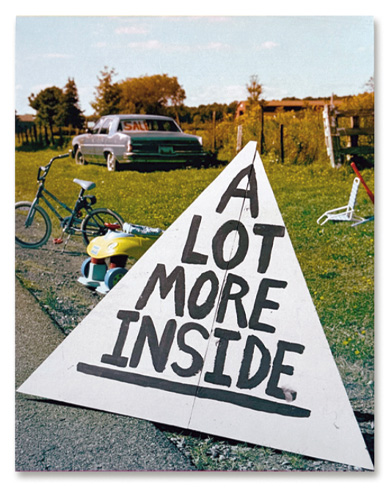
Originally pubished in A Lot More Inside: Esopus Magazine (New York: Esopus Books, 2024), pp. 7–12

Megan Carey: I first encountered the fervor of Esopus in 2010, more than a little late to the party. I was visiting the artist Bryan Nash Gill at his home and studio in Connecticut to talk about publishing a book with him (at the time, I was an editor at Princeton Architectural Press). At lunch around his table, my friend and colleague Sara Bader and I excitedly discussed all the possibilities of a book featuring his large tree prints. While Bryan, too, was excited, he said that what he really wanted, what he dreamed of, was to be in Esopus. A year later, Bryan had a monograph, was in the revered magazine (on the cover, no less), and had a show at Esopus Space (What Was Will Be Again) that was written up in The New Yorker. And that’s when I met dream-maker Tod Lippy.
Tod Lippy: I remember that meeting very well. This anecdote brings up one of the most consequential aspects of working on Esopus: the sense of community it engendered and how all of those people—subscribers, contributors, friends, and colleagues like you and Sara—played such an essential role in helping to make the magazine. I had met Bryan a few times—he often showed up at Esopus events (always wearing his Esopus hat) and I was intrigued by his work, but it took several nudges by Sara—a person whose taste and vision I respect enormously—for me finally to reach out to him.
I can’t understate how important these interactions were to me. As a magazine editor, it’s always great to get feedback from readers, but this was not a one-way street by any means. When someone felt that something they had seen, or heard, or read might be a good fit for the magazine, they told me about it, often making introductions to the people whose work they were recommending. And they were almost always correct, at least partly because so many of Esopus’s readers really got what I was trying to do with the publication. Countless contributions to Esopus came from interactions just like these. We were able to debut the photographs of Mark Hogancamp only because a former contributor to the magazine, David Naugle—who happened to live across the road from Mark in upstate New York—showed me the remarkable photos Mark had taken of his 1/6-scale village Marwencol before anyone else had seen them. I learned about Robert Guest’s daily lunchbox notes to his kids from Scott Menchin, a contributor to the first issue of Esopus and an old friend. Scott also made me aware, by the way, of 13-year-old Alex Brown’s riveting battle drawings (Alex was the stepson of Alexis Rockman, whom Scott played basketball with), one of which ended up on the cover of Esopus 7. But there are examples from every issue.
Much can be made of the “one-man magazine” description of Esopus, but it was actually only possible because so many members of its community were willing to participate in its creation.
MC: That’s not at all unlike the making of an exhibition. There are so many talented people involved in the entire process—from idea (let’s create an exhibition featuring the Esopus archive!) to production to programming and beyond. You have described yourself as a “control freak,” but I have always been impressed by your generosity and trust in the making. You don’t try to control the narrative—just the getting-things-done part. And I appreciate your tenacity on that front. That comes through in the correspondence, mockups, tests, and other items on display in the show. One of my favorites is your letter to a contributor that says something like, “As I haven’t heard from you, I’ll take that as a yes.” Who does that?! But I love it and I think that it shows a bit of what it takes to make things happen.
TL: [Laughs.] That was to Karl Ove Knausgaard, whom I was absolutely relentless with—so much so, in fact, that when I didn’t hear from him after that, I went to a reading of his at Symphony Space and cornered him as he was signing my book, to which he added the inscription “I’m sorry for not delivering.” But he eventually contributed!
To your point about collaboration, I can say that working on this exhibition reminds me of the experience of going on press with an issue of Esopus. At that point in the game, my desire to manage everything kind of evaporates, because I realize that the bulk of my job—soliciting, editing, and designing content for an issue—is essentially done, and it’s time to let others handle a process for which I lack expertise or knowledge. It’s actually a wonderful feeling to relax and let someone else take the wheel, and that’s been one of the most intense pleasures of working on this show with you and everyone else there. I’m kind of awestruck by the competence of everyone I’ve dealt with at Colby, and I’ve been continually delighted and gratified by the input of everyone here—from Beth Finch proposing the hammock for the alcove space to Juliette Walker coming up with the name for the exhibition while leafing through a folder of rejected covers in the archive. It’s been a deeply satisfying experience for me, and I’m hoping for you, too.
MC: Absolutely! I am beyond grateful for the opportunity to work on this exhibition (and to a small extent, this publication) with you and the team here. This project has completely expanded my network at the college, collaborating with Special Collections and Archives, the faculty (in particular Gary Green and Gianluca Rizzo), and the larger arts ecosystem at Colby. In my day-to-day work of producing exhibitions and publications, I can become a little siloed within the world of the museum and our contractors, but there is so much more within our community. Again, that expanded community is something that you seem to bring so seamlessly to your work. What has been the most satisfying part of this process for you?
TL: I think it’s been the experience of witnessing the enthusiasm for the archive and its contents. My parents always joked that Esopus was their “other grandchild”—my sister has a son—and when Lareese Hall acquired the archive for Colby Libraries back in 2019, I told people “my 17-year-old is going to college.” It’s partly an ego thing: there is obviously nothing better than seeing something you’ve created loved and cared for by others. But having the archive at Colby—and particularly, having a wide selection of its contents in this exhibition—represents a continuation, and an exciting new iteration, of the magazine’s mission of reaching, and activating, as wide an audience as possible. It is so satisfying to know that, despite the fact that this book will serve as the final issue, Esopus still has a long life ahead of it.
MC: I’m excited for that, too. I can’t wait to see the space of the exhibition activated by students and other visitors—using the tables to play games, hanging in the nook (lulled by the hammock and the animation of the Esopus Creek), and taking time to take in the many, many pieces of the show. It truly feels like “a lot more inside.” So much of the exhibition is a display of the process—of the back and forth of creativity and making. And this show, in general, is part of the dialog of Esopus, part of the back and forth—what will it inspire?
TL: Exactly. It’s going to be fun to see where all of this leads.
MC: What do you miss the most about producing the magazine?
TL: It’s funny, I felt that ceasing publication in 2018 was the right thing to do—I was starting to hit a wall as an editor and designer, and that is death to any creative endeavor. In those ensuing five years, what I missed most were the interactions with contributors, readers, and colleagues. I was able to mitigate that a bit by publishing a couple of Esopus books—Modern Artifacts and The Esopus Reader—and, on either end of the worst of Covid, staging events here and there. But it was only when I made the decision to turn this catalog into another, final issue of Esopus that I realized how much I had missed everything that the whole process entails, from reaching out to people for invitationals, like the Rejections book, to scanning in artworks and cleaning them up in Photoshop, to puzzling out the sequence of a range of different materials, to—last but not least—creating a mockup that can be used as a guide during the printing and binding process.
MC: Mockups are so key! We use physical scale models for our shows. They help immensely in understanding the work in the space—the relationships between objects, the viewers’ experience. They also take time to put together, and that process of cutting and taping and adjusting can shape so much. We also create full-scale mockups of graphics, and we tape out walls and other furniture in the galleries. It’s an easy step to skip and I always regret it when we do. And then, of course, once installation is underway, you have to be willing to make changes, to respond to the environment. Even with the best planning, there are surprises—hopefully mostly good ones.
There are many, many mockups in the Esopus archive—we’re including a case of them in the exhibition. The majority are minis, and they are often crude, made from 8 1/2-x-11-inch printer paper. The point is not perfection, but to test and to communicate. And yet, they are small works of art in their own right.
TL: Creating a mockup is a very personal experience: It’s just you and lots of paper and Scotch tape and repositionable adhesive, and it can be pretty transcendent as you start to see the thing you’ve been working on (these days, usually via a computer display) suddenly take physical form. And as you pointed out, mockups are logistically essential, particularly when you’re designing something with lots of curveballs, like an eight-panel foldout, or a tipped-in insert, or a complicated paper sculpture—or a hammock! More often than not, that first pass serves the purpose of revealing a design flaw that just wouldn’t be evident otherwise.
MC: There is a lot to unpack in the magazine, the archive, and the show: so much material. For the exhibition, we’ve created some simple bookmarks for visitors to fill out and mark their favorite Esopus projects. For me, I often think about that tiny question mark in the envelope from James Lee Byars in the MoMA archive (from Esopus 8). There is hope in that little 1/4-inch-square piece of paper. I can imagine receiving it in the mail—it’s so personal. I also appreciate the intense process of reproducing it—hand-cutting all those question marks (even your parents helped!) and determining whether they are “okay” or “good” (pictured in the Exploring the Archive booklet). This might be unfair, but can you talk about some of your favorites?
TL: That’s a tough call. But I’m going to go really deep and say that one might be these gummed reinforcements hand-inserted into every copy of Esopus 3. In that issue we featured a series of spreads from the entertainer Rudy Vallée’s (exceedingly cheesy, and mortifyingly dated) “joke book,” that the composer and filmmaker Michael Rohatyn had found in a thrift shop. The holes in its pages were reinforced with these little circles, and on one page, the bottom hole was “naked”—the reinforcement must have fallen off at some point. I don’t know what possessed me, but I decided it was necessary to find enough of these to enable us to insert one in the gutter on this page in all 3,000 copies of the issue. What I didn’t realize was that, starting in the 1970s, the gummed version of these, which you had to moisten to activate, were replaced by self-adhesive ones, which looked way too modern to me. It took me months to source these here and there on the Internet and by visiting every mom-and-pop stationery store I could find. Ironically, I scored the biggest cache (nearly 1,000) at an elementary school in Phoenicia, about 100 yards from the Esopus Creek.
As I talk about this, I realize how utterly absurd it sounds. But I wanted to offer a reward to that particularly careful reader who would notice this little circle and feel, if only for an instant, that they were looking at “the real thing,” rather than simply a reproduction. The fact that probably 90 percent of people who got the issue, which is long sold-out, never noticed it, doesn’t really bother me.
MC: Facsimiles play such a crucial role in Esopus. A number of these are featured in the exhibition, but it also includes quite a few original items, from handwritten correspondence to artworks.
TL: Yeah, it’s funny that, for the first time, all of these things I took great pains to reproduce realistically in the magazine are here “in the flesh,” as it were. I keep having to remind myself—or be reminded by everyone at the library and museum!—that I’m handling one-of-a-kind items. With the magazine, the goal was, in a hat toss to Walter Benjamin, to summon up the “aura” of the original that he argued was always lost when art is reproduced mechanically. Of course, you understand that you aren’t holding that actual letter from James Lee Byars, or the mail art Ray Johnson sent to Robert Warner (Esopus 16), but by using paper stocks that evoke the original, and printing on both the fronts and backs of every item, for instance, you can impart a feeling of immediacy that really adds a charge to the experience.
MC: In addition to your many talents in publishing, you are a musician. For me, your song “Good Start” became an anthem for, and earworm throughout, the making of the show. The lyrics, “A good start means you’re half done,” resonated with the process of sorting through and selecting the material for the exhibition. And I think about it often for my work overall.
TL: That was a saying of my great-grandfather’s, and it’s one of those old saws that somehow nails the essence of a particular experience. If you happen to jump into a new project—a magazine, or an exhibition, or a song, or whatever—and things are going smoothly, I think it gives you the energy and confidence to stick with it, because that solid beginning suggests that you’ll end up with something worthwhile in the long run. The other half is often the real slog, and you need that optimism to navigate through it.
MC: Thanks for the optimism! I think we can consider this exhibition a good start—a good start to the Esopus archive at Colby. But it’s truly only the beginning.
TL: Here’s to that. I can’t imagine a better home for Esopus, and I’m looking forward to seeing—and hopefully participating in—whatever comes next.