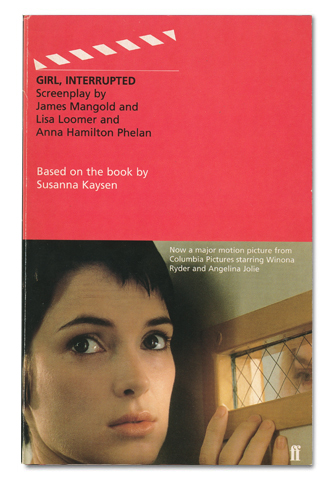
Originally published in Girl, Interrupted (London: Faber & Faber, 2000), pp. vii–xxxv
Tod Lippy: How did you get involved with this project?
James Mangold: I was in the last weeks of directing Cop Land, and I got word through my manager that Winona had loved Heavy (it had just been released) and wanted to meet so we could talk about Girl, Interrupted. I was sent the existing screenplay but I have to admit, I didn’t really connect with it. However, I set a date to meet Winona anyway—I’ve always thought she was a brilliant actress. There’s something very “silent movie” about Noni’s acting style, a quality I really adore. It’s not a “style” in the sense of a pose or put-on, but something very organic and completely unique to her. I’m also fascinated by this fragile energy that follows her through all her films, regardless of genre.
So, despite having misgivings about the script, I met her a few days after I wrapped Cop Land. I should also point out how flattered I was that Noni’s interest in working with me was motivated solely from seeing Heavy. At that moment, the hoopla around Cop Land was pretty intense. I was suddenly perceived as this guy making “the next Pulp Fiction” with this mega-pop macho cast. It was a little terrifying. Most of the scripts coming to me were all cop movies, action pictures, things that people felt fitted the “Cop Land profile.” Heavy had opened strongly in a few theaters in New York and Los Angeles, but a good part of the entertainment world had never seen it. And then here was Winona, who had seen my fragile first movie several times and could recall scenes down to the gesture. It was touching.
Which did you read first, Susanna Kaysen’s book or the script?
The producer, Cathy Konrad, and I read the script first. We were both a bit underwhelmed—it wasn’t badly written, but there wasn’t a clear handle on the movie yet. Then we read Susanna’s book and we were more curious. The book is fascinating, mysterious, elliptical and deeply poetic. In short, a really hard nut to crack. While the existing screenplay included most of the big “events” from the book—what few there were—I didn’t feel like it captured the book’s unique tone or point of view. It’s odd, because in many ways the preceding writers’ scripts were much more loyal to the literal incidents of the book than mine.
So what happened when you met with Winona Ryder?
As I said, it was only days after I wrapped Cop Land. I was exhausted. I met Winona at a hotel in New York. We both got along really well, almost immediately. But I felt badly, in a way, because no matter how much I admired her work or enjoyed Noni’s company, I was hesitant to get involved with this project. I mean, I was grasping at straws in detailing how I would attack this project, and half the time I was just avoiding the topic. All I could tell her for sure was that Susanna’s book had qualities that the screenplay (at that time) did not, and whatever attack someone brought to this material, it had to be bold and extreme and not just an effort to make a weepy TV movie with a lot of pretty girls in smocks.
I tried to lay out the challenges in the material, even though I didn’t have any solutions. For instance, in One Flew Over the Cuckoo’s Nest, you had a protagonist who is highly rational, playing the system, so you never face the problem you have with Girl, Interrupted, which is that Susanna does in fact have a problem. Whether it’s adolescence, insanity or something in between is a question the movie asks. But the antagonist of this story is her mind, not cruel ward nurses. To make this story work, I felt you somehow had to dramatize the battle between the rational side of Susanna (the lucid narrator with a sharp eye) and the crazier one (the girl who was banging her wrist and flip-flopping through time and swallowing aspirins). I thought those two girls had to be seen separately, which is what, in some sense, happens in the book. The book has this tension that exists between a highly rational narrator talking about the times when she isn’t sure she was rational.
Which is her unique perspective—as she mentions in the book, the irrationality of her “episodes” is something she was always aware of, even as they were taking place.
Yeah, Susanna was always extremely lucid. But because the movie isn’t the remembrance of a woman looking back (like the book), but rather, is present tense, you have to break these two Susannas away from each other. In some way, I thought you had to make the “illness,” or whatever it was, something you could touch or see. As I explained to Winona, if you don’t do that, then it could end up being a movie about an impenetrable girl who looks really sad all the time.
So my first instinct—which was bizarre and ultimately misguided—was to make the movie into a monster film, in which somehow we make this “thing”—this blackness—palpable and real, so that you can see it. Not “see it” like a hallucination, but make it a genuine antagonist—the thing in shadows, the thing inside death. I mean, what if death’s living manifestation were insanity? What if the way the devil calls you to death is to suck the rationality out of you until the only choice remaining is a self-induced, peaceful end?
Anyway, that was the only handle I had on this material. [Laughs.] It was risky, and I was sure this big studio in Hollywood that owned the book (Columbia Pictures) would not respond to it. But I guess Winona liked the fact that I was taking a sledgehammer to everything, just saying, if we were to do this, we would have to do some really big thinking, and make it unlike any other movie about this topic we’ve seen before.
Were there other films about insanity you had in mind in that regard?
Well, there seem to be two archetypes. The first is One Flew Over the Cuckoo’s Nest, where the protagonist is not really insane. The other type is the Good Will Hunting, Marnie, Ordinary People configuration, where the protagonist is battling madness, but they are surrounded with highly rational, healthy supportive characters. At the climax of this second type of story, the damaged protagonist confesses a deep secret to one of the rational supporting players—some Freudian trauma that occurred in their youth, whether it’s Marnie’s hooker mom beating a sailor to death, or Will Hunting’s father burning him with cigarettes. And that big confession, in a sense, initiates the character’s recovery, and healing.
However, one of the unique elements of Susanna’s book was that she maintained that there was no deep or sordid secret in her past. I mean, when I spoke with Susanna, I grilled her. I was like, “You’re sure there’s nothing?” I mean, I don’t have a psychological position on whether everybody with mental problems has a secret or not, but it was clear to me that in the world of movies, they always do. This made me very interested in the question—whether you could lose your ability to function in the world without a dark secret in your past. One of the things Susanna brought up to me in those conversations was the story about her being carried across country as an infant, strapped to that board.
I assumed that was your invention, since it doesn’t appear in the book.
It’s something that actually happened to Susanna. In fact, I shot a little sequence of a baby strapped on a board, but it just got too goofy when I cut it in.
Anyway, after that meeting with Noni, I just hung out in New York cutting Cop Land, talking with Cathy about it all, and slowly and quietly starting to believe that we could make Girl, Interrupted work. Then I came out to L.A. and met with some of the executives at Columbia. I presented this whole “monster” theory, and in truth, I think everyone thought I was totally insane, but I had gotten so amped about these ideas, I think they were just excited to have someone ready to roll up their sleeves and work on a project that had run aground.
They made a deal for Cathy and I and then I started reading and scribbling all these notes to myself about things like, you know, Winston Churchill’s black dog—his depressions—and shadows on the ceiling I would stare at when I was a kid. I was trying to understand how I could weave all of these images and ideas about depression and death and childhood fear together. I watched Repulsion over and over. In that movie, her apartment, and the world and these people intruding on her space all become manifestations of this monster. And I watched Jack Clayton’s The Innocents, too.
Because I was so busy cutting Cop Land at that time, however, we hired Anna Hamilton Phelan to try out this “monster strategy.” Anna gave it her all, but as her work came in what became immediately apparent was that this strategy was turning a very personal book into a half-baked Exorcist. Anna was making all kinds of great discoveries, some of which are in the final screenplay—but I realized this “monster” idea wasn’t working. The themes of the book weren’t becoming any clearer, they were getting lost under the weight of this “haunting.” It was still too much horror for this material. So when I got free of Cop Land and Anna had to start on another film, I attacked the script myself. I felt guilty—I’d taken this movie on an eight-month journey to nowhere.
As is often the case in movies, by the time you finish your film—with all the collaborations between the studio, your producing partner, the actors, the editor—your original strategy has been watered down. But the stronger your original strategy is, the more of its boldness remains. Sometimes I think the failure of the “monster” pass yielded a pretty good fallback position, which I don’t know I would have found if I hadn’t come at the material so hard initially.
Were there any other films that you had in mind at this point?
MGM’s musical of The Wizard of Oz, George Roy Hill’s Slaughterhouse Five, and Michael Powell’s Black Narcissus—the latter two utilizing a flashback structure in different ways.
When I write, I’m always looking for a template. I believe David Mamet said he likes to have a fable in mind when he’s writing a screenplay—no matter how complex or contemporary the story may be, he wants a kind of guiding fable. This is very true for me—it could be Sisyphus, it could be Hansel and Gretel, but I need some kind of architecture to hang things on.
So I kept thinking, “What is Susanna’s parallel fable? What tale captures the themes of this story in a nutshell?” I tried to tell myself the story of Susanna’s book at the bare-bones level—I said to myself, “OK, it’s the story of this girl, she’s depressed and confused, and tortured about her home life, she feels like the world is bland and gray and full of liars and fakers, and no one gets her. She senses there must be something more, somewhere, and one day she finds herself in a cab, heading off to a strange new universe. There she meets all these amazing other young people, people also missing some parts of themselves, but people who enrich and transport her, people who become the greatest friendships of her life, and in the act of going through the struggles of living with these friends for two years, she miraculously and quietly ends up sidestepping her sadness, and landing back in the world.
And then it hit me. It’s The Wizard of Oz! To start with, there’s the obvious parallels, and then it occurred to me how incredibly Freudian the movie was—how everyone in The Wizard of Oz is missing some part of their psyche: missing courage, missing love, missing smarts. In a sense, Dorothy was also missing something—happiness. Let’s face it, “Over the Rainbow” is a song of longing and depression—not only that, but, incidentally, it’s sung by a fragile young movie star who suffered from depression. And then it occurred to me, “My God, Winona is Judy Garland,” in the sense of having this unique, fragile quality of being forever young, trapped in childhood, looking out from it, longing to climb out of it.
Also, when I watched The Wizard of Oz as a child, I was always struck by the message of Glinda the Good at the end: “You could have gone home anytime you wanted to go home, Dorothy. All you had to do was say ‘There’s no place like home’.” That was the “no secret” ending I was looking for! Susanna runs around chasing these different feelings, trapped in this alternate world, trying to do what’s required to get out, but ultimately all that’s needed for her to leave is to find within herself the commitment to leave, a renewed belief in the real world, despite its shortcomings. It seemed to me that this was the only way out of Susanna’s story. It wasn’t about digging deeper and deeper in analysis and finding some buried, shameful secret, but instead, it was about realizing that love is the only thing that can heal and make us grow and the friendships Susanna makes in this hospital grow her up, and prepare her for the world.
Anyway, that all hit me at once like thunder. I’d been collecting all these BFI books about the greatest films in history, and Salman Rushdie had written one of them about The Wizard of Oz. Reading it, I came upon a passage that I thought was absolutely magnificent. Rushdie said “The Wizard of Oz is a film whose driving force is the inadequacy of adults, even of good adults, and how the weakness of grownups forces children to take control of their own destinies and so, ironically, grow up themselves.” I get chills every time I read that, because, first of all, it’s a beautiful sentence. Second of all, it is a brilliant observation, and thirdly, it’s a very concise concept to build a movie around.
So, I just sat down trying to figure out what more I could learn from this very unique fable. One of the first things these comparisons reinforced was my instinct to get Susanna into the hospital quickly. Even when I was eight years old, The Wizard of Oz took way too long to get Dorothy to Oz. By the time she was in that railroad car with Mr. Magicko or whatever and the crystal ball, I was always just losing it—I wanted the tornado, I wanted Oz!
Spending most of the first act getting to know Susanna outside the hospital posed many problems the previous writers had encountered. By the time she was in the hospital, every friendship she made was handicapped by the fact that these girls were going to have to catch up with the audience. We would have already gone through all these lessons about our protagonist, and now we were going to have to sit around watching her new friends go through the same lessons. I had to get to the hospital faster, but I couldn’t draw things in the comic-book fashion in which they’re presented in The Wizard of Oz, because I had to impart a lot of serious information—Susanna’s having dalliances with a friend of her father, she’s disaffected from her parents and other kids, her attempted suicide, etc. All these points had to be made quickly.
Then one night I sat down and watched Slaughterhouse Five–not because I thought it would be relevant to my struggle, but because a new DVD had just come out. I’m a big George Roy Hill fan. Slaughterhouse is clearly a movie about someone who from the outside would be considered insane, a character who believes he’s living in three times and places all at once. But because the movie itself uses its essential qualities—the ability to cut back and forth in time—as a tool to penetrate Billy Pilgrim’s crazy existence, it somehow meant we were on the journey with him and perhaps he wasn’t nuts at all. I felt like perhaps I could use this technique to get what I was always after when I was working with Anna and trying to put a mental monster in the film. Snapping forward and back again, as in Slaughterhouse, might make Susanna’s disorientation visible, even rational.
It also makes it visceral, because the viewers are jumping back and forth with her, as opposed to hearing about her jumping back and forth.
Right. I gave away oozing plates and surreal CGI moments just to use film at its most basic—the cut—to say that we can all get subverted by memory. I think that’s why we connect with Billy Pilgrim—because we all have some modest version of that confusion in our lives, where we’re in a conversation, and suddenly for some reason our mind goes to a terrible breakup, or a trauma with our parents or something: we go away, and then come back. To me, the goal was always to get the audience to connect with their own dysfunctional moments. If Susanna’s mental troubles were only amplified versions of things we’ve all experienced, then we’d always cling to her as a protagonist. We’d never feel like we needed rational supporting players to help “save” her. I wanted her to be one of the most rational characters in the film.
The most resonant part of the movie in that regard is the “checks” scene early on, when Susanna keeps falling back to sleep in between these abrupt visits from the nurse, having flashbacks to her night with Toby months earlier. The pull of the unconscious in that kind of half-awake state is familiar to everyone.
And as we’re getting to know her through these flashbacks, the other characters are getting to know her, too. So then later, like in the scene in the ice-cream shop where Lisa says “ls this the professor’s wife?” we understand that, even though we’ve never seen them have a conversation about it, that element of her life is something she has certainly talked to them about. What got me even more excited about this technique was trying to stage these transitions very aggressively so that the two scenes were always graphically similar. One of my favorite cuts occurs during that scene you mentioned in the hospital, with Winona, her head on the pillow, looking to—cut—her naked boyfriend on the other side of the bed, staring back at her from his pillow. We tried to do those graphical matches in every transition. You know, Winona walking out the door of her boyfriend’s apartment and finding a nurse, who then is saying “Checks.” Not to be clever, or athletic, but to try to emulate the way we can slip in and out of memory, instead of doing the kind of cliched, warbly dissolve into the past and then warbly dissolve back to the present.
The scene that got me in Slaughterhouse Five was the very first scene in which you have Billy sitting at his typewriter, writing, “I move back and forth in time.” He suddenly hears a loud engine, looks up, and he’s in a snowy woods. And all I could think was that if somewhere in the first five minutes of Girl, if I could utilize that technique, and get away with it; I’d have a protagonist who had a simple problem—they’re lost in a loop of their life.
But as with Slaughterhouse, I didn’t want every one of these “time jumps” to be enormously “significant” in and of themselves. Meaning, the flashback scenes weren’t necessarily violent breakups or someone asking you to marry them—they were each just a piece of a puzzle. The sum of these pieces would be a knowledge of this girl.
Which is very true to the spirit of the book, which consists of short, almost fragmentary chapters consisting of little glimpses into her various experiences.
It is very true in Susanna’s book. The whole is greater than the sum of its parts. Also, I was trying to avoid a kind of Screenplay 101, which would be just hitting all these clear bullet points of backstory, and then sending her into the institution. I lose interest so quickly if I sense those kinds of structures. I just get bored trying to write them—no amount of cigarettes or caffeine can make my fingers move on the keyboard—I feel like I’m making something I’ve already seen. When I’m pleased with myself, it’s always because I’m making something I haven’t seen before.
It’s not like I consider myself Mr. Avant-Garde; I’m fascinated by well-done straight-ahead movies. But it bores me to go from plot point to plot point, being able to predict everything that’s coming. I mean, part of drama is sensing what’s coming, but at the same time things should seem shockingly unpredictable. Alexander Mackendrick always had this great expression, that what happens at the end of a movie should be the only thing that ever could have happened, but yet it must feel completely unanticipated. In retrospect it has to seem the only way things could have gone, yet unexpected. That’s a very difficult trick to pull off.
How did Black Narcissus influence the writing of the film?
That was banging around in my head because it’s about five women in a very circumscribed, magical universe—another kind of a vacuum, a convent—fighting against their demons. What really influenced me from Black Narcissus was the ending, when one nun goes quite mad, putting on the lipstick and red dress, running around and trying to kill Deborah Kerr. I wanted the same kind of strong, ballsy ending for Girl, Interrupted. Despite the fact that this was a bit of a leap from what actually happened in the book it felt like the only way dramatically to realize Susanna’s struggle with madness and her resultant commitment to live in the world was to have a final showdown between her and a character strongly representing the exhilarating freedom of insanity. Susanna, in essence, is torn between being another grownup zombie in the real world, with all the sadnesses and compromises that entails, or giving herself up to this other kind of zombiehood that Lisa represents.
Also, that scene also calls up the struggle between the id and the ego, taking place as it does in the dark depths of the hospital’s tunnels—
Yeah, I thought about that. Also in Oz at the Witch’s castle. It was also really clear to me, even if it never happened, that there was a kind of—I mean, I said this to Susanna Kaysen—it seemed to me she had fallen in love with Lisa. And if this movie had any form, it seemed it had to be as a love story that ended with a breakup. They may get together later, run into each other, but that breakup had to somehow be tied to Susanna’s recovery.
How did Susanna Kaysen respond to that, or, for that matter, the dramatic structure you came up with for the film?
When she read the screenplay, she was—well, I don’t want to put words in her mouth, but I was incredibly relieved with the enthusiasm she showed for what I’d done. And as for the places where I departed from the facts as she presented them, she’d be the first to say she combined characters and made simplifications and changes to reality to make her book work. So I think the dramatic conflagration at the end wasn’t disturbing to her, because she thought of Susanna in the movie as a different Susanna from her. I think that’s the only healthy way to approach these things. She created a fable out of her own life, and I was creating a movie out of her fable. So I had the distance to understand. Her biggest reaction was that I really got the character of Lisa.
That’s interesting, because so much of Lisa’s dialogue is yours.
It was the same kind of space I went into when I wrote Ray Liotta’s role in Cop Land. It was the same voice in me. Lisa was a very freeing character to write—as it was for Angie to play.
I remember in one of our earlier interviews you talked about how, despite your love for wordless characters, you have a side that loves to “go on rants.” Was that something you were accessing when you were writing Lisa’s character?
I enjoyed speaking through her. One day as I was driving, I came up with this line of dialogue. I raced into the office and wrote it down on a blank piece of paper and called my assistant Lance in, and read it. “A man is a dick is a man is a dick is a chicken is a dad, a valium, a speculum, a cucumber…” I had been struggling with that Daisy scene—I had needed a culmination, not merely of the drama, but a culmination of Lisa’s poetry. It had to be a startling and rhythmically interesting line that also stung. Lance and I were like, “Wow, that’s intense.” I was sure the studio was going to cut it. Anyway, I just went back and built the scene toward that statement.
I’ve never come at a movie less structurally and more from the gut. For instance, I wrote the first two pages—that silent movie of shots in the tunnels—and all I knew at the time I wrote it was that I had to have a conflagration at the end, so I decided that’s how I would make myself write it. I would describe the aftermath of the scene, and then I’d just have to write my way up to that aftermath. I had no idea how I was going to get there—to this room with a burning furnace and a rattling window and broken glass and a cat—I just laid it down for myself as a dare. That was also inspired by Slaughterhouse Five—the idea that the first thing we see is one of the last scenes in the narrative. And then we flash backward, and then flash back further from there, swirling around until we find the present tense of the movie, all the time marching toward that climax in the furnace room.
I also felt like I had to promise the audience something intense if they were going to live through this meditative, flip-floppy first act. They had to know they were heading to a charged dramatic place.
Could you talk about how your knowing that Winona Ryder would be playing Susanna from the beginning affected the writing of Susanna’s character?
Not only was the world of Susanna Kaysen and those realities merging with my own voice and experiences, but the intricacies of Noni’s personality were feeding the writing. I found I was drawing from both women, making a “hybrid” Susanna. Some of the experiences Winona has had growing up, many of them in the strange fishbowl of stardom—their experiences were not dissimilar to the strange “through the looking-glass” journey of Susanna Kaysen. Like I said before, I’m less interested in affected performances, where someone becomes someone else. What’s always inspiring to me is when an actor puts themselves onscreen. Winona understood the kind of openness I was expecting from her and she expected the same of herself. Exposing your soul to a lens six inches from your nose can be a lot more difficult than “putting on” a character, developing a limp and a strange accent.
We’ve discussed how aggressive this adaptation is in many regards, owing to the fact that you’ve added to and modified the original source material pretty dramatically, but I was interested to find so many small details in the book, even when taken out of context, plugged back into the film. There are too many to mention, but I’ll give you one example: you give Georgina a line of dialog in the film about her dad being in the CIA that her boyfriend, Wade, had in the book.
Well, when I was writing Heavy and Cop Land, I had all these memories of growing up in the Hudson Valley—experiences, sights, faces, memories I could touch and taste and smell—and they anchored me as I wrote the fictionalized worlds of those movies. With Girl, Interrupted, I clearly had to make some kind of adjustment—so I tried to absorb Susanna Kaysen’s book, and, in a sense, make it my memory. As I wrote, I drew upon Susanna’s memories—as I had drawn upon my own while writing Cop Land or Heavy. Even with the first two films, nothing was ever quite the same as it made its translation to screen, but it was my anchor.
Susanna’s book wasn’t just a narrative, but a world of detail and impression and feeling. By the second draft, I was also having dialogues with Susanna directly—I would grab at her life and her way of looking at things for solutions to dramatic problems, twisting these pieces of reality like a pretzel—not to distort them, but in order to try and find a way to make a truer film. The book contains a tremendous amount of detail. There were so many details, like her French cigarettes, or her fixation with her hand—things that led me places.
Also, I tried to try to weave a sense of destiny into the film—to suggest that maybe Susanna’s “madness” was a kind of prescience about where she might be headed, or the challenges she was going to face. For instance, perhaps her obsessing over the bones in her hand was a vague “knowing” that someday she was going to slam a door on her hand. None of these ideas plays in an overt way, but to me, weaving these pieces, giving them an amplified Oz-like significance, was an interesting way to further ask the questions Susanna was asking—as opposed to maintaining a literal, cut-and-dried loyalty to the book, I was trying to be loyal to the ideas in the book and perhaps amplify and renew them.
Many character details in the book have been broadened considerably, or in some cases, completely changed. In the book, Polly, for instance, had a much less compelling story about why she burned herself than the one Georgina relates in the film about her losing her puppy.
Much of that comes from the Wizard of Oz template, that every character needed a greater kind of mythology than Susanna provided, like the Tin Man’s “I’ve been sitting here rusting ever since…” In fact, in the early drafts, I used Susanna’s backstory about Polly—that she set herself on fire with a book of matches for no apparent reason—but as the script began to take on a life of its own, it felt like that ambiguity belonged to Susanna. If every character had an ambiguous backstory it would defeat Susanna’s point instead of furthering it. When Susanna was writing the book, she established in every girl a kind of mystery about what had struck them. But as I was writing the movie, it felt like that point was getting overstressed. It seemed to me that the mystery of Susanna’s illness would gain intensity if many of the girls around her had very good reasons for being at the hospital, then Susanna would be a unique character—not unlike Dorothy—someone who found herself in a mythological world, but who herself possessed no mythology, no secret.
Even Lisa reveals a secret at the end, mentioning that her parents think she’s a whore and wish she were dead. And of course Daisy reveals the incestuous relationship with her father. Georgina reveals Polly’s story, but of course you don’t even know whether to believe it or not. I always thought that was one of the weirdest, most twisted parts of the movie. One of my biggest notes to Clea DuVall, who played Georgina, was to really enjoy the telling of Polly’s tale. To relish the magic of telling Susanna a story late at night—that this magic far exceeded the somber tragedy of Polly’s past. Not because Georgina was insensitive, but because part of the charm of this hospital was that everyone’s personal tragedies were kind of irrelevant.
What happened to Georgina’s boyfriend, Wade, who’s another patient in the hospital in the book?
He was in some of the other writers’ drafts, but it didn’t really lead anywhere. It’s not that the scenes were badly written; I just felt that if I were going to invest time in Georgina, I wanted to give her a more magical identity than that. There was something flat about it.
Also, in the book it seems to be there for Susanna’s internal voice to muse about not wanting a “crazy”—i.e., a fellow patient—boyfriend.
To me, if Susanna and Lisa were the most sexually aware young women on the ward, it offered a kind of clarity about why they become close. It followed then that everyone else had to be a kind of child. From the moment I started writing, I felt there needed to be an order in this universe; and this made Lisa’s attraction to Susanna logical—she found a friend who’s also been living in the world, who wasn’t stuck in childhood. In order to make this clear, I steered away from overt sexuality among the supporting characters.
I was a little nervous, however, that on the page Polly and Georgina would be too similar. But as we were rehearsing, I saw that they could be played quite differently. Clea was to be more of a granola type, more sexually aware and more folky, listening to Joni Mitchell, whereas Polly was still playing with plastic horses, which is something I took from Cathy Konrad’s childhood. Cathy still knows the names of all these beautifully painted plastic horses from the sixties that she used to collect. Also, an old friend of mine, Lisa Krueger, made a brilliant short film about a girl of who had this sweet prepubescent horse-love. So Polly became that girl—an innocent who always wanted to play musical instruments, who loved horses and animals. It’s crazy how all of this transpires. I mean, my wife’s talking to me about her childhood, and the horses, and meanwhile I’m working on the Daisy apartment scene and I’ve given her this cat, and then the cat comes back to the hospital. And suddenly I’m realizing, “Oh, that could be beautiful,” because suddenly Susanna can bestow this gift on Polly as she’s leaving, and fulfilling this dream—fulfilling a need of Polly’s to have someone to love.
In the book, Dr. Wick is described as a “disguised boarding-school matron” who blushes every time sex is mentioned by one of the girls. Can you describe how you came to give her a much more central—and sympathetic—role in Susanna’s recovery in the film?
I felt like I couldn’t make every shrink an incompetent. Susanna likes to say that the events from that period in her life are a kind of “calcified memory.” My concern was that Susanna was looking at her experiences at the hospital and was describing these doctors—who all seemed slightly boobish in the book—through the eyes of a young girl who was resistant to getting better because she was questioning the existence of an illness. But someone there had to be effective. I mean, the hospital Susanna is referring to in the book was a very respected place, located at the heart of American academia. A lot of famous people—Sylvia Plath, Ray Charles, James Taylor—went there, and I guess I just couldn’t believe that they would’ve stayed there if they were encountering nothing but idiots.
Also, it would be a sad cliche if every shrink scene featured an ineffectual psychologist. I didn’t want Melvin to be an idiot, either; I wanted him to be a kind of workaday shrink with a lot of difficult patients. But for Dr. Wick, I needed someone of grandeur and weight to come into the movie, to get to the heart of the matter with Susanna, but someone who does it so effectively that it’s almost too much for Susanna to bear. I needed someone to cut to the quick, and lay out for Susanna and the audience exactly what Susanna was going to have to do to get out of there. You know, “This has all been a bit fun, but let’s cut the shit.” I kept thinking of characters like Hannibal Lecter, with that ability to pierce a hero’s psyche. Or even James Mason in The Verdict.
The surprising thing was that Vanessa brought such warmth to the role. We rehearsed it at first, trying the scene with a more aggressive tone, but the beauty of Vanessa’s performance was to watch her methodically, and rather kindly, unravel Susanna. Anyway, the short answer is that the movie really couldn’t operate if Dr. Crumble was a jerk, if Melvin was less than effectual, and then Dr. Wick turned out to be a schoolmarm boob. The movie would have become less rich, and more one-dimensional. I also thought this was one place where we could be very different from One Flew Over the Cuckoo’s Nest.
Can you talk a little bit about the writing of that scene between Susanna and Dr. Wick?
A couple of years ago, Winona was hanging out in my office, right after she’d wrapped Alien Resurrection, and I was sharing with her some of what I was doing to the script and some of the questions facing me. I tossed these questions to Noni and she wasn’t taking a strong position. It shocked me a little, her hesitance to stake out a position unless she was absolutely sure—it’s certainly a rare quality in show business. And so I said, “You’re a really ambivalent person, aren’t you?” and she looked up kind of curiously.
Anyway, when she left, I opened my dictionary and looked up the word “ambivalent.” I’ve used the word all my life, and always thought it meant “I don’t care.” or “I don’t know,” or “I don’t have an investment either way.” But according to the dictionary the word actually describes someone with a monstrous investment in two opposing courses of action. I suddenly realized my first two movies were all about ambivalence—how someone can be seduced by both sides of a conflict.
So I started playing with the word “ambivalence” in the dialogue of the Dr. Wick scene, and I realized that I could take advantage of the fact that many of us misunderstand the meaning of the word. So after Dr. Wick tells Susanna that her progress has plateaued, and asks if that disappoints her, Susanna very curtly replies, “I’m ambivalent. In fact, that’s my new favorite word.” At that point I wanted Susanna to appear to get the better of Dr. Wick for a moment. Even if Wick was the smartest shrink in the world, I wanted the scene to have a flow to it. So when Wick asks Susanna if she knows what the word means, Susanna responds, “I don’t care.” Wick replies “Well, if it’s your favorite word I would’ve thought that you—” And Susanna snaps, “It means ‘I don’t care’.” It’s like Susanna got the better of her but then of course Vanessa gets back on top. It’s one of my favorite scenes in the movie. I love that whole interplay, and thought it somehow got to the heart of the movie. I also love the stillness of that scene.
What about the scene in which Susanna and Lisa escape from the hospital and visit Daisy? How did that evolve?
The runaway to Daisy’s had a very peculiar evolution. I kept getting hit by how undramatic it was to have this scene play as it does in the book, in which they get a postcard and Valerie gathers the ward together to announce Daisy’s suicide. First of all, even if it happened that way, it was hard to believe. Gathering all these troubled girls together and announcing that their friend has killed herself—it seemed highly unproductive. I didn’t know how to resolve Daisy. I remember saying to Anna Hamilton Phelan as she was writing, “If Daisy dies, then we’re going to have to see it.” I had this idea that when Lisa ran away, you could crosscut between her and Susanna, and you could see that Lisa seeks out Daisy and “undoes” her.
It was Cathy who suggested, “Just let them both out of the hospital. Let them run away together and go to Daisy’s.” I guess I had been a little trapped by my fear of breaking from the book. It was Cathy who gave me the courage to say, “I need an event here, and it ain’t in the book.” So suddenly things just started to line up. If you have this character, Susanna, whose disease is enigmatic—if it even exists at all—then what is the logical way for her to behave? The closer someone gets to pinning her down, the more she’s going to want to get out. Also, if Lisa represents the beauty of a creature ruled by passion and not reason, then it seemed logical that at a certain point in Susanna’s trajectory, she’d run away with madness. That became the physical act of running away, and running from the people who were on to her game. So this became an opportunity to write what I thought could be an eerie set piece in which Lisa reveals her contempt for normalcy, even the fucked-up “normalcy” of Daisy’s situation, and where she could ruthlessly pull the veil off of it—forcing Susanna to confront the downside of Lisa’s inhibitions.
I also felt there was a good parallel between the way Wick pressed so hard on Susanna and Lisa pressed so hard on Daisy. If you thought Wick was applying pressure to Susanna, Lisa was off the charts—brutal and unflinching and cruel. I wanted it to be a really conflicting scene for the audience, where everything she’s saying seems entirely true but terribly wrong at the same time.
The other thing that scene provided me with was a chance to stage the standard intervention scene—the revelation of the buried “secret”—with someone other than my protagonist. I felt that if I could deliver a revelatory scene about a repressed psychological secret to the audience, then I might be freed from having to do it again with Susanna. And more obviously, it was a chance for Susanna to see what the “dark side” of Lisa’s freedom could yield.
How about the ice-cream parlor scene? In the book, Kaysen describes this as a fairly common ritual for the girls.
Well, again, every scene has to have a greater role in the movie. It can’t just be there for its texture. In Susanna’s book, there were these wonderful snapshots of tension as the nurses escorted the girls down the street. Anyway, I needed something to happen in the scene besides the girls just misbehaving, which is basically all that happens in the book. I think it was while I was working with Anna that it occurred to us that we could put Mrs. Gilcrest at another table in the scene—in the background, basically. But it wasn’t until much later, when the studio was pressuring me to cut the scene, that I realized how to make something even more out of it. The idea came to me when we cast Mary Kay Place in the role. Cathy had known Mary Kay through Citizen Ruth.
When she accepted the role, it really galvanized me to make this scene worthy of such a wonderful actress. And suddenly it was so obvious! Susanna’s been screwing Mrs. Gilcrest’s husband—it’s a dramatic necessity that she come at this girl, directly, in a full-on attack. And it’s so perfect in the timing of the story because it’s a chance then for Lisa to show Susanna what a good thing it is to have a friend with big balls.
It’s also a great way to illustrate Susanna finally—and joyously—surrendering herself to this new universe. Finally giving up her resistance to being “one of—”
“Them.” Right. They now become her family. When something hostile and disapproving comes at her, and she doesn’t know what to say, this new world of loyalties comes to her defense. What I did draw from Susanna’s book was that after you’ve hung out in a place like Claymoore for a while and made profound friendships with “crazy” people, the normal world can start to look pretty nuts.
In the book, there’s a mention of Susanna getting together with Georgina several times, and bumping into Lisa, with her child, on the street in Boston years later.
All the way to the very end, I think the studio was hoping I’d relent and do something like that. Not to knock them, but I always felt it would be like that movie that Bob De Niro made with Meryl Streep, Falling in Love, where they run into each other at a bookstore. To me, the romance of the film was that it was like a war movie, and the beauty of war movies is that people go through a harrowing life-changing journey together, and then have to separate and say goodbye. There’s something romantic about that to me.
Like Cop Land, this film elicited an avalanche of actors’ interest during the casting process. I remember there was a “buzz” about actresses interested in playing the role of Lisa, particularly.
I don’t know what to say about the buzz thing. I knew, certainly, that Lisa on the page was a phenomenal role. I mean, Winona knew it was a phenomenal role, and there were nothing but phenomenal actresses interested in playing it.
When Angelina Jolie came in to read for Lisa, it was an amazing moment. She read not just one scene, not two scenes, but every scene Lisa had in the entire motion picture, then gave me a hug and walked out. She literally knocked the wind out of me. After that reading, there was no question. When I sent her tape to the studio, there was no question among the executives, either, even though no one had seen Gia yet. She was so powerful. Terrifying and charming and sexy and truthful and real. Brilliant. I mean, all of these gestures I’d written came to life without pose, without posturing. She’s incredible with language, and she got the rhythms of all the verbal dances I was doing like a jazz musician. I thought, “Man, she is going to make me look like I can write.” The press started making stuff of the “race” for the Lisa role. In fact, after Angie read, it was pretty much over. Then Brittany read for the role of Daisy and really aced it.
Could you describe the audition process a little bit?
I don’t like to call them “auditions,” because I’m embarrassed by the kind of hiring quality of the whole event. I try to destigmatize it as much as possible. Whenever I do a reading with an actor—especially an actor I’m very, very interested in—I will take a lot of time. To a point where it’s been an hour or so of really working on the role.
I think it’s totally unfair to ask an actor to come with a particular tactic and find out whether or not it’s a score. I hate the idea that they’ve been home, talking with a boyfriend or an acting coach, torturing themselves about how they’re going to interpret the material—it’s such a fuckup, and it’s so hurtful, and everything comes down to this moment of whether they’ve guessed right. I want them to come in neutral, and take the time with me where I try to find a part of them that connects with some part of the role.
So you’ll actually read with the actors?
Oh, yeah. On Cop Land, I did all the reading with actors. I just like to do it, and in that case it made sense because all the roles were male. Lisa Beech, the casting director, did some of the reading for Girl, Interrupted, because so many of these roles are female. She was phenomenal, and kind of wacky, like me, in the sense that she loves going there, getting there. One actress spat in Lisa’s face during a reading—it was crazy.
I know that some of the actors of great note who came in to read had great times working on it, whether they got it or not, and that was very meaningful to me, not to sound like a sap. But I hate the hiring-or-not quality to these things; I think it’s much more about making sure that the actor is going to be brilliant in the role. It’s not about giving someone a chance, it’s about going through a process where you sense a certain potential. Otherwise, it’s so painful having the wrong person in a role.
How did you get Vanessa Redgrave?
She was the one actor I never got to meet, because she was in London. I just made the leap because I was so crazy about her. It was an amazing honor to have her on the film, and I think she had a great deal of fun even though she was with us only for a week. It was so magical the day she arrived, because she immediately began telling me about the backstory she imagined for Dr. Wick. She had this idea that Wick’s parents had been killed in World War II, and she was a Jew, and had moved or fled as a young child to South Africa, and had grown up with a relative there. And after she completed her studies, she emigrated alone to this country, where she quickly rose to prominence.
Did the other actors devise backstories for their characters as well?
Everyone had a story they were drawing upon. Angie, for instance, developed this amazingly rich backstory about how she accidentally killed her baby brother or sister—I can’t remember which it was—when she was young. Whoopi Goldberg was drawing upon her mother, who was a nurse at, I believe, New York Hospital. In many ways, this for her was a real tribute to her mother, whom she really admired for having great dignity, yet also having the ability to keep a certain distance. You know, the fine balance someone has to employ in doing a job like that between feeling too much and feeling too little.
How did Whoopi Goldberg become involved with the film?
Whoopi was tracking this movie very early on, and to be honest, I was very resistant to the idea. First of all, she’s a very big movie star, and I knew we couldn’t afford her. You’d think because we were making a studio picture, it would be, like, “Oh, you have more money now.” But the funny thing is because it’s a big studio, actors won’t work for nothing like they will on a Miramax film. Even if Miramax is owned by Disney, it doesn’t matter—agents will make deals with their clients for less.
Also, I had this prejudice—she was on Hollywood Squares, she makes all these comedies, I’m making a big serious movie—basically, I was being a little snobbish. To her credit, though, Whoopi called my assistant, Lance, one day. I was in the office, in a panic: “What do I do? What am I supposed to say?” This is when it’s so great to have a partner who understands producing so well. So I call Cathy on another line as Whoopi’s talking to Lance. “Whoopi Goldberg’s on the phone, what am I supposed to say?!” Cathy was really into the idea, but I was much more suspect about what it was going to say about the movie, and what kind of job she was going to do. So Whoopi says to Lance—in my first introduction to how charming she is—“Take this down. My name is Whoopi Goldberg, and I’m very interested in playing Valerie. I’m a really nice person, and I would listen to everything you said, and I would work very hard on your movie.” And I think she added something like, “I don’t smell, and I don’t throw temper tantrums”—something very funny like that. And she was like, “You have all that, Lance?” [Laughs.] And she gave him her home phone number, and said, “Tell him to call me.”
So I called her, and told her I didn’t think I could afford her, and I kind of stumbled through how I feel I really have to know kind of everybody I work with, and that I can’t make a decision, even though she’s a big movie star blah blah blah; how everyone—even Winona, who I got to know very well over this period of writing the script and deciding whether or not I was going to make the movie—has to go through this process so we both know we want to work together. She said, “So come on down; I’m taping Hoillywood Squares on Friday.”
So here I am, walking into game-show world. I go into her dressing room, and meet her mom, and her grandkids and daughter marching in and out, and sense this tremendous amount of love and seriousness in her. But I even needed more. I went and saw her at her house, and we worked on a scene together—I don’t know when anyone has put Whoopi through this, ever. Certainly not in the last ten years. I told her I needed somebody who’s going to be part of an ensemble, and what that translates to when you’re a movie star is that you’ve gotta be around when sometimes you’re out of focus in the background. I remember saying to Sly, “Some days I’m going to be shooting someone else and you’re going to be sitting on a barstool in the background, and I need you there. I don’t want to shoot around you; I don’t want to shoot you out. I don’t want to put you in a place where I can get you done with one shot and then send you home. I want you to be part of the fabric of the film, even if some days you feel like you came in to do extra work,” So I got a chance—since all of life is a rehearsal, and I had already been through this once with Sly—to kind of put down those fears I had. And Whoopi said, “I hear you. Don’t worry about it.”
I quickly realized she is 100 percent gold. There is such dignity to her and the world she has built around herself. She is an amazingly grounded human being. She’s loyal and kind to the people who work with her. She’s always there on time, always working hard. She’s just profoundly connected to people. I was really wrong—I’d created all these artistic boundaries about what you can and can’t be, and do, and she just doesn’t recognize them.
In the book, Valerie is actually white—did you write that character as black in your script?
No, that came from an early draft written by Lisa Loomer, and I just thought it was a really smart move, because in many ways, the all-whiteness of the movie did not reflect the sixties. Also, as much as I wanted to avoid shrinks that were all boobs, I wanted to avoid nurses that were all Nurse Ratcheds. And I had this idea, just in my head when I was writing—between Jackie Brown and all those other movies getting rereleased through Quentin’s new label—about someone in a big-ass Afro, with shades. When I was growing up, there was a Jamaican nurse, a friend of my family, who had this great Afro and wore shades and just looked so cool.
By the way, Whoopi was a great help to me in that she was such a maternal presence and power, even when she’s not working. She really aided me in my ability to control the set, and let’s face it, I had a lot of young women—and I’m not saying it’s about any of them being brats, because they weren’t—but they were all very young and full of life and bounce and ideas, and it could be overwhelming. There was a quality of Valerie to Whoopi, and it bled into her influence on the set itself. Everything stayed calm; things got sorted out, and went in an order. No one was going to tangle to with Valerie, and no one was going to tangle with Whoopi. For instance, when Angie was playing scenes out, she was so powerful—before Whoopi arrived on the set; I’d be like, “Oh, man, Angie is so powerful, how is Whoopi going to stop her? She doesn’t fear anything.” And one of the first scenes we did was where Valerie stops Lisa from plunging the pen into her neck—and all Angie had to do was lock eyes with Whoopi to know, “OK, I’m not fucking with you.” And I never had to worry about it.
Along those lines, did you find that the find that the actors’ relationships with one another mirrored their characters’ relationships in the movie?
It’s not the relationships in the movie, but everyone dug very deep into their characters. Angie was very free. I mean, there’s a great deal of her that is Lisa. She’s an incredible truth-teller, has a very hard time containing what she thinks, is full of ideas, insatiably rebellious yet incredibly driven by her craft. Everyone was investigating their characters. More than everyone was their characters, everyone was going deeper and deeper into these places. The first rehearsal day, the ward wasn’t fully dressed, but it was painted and the tile was down, and I got the beds in everyone’s room. We had this whole floor with two hallways, and this great TV room, and I got the entire cast and the nurses in, and I just let the ward exist. I showed everyone their rooms, gave them their central props—you know, showed Polly where the horses and musical instruments were kept—and J.P., our prop guy, showed the nurses how to do beds. I just let them be, in this kind of giant organic improv.
Sometimes this kind of thing is more important than hashing out the blocking of a specific scene way in advance; I wanted to understand the blocking of the ward. How would people move around? Where would they hang out? For instance, the great scene of Winona in front of that big round window? That came from a certain point during this hour and a half, while Cynthia was fixing the TV, and Angie was sliding around the ward in a rolling chair. I discovered Winona in that vinyl couch by that window, with her legs pulled up to her chest, smoking a cigarette and watching the light through the trees. I looked at her and said, “I don’t have a single fucking scene that sees this, and I have to find one.” And when we shot that scene, it was completely improv. I had a day when I finished early, and Jack Green and I set up a camera that kind of captured the symmetry of these two benches and Winona sat down and I just said, “All right, get up, move to here. Move to there.” We just did it in an hour, and it was all because of that one moment in rehearsal.
A lot of the little moments of that swirling montage sequence—little beats, almost New Yorker cartoons—came from that hour and a half—like Whoopi on a smoke break on a fire escape. That fire escape was what we called our “deck of shame.” It’s where we all went out to smoke, because the ward was too claustrophobic. Whoopi and I, or Winona and Angie, or whoever, would gather on these really cold days to smoke on the deck of shame. So on Whoopi’s last day I did this shot of her looking wistfully out on the grounds as we swirled around with the camera on the deck of shame. That’s the other wonderful thing about being on one location for so long—you get to know it so well, discover all the nooks and crannies.
There are a few things in the script published here that I assume were shot, and later cut in the editing process. In the screenplay, for instance, one of Lisa’s first lines to Susanna is a rather odd, violent snippet of dialogue: “I will kill you, Geisha girl.” What happened to that?
Well, this is where it gets really funny for me. As I’ve discussed, there’s this way that, as you’re writing, your character merges with your actress. I wanted to set Angie and Winona and Lisa and Susanna off in opposition at the beginning, so that line just came from how I thought Lisa would view this perfect, fragile creation. The other thing is that with this scene, I wasn’t just thinking about The Wizard of Oz; I was using it. That scene of Lisa’s arrival is the arrival of the Wicked Witch of the West. Like Dorothy, Susanna shows up and lands in the bed of a girl who, in a less obvious way, is dead because of her arrival. And Lisa arrives and realizes her friend has been replaced by this other girl.
John Gardner wrote a great book called On Becoming a Novelist, which has this passage where he talks about writing an entire section of a Faulkner book down just to internalize his language. When you’re searching for structures, you can just steal one. Hurl your characters into these existing structures, and you’ll end up throwing away most of it because the life in your characters will obliterate it anyway. That “I’m going to kill you, Geisha girl” was a sort of “I’ll get you, my pretty, and your little dog, too.” To Angie’s credit, she got what I was trying to do—I leveled about it with her—but she had a hard time saying “I will kill you.” She came up with the line in the picture, which I think is really good: “You’re all such weak people.” It’s this whole other statement about fragility and fear of the truth.
How about the scene where the girls, after sneaking into Dr. Wick’s office, end up having to hide from a security guard?
It was another one of these go-back-in-time moments where we flip back to a sex scene between Susanna and Professor Gilchrest. That scene was all shot, it’s just one of those instances where a movie starts to speak to you. One of the things it was saying to Kevin and me in the cutting room was, “Hey, man, this movie’s together; you can’t dump them all and go into one girl’s head any more.” That whole reel started becoming this passage about this band of girls befriending one another. As I started getting rid of the stuff in between, it became much more powerful; it’s one of my favorite passes of the movie. You know, when you’re at a screening for an audience you get to a point in the film where you can suddenly go, “OK, I’m safe now.” And I feel that way about that whole reel—it goes from the films to the ice-cream to the montage, from the montage to Tobias arriving, to him leaving without her, to the scene with Susanna and John changing the light bulb, to the singing to Polly through the door to that scene with Dr. Wick, and right to the runaway. It’s a powerful segment of the movie, and what it speaks about is friendship. And anything tangential to that seemed to just fuck up this beautiful music.
Poor Winona, though. She had to do this whole thing where she’s grinding up against Professor Gilchrest, palms to the wall, staring at this map of Florida hanging in front of her. [Laughs.] She was like, “I can’t believe you put me through that and you aren’t using it.”
That light-bulb-changing scene you mentioned was my favorite in the film. Winona Ryder’s performance is very moving, and it’s just a wonderfully subtle moment between her and the actor who plays John.
Travis Fine. I love him in the doorway, silhouetted, like it’s The Searchers. When I was writing this movie I entered this space that was similar to the one I was in when I was writing Heavy. There were moments in which I wrote scenes where the exchanges were really simple, and I’m so thankful that the studio didn’t encourage me to go back and overwrite them. I’m very proud of that scene—it was like a chance to put a little piece of the old me in this “Hollywood” movie.
What’s funny is how these things sometimes come to you backwards. I needed a night scene because I wanted this to go right before the Polly scene, so I was trying to figure out what John would be doing in the room at night. So I thought he could be changing a light bulb, but then I was like, “Why would he be doing that at night?” But then I realized that’s what was beautiful and odd about it. That she’s sleeping, and he snuck in her room just to put in a new light bulb.
So much of the book consists of Susanna Kaysen’s ruminations on madness and sanity, like her chapter on “viscosity” versus “velocity.”
But in a movie, can you imagine Winona sitting there talking about viscosity versus velocity? It’s like, “What’s going on?” It’s impenetrable. The true, loyal translation of that kind of thought into a motion picture is shooting Winona’s eyes watching the world work. That was a discovery I made while making the film. The way all of that translated into the poetry of cinema was through actual cinema, not through repeating those words. I mean, I still feel slightly cheated that some of that stuff is not in the movie in a more obvious way. But then I really feel vindicated when I see that it’s in the movie in a poetic way. When I hear people talk about the movie, it’s so clear they’ve absorbed the central questions of the book.
One could say that Girl, Interrupted is your first “studio” film—
I don’t think that’s true, but go ahead.
You would call Cop Land a studio film?
Yes, let’s be honest. I mean, the budget level is not all that different between the two movies.
But what about the whole issue of previews, test screenings, that kind of thing?
That was an issue on Cop Land, too. Although, because this picture is so filled with comedy and love, the process was easier here simply because the previews were easier. Despite the movie’s dark setting, it had so much emotion in it, and such a clear sense of change for the protagonist, that we did extremely well. The world now, frankly, is driven by previews and scores, so whatever trouble I could have gotten into I dodged because it played.
Did you attend all of the preview screenings?
Of course. It’s hair-raising. You have to, because the studio starts to quote to you what people in focus groups said, and you want to have heard it yourself just in case you need to argue. But the truth was that the studio loved this movie, long before any previews. Lucy Fischer and Amy Pascal, and John Calley, all of whom saw the movie the very first time I showed it, responded very strongly to it. And all the other executives—the head of marketing, the head of distribution—loved it, and at a big studio they are all so important because they each control these separate wings.
Also, the funny thing was that, in a studio context, Girl, Interrupted was one of their cheapest movies. So that where Cop Land for Miramax was a giant tentpole movie of the year, at this studio we were a kind of a lark. If we didn’t spend too much, they’d leave us alone. They were making movies like Godzilla and Starship Troopers, whose budgets were many multiples of what we were spending. I’m sure they had a lot of trepidation about making this picture, and I do believe they showed a lot of courage and faith in Cathy and me and the cast in letting us go off to Harrisburg, Pennsylvania, to make it. But we weren’t their biggest fish, and that was a kind of a blessing.
Could you classify this movie for me? You’ve referenced every genre from war films to monster movies to love stories as your inspirations.
I always sort of thought to myself, “This is a woman’s picture with balls.” Instead of that kind of gauzy, pop-music-playing, gather-in-a-circle-and-talk-about-how-fucked-up-men-are kind of movie. What I think is so interesting about the movie is that it has incredible darkness and grit, but also such love, and it’s so sweet. Heavy’s a pretty damn sweet movie, and I wanted to bring some of those energies to bear on the film. But also Winona, and a lot of the other women, brought such light and tenderness with them. I think it’s a very unique combination of grit and terror and darkness and a kind of love. So in that sense it still is a classical woman’s drama, but at the same time it does try to get to the nugget of some other deep stuff.
What are you working on now?
I’m doing a rewrite on a romantic comedy. It’s a story about love and destiny and time travel, and I’m trying to write it in a very amped-up style—I’m looking at a lot of Preston Sturges, and trying to learn a lot from him about how fast you can keep everything moving. It’s been a kind of release of pressure from the heaviness of this film. I’m not sure I want to do another picture just like this again, although I do very much enjoy the fact that I can make dramas in the Hollywood context. For so many young directors, we’re kind of cordoned off in the world of being big shooters of action pictures or doing kind of quirky independent movies, or else the third thing, teen pictures. But I’m really honored to be getting the chance to be working in the genre of Martin Ritt, or Sidney Lumet, or Mike Nichols. That I managed to get my foot in that door is really amazing. But I’m trying to keep jumping around, and I think Cathy’s a great adviser on that. Early on, don’t let anyone pin you down. It’s always about protecting yourself. I don’t know what’s going to happen with this movie, but as long as I keep jumping around, no one’s quite sure. Maybe this one’s a very commercial picture, maybe the next one’s a very commercial picture. But as long as I keep dancing and shadowboxing, no one can fix me as the guy that makes the one kind of movie that no one wants to see.