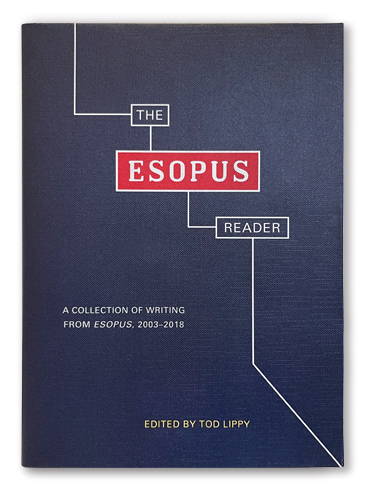
Originally published in Esopus 23 (2016); reprinted in The Esopus Reader (New York: Esopus Books, 2022), pp. 47–62

While visiting family during the holidays in 2015, I happened to glance over the shoulder of my 13-year-old nephew as he was engrossed in a video game on his computer, and I was immediately taken with what I saw on his display: a haunting winter landscape rendered in a distinctive, painterly way, dotted here and there with abandoned structures, snow-crusted pine trees, and the occasional bear, wolf, or deer. As he navigated through this eerily beautiful world, I asked, “Where are the enemy combatants?” He told me that there were none of these in The Long Dark, a remarkable first-person game that pits its users in a battle against only one foe: their own mortality. Players enter the game as the survivor of a plane crash in the frigid Canadian wilderness after a global geomagnetic disaster. They must count on their own ingenuity in order to survive, which means foraging for food and fuel, seeking shelter, monitoring constantly shifting weather conditions, and making use of whichever items (from crowbars to energy bars) they might happen to find along the way. The Long Dark represents the vision of Raphael van Lierop and his creative team at Hinterland, the Vancouver Island–based studio he founded in 2012 with the purpose of bringing this concept to life. I spoke with van Lierop in early 2016, and this interview, along with a series of visuals related to the game, appeared in Esopus 23 that spring.
Tod Lippy: How did you first get involved in gaming?
Raphael van Lierop: I’ve been playing games for 30 years, basically, but never had thought of it as a career option until I’d already been working for a while. I did an English lit degree, and I really didn’t have any firm career plans in mind. I’d always been into computers: My dad was a scientist, so I grew up around them and was always comfortable using them. I had one foot in the arts world and one foot in the technology world—in fact, I was paying my way through school by working at the university’s computer lab. When I was doing my honors thesis, my adviser said, “You’ve got to make a choice—do you want to mess around with computers, or do you want to become an academic and focus on literature? You can’t do both.” As soon as somebody says, “You can’t do that,” I immediately try to figure out how I’m going to do it.
What was your first job out of university?
Even before I’d finished my degree I went to work as a technical writer at Matrox, a graphics-hardware company in Montreal, which is still around. You hear a lot about 3D graphics hardware in the context of the film industry—especially where special effects are concerned—but the industry is really driven by games. At Matrox, I was embedded in their engineering team and surrounded by these hard-core computer scientists and hardware engineers.
There were companies Matrox worked with that were using its 3D hardware for video-game development, and that’s how I started learning about the game industry: “People actually get paid to make games—that’s crazy!” Technical writing was a great way to pay the bills, but it’s not very creative work. As I was exposed to more of these game projects, I started thinking, “Maybe this is something I should look into.”
I embarked on this two-year process where I spent every spare moment reading everything I could get my hands on about game development. I would pin down and ask questions of anybody in the industry who would talk to me. I was doing everything I could to figure out how to break in, because it was—and still is—an extremely competitive industry. And I wasn’t a programmer, not even really an artist. My “way in” turned out to be working on a project helping to North Americanize PlayStation 2 games that were coming to the original Xbox in 2000 or so. The Japanese developers would provide the literal translations—which of course would make no sense to a native English speaker—and I would turn them into something that a North American player could actually understand, something that would have a little bit of cultural nuance to it.
I was able to use that experience to get a job as a developer in Vancouver at Relic Entertainment. Back then, the Canadian game industry was really focused on Vancouver, and it was clear to me that if I wanted to break into this world I needed to “go West.” My girlfriend at the time—she’s now my wife—agreed to the move. I started as an assistant producer, basically the bottom rung of the production ladder—taking meeting minutes and ordering pizza for people—and over the years moved my way up to being a producer with my own team and my own projects. I got a chance to work with some fantastic people on some really good games. But I hit a wall—I was working in a creative field, but I wasn’t truly in a creative role that felt fulfilling to me. I wasn’t doing the designing or writing or lots of other things that in my heart I really wanted to do.
Around 2005 I had an opportunity to go work with a start-up developer, Radar, that was dealing with what is now called transmedia, which is basically coming up with intellectual property, or IP, that’s designed from the ground up to be used in multiple ways—games, film, TV, you name it. I did that for two years and worked on a bunch of cool projects, but then, right around the time of the credit crisis, the company went out of business. It was kind of a mixed blessing, because it forced me to figure out what I was going to do next, and I ended up getting a job at Ubisoft Montreal—one of the best studios in the world—as a narrative director on the video game Far Cry 3. So my wife and I moved back east, but it proved to be challenging for us this second time around because we had young kids and it was just really hard for us to integrate into the city as Anglophones, etc. etc. After a little while, we returned to Vancouver. I went back to Relic, where I worked on something called Space Marine, a console action game in the Warhammer 40,000 setting, which was a British tabletop game from the 1970s that has this strangely rabid following. Imagine heavy-metal album covers from the 1970s as an IP, and that’s kind of what it was. It’s very, very rich, and very deep and fascinating, but it’s some of the nerdiest sci-fi you can imagine.
It was interesting to try to translate it into an action-game experience, because it had always been a real-time strategy game. It was all about figuring out how to take an aesthetic that had existed only on paper—in novels and rule books and things like that—and put the player in the middle of that world, make them feel its texture: What does it sound and feel like to be this hulking warrior in this weird, sci-fi fantasy setting? So it was pretty cool from that perspective.
One thing about Space Marine, though, was that it was literally one of the most violent games ever made. I mean, its tagline is something like, “In the grim darkness of the far future there is only war,” and its sole premise is that there are all of these different alien races constantly at war with one another, trying to snuff each other out. So it’s very grim and dark and depressing in a lot of ways, since you have no chance of winning; you’re just prolonging the inevitable. I remember one evening when I was working on a build of the game at home after my kids were asleep, and my wife was kind of looking over my shoulder. She’s not a gamer or anything, and at first she made polite comments about it, but later that evening, she said to me, “You know, you talk a lot about how much you care about your industry and your medium, and how you want to push interactive entertainment forward in all of these meaningful ways, and how important storytelling and emotion are—and I don’t see any of you in that violent game.” And she was right: There was really nothing in the game that was an expression of my creative values. I think I found values in the IP that I cared about—like bringing that world alive in a way that would be truthful to fans’ expectations—but it didn’t at all feel like the kind of experience I would happily show my kids when they were older, or talk about with people in a meaningful way.
Was this the moment you decided to begin work on The Long Dark?
It was definitely a reaction to finishing that game. You go through this kind of postpartum depression. It’s such an intense process; you work on a game for two or three years, and when you’re in the middle of it, going 100 miles an hour, you lose all perspective—it feels like it’s the only thing that matters. And then it’s out, and it’s over and you don’t know what to do with yourself. These junctures are always really powerful times for reflection for people who make video games, and for me particularly. You have that existential what the hell am I doing with my life? kind of moment.
I realized I needed either to do something different—something more truthful to my experience and my sensibilities—or I needed to leave the industry. Ironically, at around that time, I had all of these amazing job offers on much better projects with much better teams than I had any right to expect, especially having just shipped this incredibly violent game. These were projects that a year or two earlier I would have killed to work on, and yet I didn’t feel excited about them at all. It helped me see that I was really ready for a change.
Right around that time I had lunch with my friend Jamie Chang, who runs a studio called Klei, whose games include Don’t Starve and others that have been really successful. We had worked together at Relic—he was a programmer—and as we were reflecting on our career paths, he said, “You know, the only difference between you and me is that you’ve been searching for this credibility that you think you need in order to do the thing you really want to do, whereas I just went into a part of the industry where that doesn’t matter. In the world of independent games, nobody gives a shit about the stuff you’ve worked on before.” It was an interesting moment for me, because I realized that my concern that I needed to work on all of these big, triple-A titles—gain all of these credits—before I could do my own thing was probably unfounded.
All of these things put me in a frame of mind to do something different, and this happened to coincide with my wife and I deciding that we were pretty much done with living in the city. She had grown up on Vancouver Island, and it had always been in the back of our minds that we would end up there, so we just decided to do it. At first I did a bunch of consulting work for game studios to pay my bills while I incubated the idea of The Long Dark in the background, for probably about a year, before things started to come together.
From what I understand, the development of The Long Dark is related directly to your founding of Hinterland Studio.
Hinterland Studio and The Long Dark are all wrapped up in my decision to no longer be a part of the mainstream industry. I didn’t want to make that kind of game. My wife and I didn’t want to be in the city; we wanted to raise our family in the “hinterlands.” Everything’s connected, right? So that’s how it all started. And we’re really lucky to have the Canada Media Fund, a government program created specifically to promote Canadian film, TV, and interactive industries, so we were able to get some money to build a prototype. It was a loan, essentially, but it allowed me to hire my first team members, and that’s when things really started.
How did you find collaborators?
Most of the team, then and now, are people with a story similar to mine: They either left the mainstream blockbuster industry for the reasons I did or they decided they wanted to live here. My initial hire was my technical director, Alan Lawrance, who had been at a studio called Volition for 16 years—he’d basically grown up there—and he had been involved in several really big franchises. He and his wife decided that they didn’t want to be tied down to a specific city for work, and he was senior enough to be able to work anywhere. So he reached out to me about Vancouver Island. Our original conversation had nothing to do with The Long Dark, which at that point nobody knew about. He was just interested in learning more about the island and our decision to move here. But as we continued to talk about why someone might choose to relocate here with a family, we discovered that we had lots of shared values around quality of life and the kinds of things we might want to create, and I realized he was exactly who I needed to get started with this. I pitched him on the idea of joining the project, and he agreed, and that was really the start.
For the first year we had a small team of four or five people. We built a prototype, we got it to a place where we felt we were ready to talk about it, and then we pitched it on Kickstarter to see if there might be any interest out there in playing a niche, artistic survival-experience game. We definitely got great feedback and lots of press attention, and people supported the idea really enthusiastically, so we started to think, “Maybe we’ve really got something here.”
You felt it was important to get this feedback before proceeding with development?
Well, we knew we were doing something outside of the mainstream—we never approached it from the standpoint of making a game within an existing genre. Our initial thought behind it was, “What’s the experience we want to have?” So the next step was to see if we could find people who were interested in that kind of experience too. I had no expectations whatsoever. I still feel like I somehow have to qualify that, to say to people, “You know, we started out with this really niche thing but somehow it managed to resonate with this substantial audience.” In the end it’s proven to be really popular, which probably just tells you how ready the gaming audience is to try something fresh.
Can you talk about how you came up with the concept for the game in the first place?
I’ve always been interested in the idea of wilderness survival as an experience. There weren’t really any games that were solely focused on that when I first started thinking about this. Back then, when you talked about survival games, you were talking about zombies. You were talking about “action survival,” not about what survival is at its core: making smart choices in very challenging scenarios, conserving your resources, keeping your wits about you.
It’s funny: We’ve ended up a part of a “survivalist” genre that kind of grew up around us when we were working on the game. There’s DayZ, Rust, and many other games that have come out over the past two or three years that form this genre that didn’t exist before. But I don’t think we approached it conceptually in that way. It was always more about making a game that explores this postdisaster, northern Canadian wilderness setting, and more specifically, that considers the notion of survival in the most essential sense: that of managing your overall “condition.” How cold, tired, thirsty, or hungry you are—those became the mechanics that drove the whole experience of wanting to look for more things, for needing to explore. That was really at the core of everything.
Were there any other games that you found to be influential to the development of The Long Dark?
A few games have really resonated with me throughout the years. One was Fallout 3, which I played so much when I was starting to think about doing my own thing. It struck me how compelling it was to just move through the world and uncover what felt like all of these artifacts from an abandoned place and time. For me, the combat of the game, and a lot of the mechanics, were almost secondary to that. I just enjoyed wandering. I remember when it first came out it had a “level cap,” which means that you grind through the mechanics and increase your character’s skill level until you max out and can’t get any more rewards for playing. Several months after the game came out they increased the level cap, but I didn’t even care. I’d already invested over 100 hours just exploring the world without getting any of the game-play rewards, which seemed really superficial to my experience. I was so happy to just wander around and was loving this feeling of being in this world and being able to see things on the horizon that were interesting to me and checking them out. You know, that whole psychology of urban exploration: “There’s a building over there that’s broken down, and I probably shouldn’t go into it, but I’m going to anyway, to see what I find.” And every time you go up to a locker or desk or whatever, you’re hopeful you’re going to find something that will help you survive a little bit longer. One of the most significant questions that came out of that for me was, could I make a game that was almost purely about that experience—that feeling. Strip away all the other stuff—take away combat, take away skills, take away mechanics—and just make it about the aesthetics and the emotion of exploring an abandoned space that generates that I just need to go a little bit further feeling. That was one of the major influences on the mechanics of The Long Dark.
A Ukrainian first-person-shooter game called Stalker inspired me too. We named one of our modes after it as a sort of homage. The game is set in a fictionalized post-Chernobyl exclusion zone, where these weird portals into other dimensions exist. And there are bounty hunters, called stalkers, who go and search for artifacts that appeared because of the disaster. When you enter this zone as a player, you encounter other stalkers and there’s conflict and that sort of thing.
Does it bear any relation to the Tarkovsky film of the same name?
Actually, both the game and Tarkovsky’s film are based on a Russian novel called Roadside Picnic, although the two offer obviously very different interpretations. But the game really struck me because it provided one of the most atmospheric experiences I’ve ever had as a player. The team behind it actually went to the Chernobyl site and took photos: They built their world based on the real world, so it has a feeling of intense verisimilitude.
Stalker and Fallout 3 inspired a lot of thinking about The Long Dark, which is meant to offer, more than anything else, an experience of being immersed in a world, and being allowed to soak up its atmosphere—the wind, the snow, what the structures look and feel like. And it’s something we try to push forward as we continue to develop the game—how to communicate more and more of that sense of place.
Despite what seems to be a trend in the mainstream gaming industry toward an increasingly photorealistic visual experience, the visuals in The Long Dark are much more stylized, even impressionistic. Can you talk a litte bit more about that choice?
The practical side is that an independent game really needs a look to help it stand out in the marketplace. The art direction of every game I’ve ever been involved with is always concerned with defining a style that is strong enough for someone to be able to identify the game from one screenshot. Another thing is, the photorealistic approach to graphics is very expensive. Making the content for it is very time-consuming—with a small team and a small budget, you can take your money only so far. So do you want to make a small, extremely detailed world, or do you want to have a broader, more stylized world? Creatively speaking, the challenge becomes how to make something simplistic look beautiful—almost like an abstraction. That becomes the style, and the fact that it’s simpler doesn’t detract from the experience but actually gives it a unique identity.
How are these visuals actually created? For instance, what was the process behind coming up with the cabin interior?
That’s actually the first interior we ever made in the game. For a long time we called it “the safe house.” It was the place where you start the game, and where you keep your gear, so it had to feel cozy and protected compared to everything else. Lots of times in games you’ll use concept art, but it’s only meant to be a visual inspiration to the team. Our goal with The Long Dark, though, was always to make the game look like it was moving concept art. So with this cabin, which was literally the only interior location we had in the early stages, we started with a piece of concept art that we iterated with an artist to get the right look—the right color combinations, the right lighting, the right position of all the different pieces of furniture—to communicate the vibe of the space. We worked with all of those bits and pieces to get the look exactly where we wanted it to be in 2D; then our goal was to recreate that as closely as possible in 3D. All the assets you see there—the chairs, the bed, the window, all the objects on the shelves—each one is a 3D object crafted by hand. The textures on everything you see in the game have all been hand-painted.
This is fairly unusual in this day and age, and it kind of goes back to your question about photorealism. Most games that are highly photorealistic will use photo references for texture. So they’ll take a picture of something and then they’ll map that directly into the game on the object itself, so it ends up with a texture that has been taken from the real world. So for, let’s say, a gravel road, you would go and take a whole bunch of photos of paved roads and then turn those into textures in 3D. But in our case, everything is painted by individual artists, which is part of what gives it its unique look. It’s very handcrafted in a way that a lot of games aren’t anymore.
To me, it inspires a confidence in the vision of the people behind the game, which in turn allows me to enter into it as a player in a more complete way.
Having worked on some large-scale, big-budget productions that were really pursuing high-end graphics, I feel like photorealism is not a particularly interesting challenge. I mentioned starting out my career in the graphics-card industry, which is driven by this belief that what people need to feel immersed in a world is for it to look like the real world. I don’t think that’s true—Pixar’s success, for instance, comes from their understanding that it’s more about style than realism. There are some fantastically beautiful games out there, many of which are extremely realistic, and that’s great, but I care more about creating an interesting experience people will become immersed in. And that has very little to do with what it actually looks like. It has a lot more to do with how it feels, which has to do with many other things beyond just what you see on-screen. For instance, the audio experience is in a lot of ways just as important as the visuals, if not more so. I think that’s the reason we’ve put so much effort into the soundscapes in the game.
How are these soundscapes constructed?
Some of our audio is taken from libraries, but the majority of it is stuff that we recorded ourselves, either in Foley sessions or out in the world. For instance, a lot of our wind sounds were recorded in the wintertime on a frozen lake out near Edmonton. We have a very sophisticated audio system for this scale of game; there is a lot of detail in the soundscape. For example, the sounds that you hear when you move around the world change depending on what you have in your inventory: If I’m carrying a bunch of water with me, I’ll hear that water sloshing around when I’m walking through the world. If I’ve got a rifle slung over my shoulder and I’m wearing a nylon ski jacket, I’ll hear different sounds when I move than when I’m wearing a wool sweater. These are the kinds of details that probably only my audio director, Glenn Jamison, would ever notice—like how the sound of snow crunching under your feet changes based on the kind of footwear you have. It’s really subtle stuff, but I do believe that, as an overall experience, it definitely reinforces that feeling of presence in the world. And even if only one out of every hundred people notices, it pays off.
How did you go about assembling The Long Dark’s creative team over the past several years?
When we started, I knew I wasn’t going to be able to recruit the people I needed locally—I was really the only one here. [Laughs.] At that point, I didn’t want to have a very big team anyway, and what really mattered was finding talented people who were motivated by the same things I was. I believed at the time, and it’s been proven true since, that there were people out there who wanted to make great games but didn’t necessarily want to live in the city or work in the established studio system. Over time, the team has grown—we’re over 20 people now—and more than half work out of the studio on Vancouver Island.
I’ve never asked anyone to move here—I’ve been really careful about that, because I remember moving my family around a lot for work, and it didn’t always work out, which can be a real drag. But the people who have moved here did so in large part for quality-of-life reasons. My user-interface artist, Warren Heise—who was at BioWare for more than 10 years working on the game Dragon Age—is hugely into the outdoors and a big hiker, and he just wanted to be on an island where there are mountains and trails. And, actually, he fell in love with the game from that perspective, as an outdoors person.
Where are the other team members located, and how does the creative process work?
The rest of us are distributed between Vancouver, Edmonton, and the United States. We work mainly using Skype or Basecamp, and a little bit of email, and we’ve managed to create a set of processes using tools that allow us to work effectively even though we’re not all together. The challenges have become more pronounced as we’ve grown: How do you build a team culture when half the team is here and the other half is spread all over the place? How do you make sure the people who aren’t here feel fully incorporated into the process? However successful we end up being, I’m pretty sure there will always be a certain component of the team that is not here in the studio. The most important thing is working with really, really great people, and I would never want to say no to someone great just because they live in a different city.
How important was research for The Long Dark, whether related to wilderness survival or just certain aspects of the human body and its limits?
Years ago, I worked on a World War II strategy game called Company of Heroes. World War II history fans are some of the pickiest players you’ll ever meet. So we had to do a ton of research for every aspect of the game, from the color and cut of uniforms to the design of weapons and vehicles. What that project taught me was that you have to embrace either realism or authenticity—they’re not the same thing. What a game needs, in my view, is authenticity; realism can limit the creation of mechanics designed to promote and enhance a compelling player experience.
A good example is the way we chose to deal with starvation in The Long Dark. In reality, starvation is not a concern on a really short-term timescale. You could survive for weeks without eating. But that timescale is not interesting in the context of a game, right? Starvation and food management need to become a problem you care about over the 10 or 20 hours of a typical game-play cycle. So we tweak it to be relevant to the experience we’ve created. We do have people in our community who are really bothered by that. And I love that they approach it from that perspective, but we always have to remind them that we’ll support realism where it serves the player experience; however, when it contradicts that experience we’ll break those rules. The Long Dark is not about creating a truly realistic survival experience, and the truth is that 99.9 percent of our players never have been, and never will be, in such a scenario.
I think the sense of realism comes into play in the level of detail we try to reach by simulating certain choices. So in addition to having to worry about how cold, tired, or hungry you are, we put these little moments in there where you have to make very specific choices. “Oh shit, I’m stuck in this little house in the middle of the blizzard and I don’t want to go outside to get snow to melt for drinking water because there are wolves out there. I’m going to take water out of the toilet, make it potable by boiling it, and drink that instead.” These are the kinds of things that the mechanics of the game support that make it feel realistic even though under the hood it’s just a bunch of numbers. It’s playing on the sense of realism but being very selective about the kinds of choices you have to make in a survival situation.
“Independent” is a label that can be applied at this point to virtually any creative enterprise, from filmmaking to music. Could you possibly define it in terms of Hinterland’s relationship to the larger world of game developing and publishing?
We’re both a developer and a publisher, because we self-publish. We are not owned by anyone else. We fund all of our work, we control our IP, and we own all of our content, so we’re not beholden to anyone but our community. There’s a lot of discussion about “indie” games in our industry, and it feels a bit like a meaningless label to me. We’re an independent studio creating an artistic experience that we wouldn’t be able to make if we were owned or funded by someone else. I think that’s the only way in which being “independent” really matters: Do you ultimately call the shots?
You cited some feedback you’d received from players about the starvation issue; I was wondering if you could discuss the role community feedback plays for you and the studio. Do you feel this type of response has a different impact in the independent arena than it does in the mainstream game industry?
The community is so much more important to what we do here than it is for a publisher-run studio or a large-scale production house. Especially because of how we’re funded: We’re in multiple early-access-style programs, which essentially means we have an incomplete version of the game that’s live right now that you can buy—kind of like how Minecraft was originally funded. I think we’re one of the only games, if not the only one, that is on all three early access platforms: Steam on PC, which is kind of like the iTunes of games, Game Preview on Xbox One, and GOG [Good Old Games].
Our game and our company have grown up around this development model, and it’s one in which we iterate really, really often, and publicly. We take community feedback in all forms—what players have to say, what we see in the metrics and analytics—and we use this feedback to validate decisions we’ve made. We’re quite careful about the way we interact with our community and the way we talk about how it’s involved with the game, because there are other projects that are in this early access model that have lost their way. You can imagine: We have 675,000 players now. You don’t hear from all of them, but you hear from a lot of them. [Laughs.] How do you make one game satisfying for a cross-section of people from all over the world—we’ve been purchased in over 150 countries, and the game is played in over 40 languages—working from entirely different contexts, all looking for different things?
What often happens is that developers find themselves being influenced by a vocal minority, and then the project gets pulled in different directions. Then other people react badly to that, and suddenly it seems as if there is no vision behind the project. So we’ve been always really careful to say to our community, “This is our game, and we have a clear vision of where it’s going, but we want you guys to be a part of the process of vetting the decisions we’re making. We also want to hear what you think about mechanics, about tuning, and we want you to tell us what you like and don’t like, and we’ll use all of this as another data point for our decision making.”
But we’re never going to put something in the game or change a mechanic just because we have a bunch of people complaining about it. We’re very, very fortunate to have a community that’s really open to that. We get a lot of support from them, and we know we have a huge responsibility to them, and I think that’s partly why it works so well: They give us their trust, but we work twice as hard to earn it. As long as we stay true to our vision and produce a high-quality experience, they will continue to trust us and support our exploration in making the game, which in many ways is analogous to the experience of the game itself: You don’t always know where you’re going to end up.
You will be launching a new mode for The Long Dark this year; can you talk about that a bit?
We’re preparing the first installment of our story mode, or what we call our narrative experience. When we originally conceived of the game, and when we pitched it on Kickstarter, it was meant to be a narrative experience more than a sandbox experience. And we decided to bring the game to early access platforms so we could use the community feedback to help tune and polish and tighten the core mechanics that the story mode would then be layered on top of, because nobody wants to play-test a half-completed story. We were going to take three or four months to gather the data, finish up the story mode, and then launch that first installment. What we didn’t anticipate was that the game would blow up.
That reaction has convinced us to invest a lot more of our time and resources in creating an experience that we are passionate about, and we really want it to be excellent. You know, I’ve been making games for 15 years, and I’ve seen, and worked on, a lot of projects that were good, but I feel that we have something now that is very special and quite rare—it’s connecting with people in ways that we couldn’t have anticipated, and when we do launch this thing we want it to be as groundbreaking as it can possibly be. Because of this success with early access, we have the resources to continue developing the game and don’t have to push it out until we’re ready. We’ve said that we’re going to launch our first episode next spring, and that’s what we’re focused on right now.
Can you offer any details?
The narrative that will be layered on top of the core mechanics will include other survivors, two playable characters, and a whole storyline. And that’s just the beginning. What we hope to be able to do is a whole year of seasons. Season 2 would take place in the spring, so that it would be an entirely different environment with a different game-play focus, and we’ll advance the narrative along with it. The grand vision for the game is for players to experience a full year of The Long Dark: what was it like to live the year after the lights went out, the first year of the “quiet apocalypse.”
And we have aspirations beyond that. We’ve had a lot of interest in the IP from people outside of games who would like to work with us on things like films and TV series. We’re trying, though, to be really disciplined and not get too distracted. I’ve seen how much the film business always seems like such a big draw for game developers, and I don’t really know why that is. I think maybe it comes from a lack of confidence in our medium—maybe we don’t feel it is as respected as film is, and so we’re always looking to the film industry for validation.
I love film, but I think we can offer a level of experience you can’t have in a film. Game design is a more challenging medium, and I don’t think we’ve even hit our stride yet as to how far we can push it. But I do think film is an exciting way to reach more people. And having worked in the transmedia space, I really appreciate the fact that when I really, really love a world, I want to watch it on TV and read books and articles about it and discuss it with my friends, and I want to get wrapped up in the fiction and know about the characters and speculate on story and plot threads—I want to make it a part of my life, you know? So it would be great to reach people whose entry point may not be the game. It might be a novel, or a web show, or who knows. Hopefully there’s something compelling enough beyond the game we’ve created in this wintry northern Canadian landscape, something about the aesthetics, the theme, the setup, that allows us to have this cohesive IP that can be expressed through all of these different media by playing to the strength of each. Once you create something you’re really excited about, you just want to share it with as many people as you can.
Why do you think people want to play a game that essentially forces them to confront their own mortality?
It touches on a few different things. Blockbuster games have become similar to big-budget superhero films: really formulaic, made with the sole goal of getting as many people as possible to see them. Games have become way too easy; they’re more about being taken on an amusement-park ride that involves little or no threat to your success than they are about offering an experience that players can in some way drive, or be truly challenged by. So in the last five years there’s been a little bit of a push in the independent-game space to bring some challenge back to players. That’s one reason our game resonates with so many people, because there’s this permadeath aspect to it that makes your choices feel like they have a lot more meaning. When you die, you lose everything, and you have to start again from scratch, which adds some weight to those decisions.
But more than that, I think people really connect with the theme of vulnerability. One thing those big action games have become great at is delivering a fantasy of being a powerful warrior who can overcome all odds. In a way, that’s what games have always been, right? One of the things about The Long Dark is that it’s the exact opposite of that. It’s putting you into a scenario where you know you’re going to fail; you know you’re going to die. How can you prolong that and make good choices that will sustain you as long as possible? Can you face that mortality? Can you come to terms with the fact that you’re a tiny speck in this vast majestic nature that’s completely neutral about whether you live or die?
Talk about realism!
[Laughs.] People often talk about The Long Dark as if it’s a horror game. And I always find that really interesting, because I don’t think about it in those terms at all. But some people feel as uncomfortable and intimidated by it as they would a more traditional survivalist or horror game, because they feel that fear. Other people find it poetic. They love walking through the world and listening to the wind and looking at the sunset: “I know that eventually I’m going to die, but while I’m here, I’m going to soak it up.” But I do think it comes down to that feeling of snatching one more day from the jaws of death, even though you know you’re going to eventually fail. It’s kind of this affirmation of life, you know? You can look at it either as fatalism or as giving you a reason to fight to live. You either roll over and die, or you fight. And the game is asking you to fight. Not with guns, but with choices, with decisions, and by not giving up.