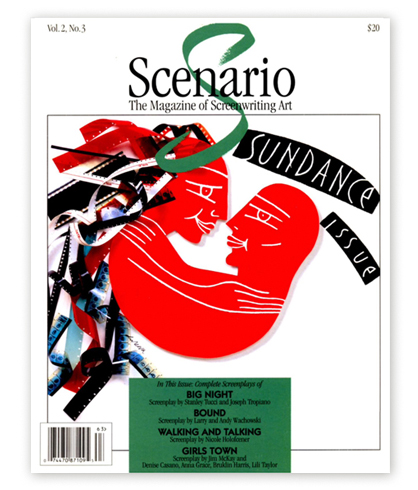
Originally published in Scenario: The Magazine of Screenwriting Art, Vol. 2, No. 3 (Fall 1996), pp. 92–95, 187–190

Tod Lippy: Could you talk about how you both got involved in screenwriting?
Larry Wachowski: Well, we wrote comic books, and then we read Roger Corman’s biography and decided to write a low-budget horror movie that we would make ourselves. We wrote a script about eating the rich, which we decided was too expensive to make, so we showed it to some of the agents who accept unsolicited manuscripts, and every agent who read it wanted to represent us. They all said, “This is really dark. Can you write something more commercial?” And so we wrote Assassins. Dino De Laurentiis bought it and then he sold it to Warner Bros. for lots of money. Then we did a rewrite for one of Dino’s movies, and at the same time wrote The Matrix.
Was Unforgettable the rewrite for De Laurentiis?
LW: Yeah.
The shooting script reads “Screenplay by Bill Geddie.”
LW: That script is not our script. The reason our names got attached to that is that we wrote a draft that John Dahl read, and he attached himself to the project because of that script, but then he returned to an earlier draft by Bill Geddie.
I read somewhere that you guys were always intending to make Bound as an independent film. Is that true?
LW: Well, it’s sort of a version of the truth. We wrote it and showed it to some people at a major studio who said, “Oh, we love it! Change Corky to a man and we’ll buy it!” [Laughs.] From those kinds of experiences we pretty much realized it had to be an independent film.
Andy Wachowski: We figured we could get more control that way as well. Had we gone to Warner Bros. with it, we’d probably still be in development. Still waiting for some big actress to say “yes.”
How did you come up with the essential idea of two lesbians taking on the mob?
LW: We wanted to write a well-contained, suspense/film-noir kind of movie, where you can use a lot of humor and can get away with a lot of sexiness and stylishness. The core idea of the screenplay is based on the character of Violet. The idea of a woman you see on the street and make a host of assumptions about that were all dead wrong. We wanted to play with what you see on the surface and the truth that lies beneath. We tried to do that with all the characters.
AW: We also thought—and our wives felt the same—that it would be great to do a movie where the women were the hero and got away, which almost never happens in this type of film.
This is a complex, plot-heavy film; after you’d come up with the main characters, did you formulate the basic mechanics of the action before adding many of the secondary characters, or vice versa?
AW: Well, you start with the basic film-noir triangle: the mistress, the main mob character, and the drifter. We just didn’t want our drifter character to be a man, because then it would be a crutch for the woman.
The film draws a lot of power from its visual impact; since you both knew you were going to be directing this, did you find yourselves coming up with scenes or situations that hinged on visual motifs?
LW: I don’t know how it all came about; it’s hard to explain. I’m not exactly sure how it works; we just sort of thought it would work itself out. We had the idea, we knew what it would look like, and we knew it was going to be funny, and scary. We wanted it to be hyperstylized as far as camerawork was concerned—that’s why we got Bill Pope, the cinematographer who’d shot Army of Darkness. Exactly how it all works is difficult to articulate.
Susie Bright, a.k.a. Susie Sexpert, whose books deal with both lesbianism and bisexuality, is listed as a “technical consultant” on the film. Did you depend on her to get a better sense of these characters’ backgrounds?
LW: That whole thing with Susie actually happened afterwards. We really liked her books. After we’d written the script, we sent it to her and asked if she wanted to do a cameo. She said, “Sure.”
AW: We approached the writing of a script with two gay characters the same way we would write a script with two heterosexual characters.
LW: Corky essentially wears everything outside; Violet you need to got get to know for a while before you can figure her out. Once we into the research, the idea of butch/femme struck us as being another form of dualism, which is something we both believe in: yin-yang, exchange of energy. They’re just reflections of each other and a part of a whole. So they’re pretty much the same character, even though on the surface they seem very different. Corky’s more emotional than Violet, and Violet is very tough, despite outward appearances, so once we had that...
AW: We actually tried to expand on that in the actual set design: we had two apartments, and Violet’s was the very masculine one—lots of grays and blacks, very stylish, sort of barren—while Corky’s was more feminine.
What kind of research did you do?
LW: Well, we read a lot of lesbian novels and nonfiction books, by people like Susie. Dorothy Allison’s Trash was a really cool book that we liked a lot, and we also looked at some stuff by Pat Califia. We spent a lot of time in gay bookstores—
AW: Yeah, people thought we were a couple. It was right around Bulls time, and we were both wearing a lot of Bulls paraphernalia and one guy complimented us on our Bulls paraphernalia.
What about the whole Mafia angle? Did that require any research?
LW: We’re from Chicago, that’s all we needed. [Laughs.]
The male characters are pretty unsympathetic—
LW: You mean you didn’t like Ceasar? [Laughs.]
AW: It’s funny, some guys feel really sorry for Ceasar.
LW: All of our friends think it’s a tragedy: [Laughs.] “Poor Ceasar.” We wanted Corky and Violet to be really cool, the way men always are cool in this kind of film, and conversely, we wrote Ceasar as the most hysterical figure—the most “feminine,” in that he’s always crying, spitting everything out, up and down, emotional. That’s where a lot of that came from.
This screenplay is full of twists and turns: did you need some sort of an outline to keep things humming?
LW: We’d plot it together to speed things up—come up with the basic plot points, sequences—and then we’d each write certain scenes and then give them to each other to rewrite. We can be really brutal to each other.
You tend to write fairly terse prose reminiscent of crime writers like James M. Cain; is that reflective of the content, or just the way you always write?
AW: A script has to be easy to read. The images should come freely, you shouldn’t have to struggle with a mental picture.
How long did it take you to write a first draft?
LW: This was actually a very hard script to write. Structurally, it was very strange. It bothers people, because it has this whole prelude, basically, where they meet and fall for each other. It’s common for a film noir to have that kind of prelude, but it’s usually five to ten minutes long, as opposed to almost a half hour. But we were convinced that once we got into the actual plot—the caper—we didn’t want to slow down and have those [sings] “Getting to Know You” scenes. We wanted to have the characters and their relationship completely set up. So we kept reworking the structure and reworking the structure and we finally decided we needed it to be there.
Was this self-censorship, or feedback from other people?
LW: It was pretty much ourselves. You know, everyone would read the script and say, “God, l couldn’t put it down.” And then they’d start talking about it: “Well, the beginning’s slow.” And it’s true, the beginning is slow, compared to the rest of the movie, but you can’t sustain that ratcheting effect—keeping the thing continually escalating—if you didn’t do it that way. We wanted the beginning to be almost European—slow-paced scenes with this sort of circuitous dialogue, like the coffee scene, before the pace quickens and things start to go wrong.
How did you come up with the rich variety of difficulties the two of them have to contend with as their plans start to unravel?
LW: We always wanted to make it so that whenever the audience had any inkling of what might happen next, we would have already thought of it and it would be happening onscreen. You know, like, “Oh, come on, there were all those gunshots. Where are the police?” and then, boom, there they are, ringing the buzzer from downstairs.
Well, that moves along even quicker in the film than it does in the script, because here you have a scene in between where Corky actually calls the police from the apartment next door.
AW: We had to take that one out because we shot it badly. [Both laugh.] Besides, the action is so compelling in the other room that you don’t want to leave it.
LW: I mean, the whole idea of the script—what we really wanted to do as writer/directors—is to make a movie where you don’t know what’s going to happen next. So many movies these days—and we go to just about every movie made—you just get so tired and bored by everything. It’s obvious, you see every tip-off, every setup. So we thought we’d just go farther than you possibly think we could go, we’ll go so far we’re gonna freak everybody out. Which was the same with the violence. We fought heavily over the scene with the finger being cut off—the finger had to hit the floor.
Who was resisting that?
LW: Everybody.
AW: “It’s gratuitous,” “Violence is so much better when it’s off-screen,” etc. There’s actually a great story about this. We showed the film to some friends of ours in Chicago, and our parents invited all of their friends, so we had a lot of “senior citizens.” We had one walkout—this lady left during the scene in which Ceasar pulls the clippers out of the drawer and walks into the bedroom, because she knew we were going to show Violet’s fingers being cut off. Which is the point: you have to see the finger hit the floor. That way, the audience is off-balance for the rest of the movie. The cop scene is meant to be funny, but everybody is so on edge, so certain that Ceasar’s gonna blow them away, that they don’t laugh; they just sit there holding their breath until the cops leave, and then there’s this sort of collective sigh.
How did you come up with that scene with the cops?
LW: Oh, you know, dumb cops, trying to have fun with cops…
AW: Trying to equal the balance of all of “copaganda” that’s out there. Whenever anybody’s ripped anything off in my neighborhood, the only things the cops say is, “You wanna file a report?”
LW: The only thing we really rewrote seriously was that scene near the end when Violet kills Ceasar. We’d originally had it so that Ceasar dives for the gun and she kills him only because he’s about to shoot her, but we were a little bit uncomfortable about that. I mean, by this point she’s given him multiple opportunities to give up and let her walk away, but he’s not going to do that: he’s given her no choice. So we decided to let her have that speech, and then blow him away.
AW: “It’s time to take out the trash.” [Both laugh.]
LW: It was funny, that day on the set we’d been there for a while, reworking it, and Joe Pantoliano [Ceasar] showed up and was like, “Guys, guys, I gotta say, I love this script—I love everything you guys have written—but I’m just not completely convinced about this ending.” We both just said, “Don’t worry,” and handed him the revise.
That the only major revision?
LW: That’s the only big one. Corky and Ceasar were originally supposed to fight in the paint, and logistically, for a low-budget movie, it was just too hard to do.
I’ve read that De Laurentiis loved the lesbian angle; once he had committed to financing Bound, did he have any other concerns or suggestions regarding the screenplay?
LW: Yeah, he looked at it and wanted some changes, and we weren’t completely satisfied, either, so we did another draft.
What kind of changes was he looking for?
LW: You know, just more old-fashioned story sensibility. He was worried about the fact that the structure was slightly strange, the fact that there was a lot of dialogue, that kind of thing.
AW: The killing of Shelly—
LW: Oh, yeah, we loved the fact that you never actually saw what happened to Shelly; you just see this big bloody pile of money. Dino was like [Italian accent] “This is not theater, this is cinema. You must show the killing of Shelly; you will go to flashbacks.” [Both laugh.]
What about casting? Did you write any of this with the leads who eventually played in it in mind?
LW: No, we’re bad at that. I don’t know how people do it. It’s a skill that a lot of people out here have, but we just can’t.
How did you manage to get Gina Gershon and Jennifer Tilly involved?
AW: It’s kind of a miracle.
LW: It was hard to cast. A lot of people were afraid of it—managers and agents would look at the script and discourage their clients from reading for it.
AW: Sometimes actresses were scheduled to read for one or the other part and we’d be sitting there waiting for them to arrive and they’d never show up. Then we’d call the agent and he’d say, “Oh, she’s not coming.” We could imagine the actress reading the script on the way over, getting to the sex scene and pitching the script out the sunroof.
LW: Jennifer was the first person who came in and read. She wanted to be Corky.
AW: It was so bizarre. We’d never heard anybody read our dialogue before, and there she was, with that shaky voice, reading Corky. She finished, and there was this overwhelming, cathedral-like silence, and then she said, “Would you like me to try it another way?” [Laughs.] And she did a really good reading, but it was just so different from what we had imagined that character being like.
How did you convince her to play Violet instead?
LW: It was a two-month, three-month process. We’d lost somebody we thought was going to do it, and we’d convinced Gina to go from playing Corky to playing Violet. And then Jennifer was nominated for a best-supporting-actress Oscar for Bullets Over Broadway and suddenly everybody was like, “What about Jennifer Tilly?!” What was great about both Jennifer and Gina was that they both had elements of each character; Gina can be very feminine, glamorous and girlie, and Jennifer can be really tough, but she was just so much like Violet in terms of not having that kind of persona. So anyway, Jennifer was filming this movie in Canada—and this was our last shot; we’d decided that if she said “no” we were going back to Chicago and never writing another movie for women again—
AW: Jennifer didn’t want us to come up there unless we were open-minded about her playing Corky; in the meantime we’d convinced Gina to be Corky. So we go up there with Gina, and Gina starts talking about how Corky is going to be a great part for her, and Jennifer is just sort of seething—we’re like, “Okay, this is a disaster.” So we get on the plane and come home, only to find out that Jennifer has said “yes” to playing Violet. We later asked her why she decided to play it, and she said, “I have no idea.”
What about Joe Pantoliano?
LW: Actually, Jennifer and Gina, especially, lobbied for him, and he drove in to read for us, and we were both like, “Okay, he’s good.” On the first day of shooting, we shot the scene where he trashes Johnnie’s apartment, and he came onto the set and started doing push-ups, working himself into a frenzy, and we were like—
AW: We were a little worried beforehand, because during rehearsal he’d just sort of go through the motions—he has this philosophy about not wanting to play something over and over and lose the energy for it. But once we started shooting, he was amazing.
Was this shot in Chicago?
LW: No, it was shot in L.A.
And a set was constructed for all the interiors?
LW: Yeah, we drew out rough approximations as to where everything should generally be—like the bedrooms back-to-back, that kind of thing. We wanted the sense that the two apartments were woven together: it had been written that way, with all the references to pipes and plumbing and phone lines, and that one shot where we go over the wall when Corky and Violet are on the phone together. Anyway, we gave the rough approximations to Eve Cauley, the production designer, and she drew up the lines on the floor of the studio, and we all went, “Wow. It’s kind of small.” So we just sort of multiplied the size of everything. She did a great job.
How did you two split directorial duties on the set?
AW: We each only had to do half as much as a real director.
LW: He had ideas, I had ideas. One of us would go off with one actor to talk about a scene, while the other talked to somebody else. Film is such a collaborative medium, it makes sense to have two directors.
AW: You’re collaborating with your DP, your set designer and everybody else already.
LW: It’s great—especially if you’ve also written it together.
This was the first feature film either of you had directed. Was that at all daunting?
AW: Comic books are a pretty visual medium. They’re like films, in a way: you’re doing storyboards, that kind of thing.
Did you draw as well as write comics?
AW: No, we just wrote them. But it was similar, “directing” your artist.
How long was your shooting schedule?
LW: Thirty-nine days. It was hard. Doing a movie that’s as stylish as this one was meant to be, you had to know exactly how you were going to shoot every shot. I mean, every day we’d start with a shot list of 20, and by the end of the day we’d be down to 12—
AW: Or 10...
Who were you thinking about as precedents for this kind of film as you were shooting?
LW: Those other brothers—the Coens—and Sam Raimi. James Cameron is great. We are heavily influenced by Billy Wilder.
How did you come up with the first seduction scene with Violet and Corky?
LW: Jennifer and Gina did it really well.
AW: It was our Penthouse letter: “I never thought these letters were true until I had my experience with the repairwoman...”
LW: One of the main ideas behind the erotic element of their relationship was something we picked up in one of Susie Bright’s books, in which she says, “We also have insistent, probing sex organs; we just call them hands.” So when we read that, we were like, “Yeah! We’ll eroticize hands.”
AW: It kinda starts in the coffee scene, when Violet’s talking about her father’s hands.
Jennifer Tilly plays it a little differently than the directions in this script indicate: you have Violet “squealing” and hugging Corky when she finds the earring in the drain.
LW: That was a rehearsal thing. She wanted to do it a little slower, which worked beautifully.
AW: She also came up with something else there that was great. You can’t really tell in the film, but later on in that scene, she looks at Corky and then just sort of tosses the earring onto the bar.
Sound plays an extremely important part in this film’s effect. Was that all done in postproduction?
LW: We knew the sound was going to be as stylistically important as the visuals.
I can still recall the sound the money-counting machine makes in the money-laundering scene.
LW: There are dozens of sound effects in that scene. It was an important image in the script. It’s based on the joke of a mob launderer having to wash and iron a bag of bloody money. It was also a chance to play more with the masculine/feminine thing.
In the script, you even go so far as to have Ceasar applying nail polish in preparation for Gino’s visit.
UV: We shot that, too, but it was another casualty of pacing.
How long was your first assembly?
AW: Two hours and 20 minutes.
LW: Just about every scene in the script was shot, and each had a series of flourishes around it, so we just kept trimming and trimming.
Let’s talk about a few things in this draft that were either cut or not shot in the first place. There’s a classic pickup line of Corky’s in the bar, when she tells her prospective companion that her “clothes would look great on her bedroom floor.”
LW: That bar scene was shot on our first day as directors. It wasn’t very good. [Laughs.]
AW: It’s also one of the most unvisual parts of the script: “INT. BAR.” There wasn’t a single thing we could grab onto.
What about the addition of Corky playing a Jew’s harp? That isn’t in this version of the script at all.
LW: That was all Gina. She plays it.
AW: She said, “I want to do something.” And we said, “Like what?” “Well, I’ve got this Jew’s harp; can I play it?” “Sure, why not.” It was a funny sort of cliche, and also, it looks Iike...you know what. And it was another thing we could play with sound on. One thing we started to do with a lot of the sound was to pre-echo things. It would really suck you into it.
Most of the visual stuff—the phone cord, the tumbler of Scotch—you’ve incorporated into the script. But there’s one great image, in which the camera glides behind a wall of glass bricks, multiplying Ceasar’s image while he’s making a drink as he prepares to confront Johnnie, that wasn’t in the screenplay at all. How did you come up with that?
AW: Somebody on the set was just goofing around, putting his face up to the wall, and we were like, “Hey, that’s cool! That’s Ceasar, that’s his frame of mind right now. Twenty Ceasars trying to figure out what to do next.”
There’s a big cut near the beginning of the film, in the scene following the sex, when Corky tells Violet how she first became involved in her “life of crime.” It goes a long way toward establishing their attraction to one another, and makes it easier to believe they’re really into each other. Was that shot?
LW: Yeah. It was so much dialogue in a row. On paper, it worked pretty well. But on film—
AW: The scene worked well—it was shot from their backs—she’s just revealing a sliver of herself—
LW: We liked it a lot, and we wanted to keep it in, but every single person we showed it to felt the same about the first part: “Boy, once you get to the heist it really takes off.” And we were like, “Yeah, that’s the idea. But you have to establish the fact that these are human beings first.” It was hard to give up, because it references itself several other times in the script.
Right. At one point, when Violet is trying to convince Corky to help her scam Ceasar, she talks again about the roll of quarters dropping—
LW: That was a great payoff line. A great setup to the whole heist.
AW: At some point it gets really petty—when people are talking about two minutes in the whole movie, it’s really brutal.
Do you miss that now?
LW: Well...no, not really. I mean, it was fun, clever dialogue, and I liked getting the opportunity to know Corky a little better.
I think its absence tends to amp up the suspense as to whether or not they’re going to be able to count on each other in the end, because you’re a little less sure of the depth of feeling between them.
AW: That’s our surprise ending.
LW: Everybody expects Violet to screw her, because that’s what audiences are programmed to think: she’s the femme fatale, and the femme fatale always does that. Again, the whole issue of surfaces. It all comes down to the line, “You can’t believe what you see, but you can believe what you feel.”
There’s a bit more cut out of the scene in which Corky and Violet go to the bar while Shelly’s being tortured. First of all, the beginning of the scene has disappeared, where Corky has to deal with the stares of the men at the bar counter.
AW: Well, you get into these angles that you’re trying to draw the audience into, and you don’t want them to get distracted by basically superfluous action.
LW: When you’re reading the text, it helps to keep you aware of the environment, the room—the context—but when you have an actor saying it, being lit a certain way, with music in the background, it just gets too busy. Those kind of things are really just mood tools in the text. You wouldn’t write it any differently, even now, because in the script it’s necessary.
Also in that scene, Violet talks a bit more about her understanding of both the mob and men in general: their love of violence, etc. What happened to that? It gave us a sense of how perceptive she is.
LW: All shot, all well-acted. Again, pacing—deeds, not words. You get it without her having to say it. Although we miss the line about Mickey being good at violence because he doesn’t like it.
Was Sundance the first public screening for the film?
LW: Yeah. We showed it to them early on, and they really liked it, but they didn’t want to show it in competition, so they made it a premiere.
How was the reaction there? Did you get to attend all the screenings?
LW: No. We went to one. It makes us very nervous—not the showing of the movie, but asking questions afterward, all of that.
AW: Also, we’d gotten a really terrible review in Variety the day of the screening we went to. So that was kind of weird; there was this sort of hesitance among the crowd at the beginning. But they loved it.
More generally, I’d like to talk about a theme I’ve noticed you guys seem to have an interest in, judging from both this film and Assassins. But first of all, I know that that script was rewritten after you both sold it, and I’m wondering how you feel about the rewrite.
LW: Rewrite? That’s a politically correct way of putting it. When we read the shooting script, we asked to take our names off of it. That was, like, our first sale, and no one could believe we would want to do such a thing—“You’re not supposed to take your names off of it!”
AW: Everybody kept saying, “Just wait until you see it; it’ll seem so much better.”
LW: So we waited. They sent us a tape of the final cut, which was as bad as we imagined it to be, and we asked again to have our name taken off.
AW: Joel Silver [the film’s producer] said, “Guys, guys—I can’t let you do that.”
LW: And then we went through this battle where we discovered that, if you’re paid over a certain amount for a script, you actually don’t have the right to remove your name from the credits.
That film concerns two characters who are involved in something essentially illicit that they “want out of”—lines Julianne Moore’s character in that film actually says, like Violet here—and who have to depend on each other—establish a trust—to do so.
LW: It had a lot of similar elements to Bound, but the basic concept of Assassins was based on the metaphor of chess—the lead character is stuck in this unwinnable chess game which he nevertheless keeps playing. He’s basically living in this alternate world, which informs his morality, everything. So he isn’t actually killing people, he’s just taking chess pieces. The concept was in order to get out of that alternate world—become a human being again—he would have to put his life into this other character’s hands.
AW: It wasn’t until we met Donner and heard his response to the script that we knew we were in trouble. He wanted this whole Cold War plot.
You’ve now finished this independent film, where you essentially—as both writers and directors—had creative control over the project. Your next film, The Matrix, is going to be produced by a studio—are you worried about having similar problems? Or do you feel because you’re directing that you’ll be able to retain that control?
LW: Oh, you’ve got to direct. I mean, Dino took a big chance with us for Bound, and we appreciated that chance, and we wanted to do a commercial, salable, film. It’s the same thing, really, as going into the studio world—
AW: It’s a business; you’ve got to be a businessman. These guys want to protect their investment, and the way you do that is to try and work within their parameters.
Some people might argue those kind of limitations are conducive to the most imaginative, creative work.
LW: Well, that’s true to a certain extent. I really can’t say because I’ve never been in a situation where somebody has said, “Go do whatever you want to do.” But it wouldn’t really matter, because I’m naturally limited by Andy all the time anyway... [Both laugh.]
(The interview with Larry and Andy Wachowski was conducted by Tod Lippy at the Wachowskis’ production office in Los Angeles.)