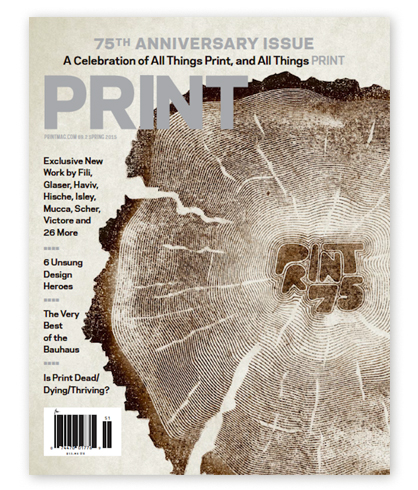
Originally published in Print (Spring 2015), pp. 65–69

During a day and age when e-book sales are on the rise, most of us get our news from digital outlets and few of us have—or want—the additional space needed to store print media, small and large print publishers have all had to do more hustling to stay ahead of the game. Here, two industry professionals discuss how the tech world has changed the print world, and vice versa, addressing whether or not everything is in fact fit to print.
Peter Cho is vice president of design at Inkling, a company that creates digital products and solutions for mobile learning, employee training, sales training and publishing, offering tools for content creation and distribution. Prior to Inkling he worked at Imaginary Forces and received his master’s in science from the MIT Media Lab.
Tod Lippy, editor and executive director of the Esopus Foundation Ltd., has overseen the birth, maturation and ongoing success of Esopus. The magazine showcases a wide range of cultural materials in a format with no advertising, and has featured such artists as Jenny Holzer and Richard Tuttle, and choreographer Christopher Wheeldon. Lippy was a senior editor at Print from 1990 to 1997.—Todd Tselentis
Todd Tselentis: What parallels do you see between the current state of print publishing and other industries, past and present?
Peter Cho: Like many other industries, print publishing is being disrupted by digital technology. For instance, digital e-books now outsell print books at Amazon (NYT). At Inkling, we work closely with academic publishers, and they see their future is in leveraging their editorial expertise to create digital learning platforms, not just books. They can have a stronger business if they’re providing software on an ongoing basis to schools, instead of books that have limited use in the classroom. Working in the startup tech world, you hear about “disruption” all the time, whether it’s Airbnb disrupting the hotel industry, or Uber with taxis. There are some startups in publishing, too, but no clear leader yet disrupting the print publishing industry. I’m not sure what that could mean, since “print” is a vast industry playing so many different purposes.
Tod Lippy: Well, the obvious parallel, at least to me, is what’s happening to the film industry. Digital technology has dramatically changed not only modes of production, but it’s also completely altered how, when and where content is distributed.
There’s an analog between Blockbuster’s brick-and-mortar stores closing and the big-box bookstores such as Borders closing. And with funding, filmmakers have been digitally producing and distributing for years and self-financing for longer. Today, designers are producing books on their own as e-books or in the case of printed, limited editions, many are using Kickstarter to great success. What can designers learn from filmmakers as they face this disruption head-on, and who stands to gain?
Lippy: I can really only speak to this as an independent boutique publisher, and I can say that the disruption has been for the most part a positive thing for us. For one thing, we don’t include any advertising in Esopus, which means we have been able to avoid losing any revenue related to ad dollars (which every major magazine has had to deal with in the past decade as advertisers migrate to digital media). Distribution for smaller publishers—especially those which produce periodicals—is kind of a nightmare, as the only way into major chain stores like Barnes & Noble, or online retailers like Amazon, is via a wholesaler or distributor, and these companies take a huge cut of each sale. But because we have a website, we’re able to sell both subscriptions and issues directly to readers, which saves us enormous amounts of money.
Cho: I think with print publishing, as with film and other media, Kickstarter and the like are great for finding a niche. You have a smaller audience, but a much more passionate and involved one. You can fund the creation of something by finding your audience sooner.
Whether you’ve seen it in Barnes & Noble, on Amazon or in a Kickstarter, what design work from the past 20 years signals either print’s decline or blossoming?
Lippy: Graphic novels are certainly a significant contribution to the continuing relevance of print. Consider Chris Ware’s stuff, or Richard McGuire’s Here. You can look at these things online, but they work best, and provide enormous punch, when they’re flipped through page by page. While it’s a genre that’s drawing from historical sources like comic books, to me it still feels vital, fresh and full of possibilities.
Cho: I really like the innovations that The New York Times has made in long-form journalism. Their piece “Snow Fall” from 2012 was influential and shows how motion and filmmaking can play a part in telling a compelling story. We’ve seen a lot of great information visualization too, interactive graphics that would be hard to reproduce in print. Al Gore’s 2009 book Our Choice was published in print but also as a rich, immersive app in 2011. Bret Victor contributed the interactive infographics for this app, and he has a great body of work focused on how to teach complex topics in smart ways.
The examples you cite, Peter, show how digital can expand and enhance print content, or do things print content can’t. But there’s something digital can’t do. As a boy, my parents supported my reading interests, allowing me to subscribe to comic books. The anticipation of finding that comic book in the mailbox and then having it in my hands was—and is—akin to opening a gift on my birthday. Today, I still look forward to receiving a magazine in the mail, and I see my sons experience this too. How can digital-anything simulate or replace that experience, that anticipation?
Cho: Absolutely, I hear you. There’s joy in the tactile experience of it, the delight in seeing the thing in print arrive in the mail, the pleasure in unwrapping it. Digital experiences don’t have the same tactile quality, but I think they can be special too. Audiences definitely anticipate a new album by a favorite artist dropping on a certain date, or episodes for a new season of a show on Netflix coming out all at once. Personally, I’m eagerly awaiting the new levels of [the app game] Monument Valley, and I’m looking forward to seeing how they introduce those add-ons into the storytelling of the game.
Lippy: That’s a great point about the anticipation people feel regarding release dates for albums, games or even music videos online, but I honestly don’t believe that the intense, even fetishistic experience of getting something physically delivered to you can be replicated by digital publications, at least for now. For one thing, there are too many senses involved—sight and sound, of course, but also touch and smell.
Maybe those sensory experiences are why we’ll never really see the end of print. Why do you think David Carson’s “end of print” proclamation—although it’s really just a book title—continues to serve as foreshadowing of sorts, with people taking it so literally?
Lippy: It’s a talking point, just as “the end of painting” was a talking point in the ’60s and ’70s with the advent of conceptual art. Let’s face it: Anything in our capitalist culture that creates and sustains a market—whether it’s enormous or tiny—will never die.
Cho: I agree that print will probably never die, but I think over time people will use print for the things that print is especially good for, not as a default for all kinds of publishing, information delivery and storytelling. It seems like print is becoming more special and precious, even now. (I wonder when wedding invitations will go digital?)
Because I consider invitations to be precious, I cringe at the notion of digital wedding invitations eclipsing printed ones. But you make a good point, Peter, about preciousness. Are boutique printed goods the future of print?
Cho: One project that comes to mind is the Penguin Drop Caps project with the beautiful lettering by Jessica Hische. It would be nice to know how successful it’s been for them. I love Sagmeister’s books, Made You Look and Things I Have Learned in My Life So Far—they do things with the printed object that wouldn’t have the same impact digitally.
Lippy: When I started Esopus 11 years ago, colleagues looked at me like I was crazy when I said I was going to create a resolutely print-based publication using a variety of paper stocks, specialty inks, foldouts, hand-inserted objects, pop-ups, etc. The feeling at the time was, “Why not do something new and amazing in the digital realm? Print is over.” Then, about four or five years ago, everyone started changing their tune. Suddenly it seemed that the decision to go in this direction had been a good one, since there was now a demand—at least among a certain group of people—for exactly this kind of product. “Boutique” is the perfect descriptor for what’s happened with print publishing in this day and age. These types of more “precious” publications generally have smaller print runs, as there is usually a significant amount of hand work involved that drives up costs, but the audiences they attract—at least in our case—are intensely devoted to them.
Would the premium subscriber publication Esopus revealed in 2014—which includes an exclusive piece of artwork—be a good example of these kinds of boutique, precious products, Tod? People seemed enthusiastic about it on Twitter. Why do you think people meet these kinds of limited-edition publications with such excitement?
Lippy: I think so. One of the major goals of Esopus, which is a nonprofit, is to provide a general audience with limited-edition artworks that are affordable. This happens in basically every issue—we’ve done projects with a range of important contemporary artists, from Robert Gober to Jenny Holzer, and many of these consist of removable posters or hand-crafted objects which, while produced in fairly large quantities (in the thousands), still feel precious and “collectible.” I think people get excited about these for a number of reasons, not the least of which is that they’re extremely inexpensive (relatively speaking). But part of it is impossible to explain, at least for me. Peter touched upon it earlier when describing the visceral pleasure one gets from receiving something in the mail and unwrapping/exploring it. There’s just something very elemental in that whole process of handling a beautiful physical object.
Cho: Now you’ve got me excited! For me, digital can displace a lot of what happens in print—information delivery, news, some storytelling. But art is definitely a different animal.
Despite the growth of digital platforms such as social media, blogs, online magazines and e-books, printed magazines still seem alive and well. Recently, CNET, an online source for technology news and product reviews, launched a magazine. And Modern Farmer, which is in its second year, won two National Magazine Awards, and is still going strong. Amid the print versus digital versus print-and-also-digital magazine landscape, who’s doing it right or who’s doing it wrong?
Lippy: I’m not sure “right” or “wrong” is the best way to approach this question, but I will say that, in an era when publishers are able to reach a potentially wide audience quickly, efficiently and (relatively) inexpensively via the internet, there really isn’t much point in publishing in print unless you have a truly compelling reason to do so. For me, that means producing something that takes maximum advantage of—and in some sense depends upon—the materiality of the print medium. It could be something as elaborate as Visionaire or as simply designed as The New York Review of Books. But if you’re the publisher of Time or Newsweek, I can’t imagine why you’d even consider maintaining a presence in print when you consider the costs of paper, printing and mailing, not to mention the inherent “slowness” of the medium.
Cho: There’s still the case of the newsstand—people tend to buy magazines when they’re traveling, and this really only works in print, though tech companies like Next Issue are trying to change that. I’d love to know the stats on revenue from newsstand sales versus subscriptions.
Tod makes a good point: Perhaps “right” or “wrong” isn’t the best way to analyze things, especially because industries are reacting to what Peter mentioned earlier—the disruption. Has this disruption forced the publishing industries to make a lot of guesses? Or do you get the sense that there really is a keen awareness of what needs to happen and a successful execution?
Cho: From my exposure to the academic publishing industry, I think they still see print as a large but declining part of their business, and they’re working on initiatives in digital for the longer-term. They’re using our tools (Inkling Habitat) to manage content authoring and development, so they’re not locked into desktop software. They have one true source of content stored in the cloud and then multiple outputs, including e-books in different formats, adaptive learning platforms—and print. This is a reversal of the typical e-book process, where the digital version is created after the paper book is sent to the printers.
What needs to happen for the print side of publishing to continue to be a sustainable business model?
Cho: I’d be interested to learn how self-publishing models and print-on-demand have affected the industry, and also the shift to overseas, with most book publishing happening in China.
Lippy: I think—and I guess I’m just restating what I said earlier—that the best way to ensure the continued health of the print-publishing industry is for it to create products that can’t be replicated digitally. As much as I love the experience of flipping through the pages of an actual novel, I have to admit that the last three books I bought I read on my iPhone, which is so much more convenient, especially when you’re doing a lot of traveling. But I couldn’t imagine trying to replicate the glorious experience of looking at, say, a beautifully designed and printed artist’s monograph online.
With Inkling, it’s interesting to see how the company touts digital as a solution for various needs, from publishing to employee training. Tod and Peter, where do you see digital simply “not being able to do such-and-such thing” that print can do? Not in that emotional sense that we addressed above, but in a more functional way.
Lippy: To be completely honest, I’m not so sure there’s that much if you remove emotion from the equation! Digital technology is hyper-functional, and it’s constantly evolving, constantly improv-ing, constantly innovating. Inkling’s work with Lonely Planet is a great example. As much as I love my dog-eared travel guides from years past, they’re essentially useless to me as a traveler in 2015. Hotels and restaurants have gone out of business (or changed, and not necessarily for the better); cultural sites can close for renovation; maps go out-of-date quickly.
Cho: Travel is one category where people still overwhelmingly prefer print— witness how it’s still a large section in brick-and-mortar bookstores. There are only a couple specific windows of time when someone needs a travel guide—when they’re planning a trip, or when they’re just starting the trip—and they’re still conditioned to seek out a print book, even if a digital version could offer more advanced functionality. There’s also coffee-table books, books that are really more art objects than “information delivery.” I don’t see those being displaced by digital.
Lippy: I think books still carry much more prestige. Do you remember the enormous catalog Restoration Hardware put out last year? I mean, you could barely lift it, it was so huge. I live in a residential Brooklyn neighborhood and it was in nearly every recycling pile I passed for weeks. It was a perfect example of how utterly cumbersome (not to mention environmentally unfriendly) a print publication can be. You would have to spend several minutes (and risk a hernia!) trying to find a particular object in the catalog, whereas a granular search on the company’s website for a particular item would take seconds. It’s an extreme example, but as a functional object, it fails miserably. Yet the company wouldn’t have spent a significant amount of money on it if they didn’t feel that their customers craved the visceral experience of handling it, browsing through it slowly, or running their fingers across its pages. As long as that desire, however irrational, remains with consumers, print isn’t going anywhere.