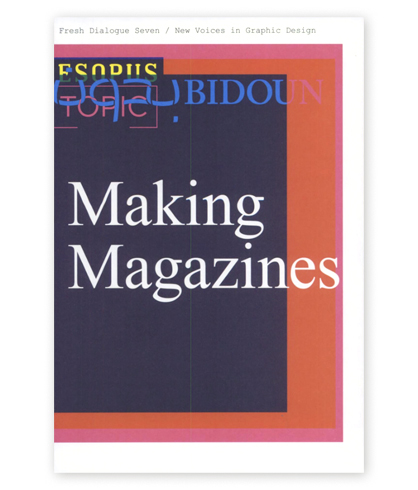
Making Magazines: James Truman Speaks with Lisa Farjam, David Haskell, and Tod Lippy
Originally published in Fresh Dialogue Seven: Making Magazines (New York: Princeton Architectural Press, 2007)

Date: June 7, 2006
Location: Fashion Institute of Technology
[Music/background conversation]
[The three panelists sit center stage in front of a large projection screen. To their left, a podium is set up.]
[Enter James Truman]
James Truman: Good evening, everyone and welcome to Fresh Dialogue. I’m sitting here this evening with three people who have each done one of the most reckless things a person could do: they’ve started their own magazine. It’s a great ambition, and one that I suspect many people in this room have had. What could be better? You sculpt a picture of the world according to your own personal vision. You hire and hang out with creative people such as writers and photographers and artists. You get yourself written about and photographed. You receive fabulous invitations. And if you’re really good, you get a 30 percent discount at Prada and free access to MoMA. [Laughter]
So what’s the catch? Well, here’s a few. The first is, it’s really expensive. It costs a lot of money to launch a new magazine, and it typically takes about five years, if you’re successful, to stop bleeding cash. So you need a benefactor. It’s not going to be Wall Street; they don’t like magazine publishing very much. It’s not going to be one of the big publishing houses; they don’t like unproven talent very much. So typically, you scour your address book for someone, anyone, with some savings. Very likely it’s someone in your family. It’s a poignant moment when your rich uncle hands you that first check for $50,000. You both know you’ve just fleeced him, that he’s never going to see the money again, [Laughter] but you need it and that’s that. Around this time, your apartment becomes global headquarters. Your friends become unpaid labor, and anyone who ever worked for a magazine before becomes your counselor. Suddenly you have three months to produce a first issue.
You have to find an art director, you have to sign up a printer, you have to find a distributor, you have to buy paper, you have to find advertisers to pay for all of this, or you have to find a foundation to underwrite you. None of these things is straightforward, not even buying paper. The cost of paper changes constantly, and it never goes down. Of course, there’s always a fantastic reason for it going up. [Laughter] The rising literacy rate in China. [Laughter] I’m serious. [Laughter] Union problems in Finland. The rising literacy rate in India. The impending civil war in Canada. [Laughter]
And finally, if you’re lucky, you’ll get your magazine printed. It sits in a warehouse for what seems like a year and then is distributed around the world. You know this only because your distributor tells you so. [Laughter] In fact, half the copies may stay in the warehouse, and the other half may return there if they don’t get unpacked in the bookstores and newsstands that supposedly agreed to take them. The best you can hope for is to sell 50 percent of all copies; the industry average last year was 34 percent. The rest of your expensive paper gets pulped.
And then you have your next issue to prepare, and then your next. Sometime around this moment, a few people start to point out to you that 70 percent of new magazines fail in the first two years. Ladies and gentlemen, the three panelists we’re hearing from tonight are not mere editors and publishers, they are warriors. [Laughter] They’ve not only survived the two-year death watch, they’ve done so with magazines that are bold, original, and not obviously commercial. So let’s start by hearing from each of them individually. How they started, why they started, and how the hell they’ve gotten away with it. [Laughter]
First of all, I’d like to introduce Lisa Farjam. Lisa is the founder and editor-in-chief of Bidoun, a remarkable magazine in English about the art, culture, and politics of the Middle East. Lisa graduated from Bard College with a BA in writing and worked as a secretary to the Iranian Delegation of UNESCO in Paris before launching Bidoun in the spring of 2004. In two years, the magazine has grown from 5,000 to 15,000 copies sold; it is distributed worldwide and has been heralded as the barometer of contemporary Middle Eastern culture. [Applause]
Lisa Farjam: We founded Bidoun in 2003 as an experiment, out of recognition that there was no publication that linked what was happening in cities such as Cairo, Tehran, and Beirut to readers in London, New York, L.A., and beyond. Equally, there were things that were happening in those cities that were unknown in the Middle East. So our mandate became to connect people from East and West through a magazine—what may sound like some sort of hand-holding United Colors of Benetton vision of diplomacy, but, we felt, was enormously important all the same.
Our first task was outreach, so Alia Rayyan, my coeditor at the time, and I started traveling, talking about our vision and collecting feedback. We soon realized that there was an enormous interest in a publication like this one, perhaps first and foremost because it could be a repository for documentation of the extraordinary things that were happening in the region, whether it was an arts movement in Beirut, a new space opening in Cairo, or artists producing unparalleled work—some of which had never been written about critically and was unknown to Western audiences. At the same time, there was great interest in the East in what was happening “over there” in the West—especially with some of the developments following 9/11.
And so we began, over the span of four months, to meet with curators, artists, writers, and musicians, taking buses from city to city, staying on people’s couches, and getting a sense of what they would want from a publication on arts and culture. We collected writers all along the way through word of mouth and emails, creating a network that today is significant and continues to grow.
Beginning a magazine with no publishing experience and a team of three people that came from art school was a challenge. We built a business plan by asking a friend to plug in some numbers into a model she was using for her business classes at grad school. I put together some visuals and became a traveling salesman, going from office to office in Dubai and Tehran with my big idea. Most people laughed in my face. In Dubai I was told that no one would ever read a magazine about art based over there. Three years later, there are two Bidoun rip-offs, both claiming to be the first cultural magazine of the Arab world. [Scattered laughter]
I finally managed to collect enough investment capital to float us for the first two years. When the two years were up, I returned and raised another year’s worth, but we don’t plan to rely on investors forever and are working on receiving funding from organizations.
Of course, there were initial stumbling blocks, obstacles, mistakes—we even had some trouble defining our audience in a single sentence. Trying to strike a balance between an audience of so-called Middle East insiders, who may have heard of, say, the ultra-famous and hyped Beirut-based architect Bernard Khoury, and so-called outsiders, who may very well have never heard of him, was a challenge. At the same time we wanted our magazine to reach an audience far beyond those with an immediate link to the Middle East. This isn’t just a magazine about the Middle East. We talk about urbanism, cosmopolitanism, terrorism, war, economics, censorship, and globalization in general.
Another issue was the task of representation: is our mandate and mission geared toward the Middle East first, or are we to serve as a tool for cultural diplomacy—showing the West that the Middle East is in fact more nuanced and dynamic than the popular consciousness tends to think? Do we privilege younger artists or more established ones? What do we do with censorship—a reality in many parts of the world where we want to be read? Do we aim to be glossy and seductive, pulling people in by privileging visual culture and even exotica à la Tank magazine or do we pursue a more pared-down, literary option like the New Yorker? And how can we be accessible to the part of the world we are talking about when we are printed entirely in English? Who are we really making this magazine for?
So what next? We have a lot left to do. We’ve come a long way since our beginnings but I think we have managed to sustain a strong, critical, idiosyncratic voice. We base each issue around a theme—a structure that allows us to pull apart an idea and attack it in a completely new way. This has kind of become a Bidoun trademark. We rely on a stable of young writers and are continually seeking out new voices. Our contributors range from young bloggers in Tehran and activists in Cairo who’ve never had a wider platform for their work to the blue-chip figures such as Christopher Hitchens or Walid Raad.
And what about politics? We consider ourselves as positioned at the intersection of art and politics. Yet we are not overtly political in any sort of partisan or rhetorical sense. Rather, we examine ideas of human rights, law, and democracy and focus on work from the Middle East that addresses these issues in a political context. We’re also starting a talk series on art and politics, the first of which will debut at P.S.1 at the end of June with Trevor Paglen, an artist, writer, and experimental geographer based in Berkeley, whose work involves deliberately blurring the lines between social science, contemporary art, and a host of even more obscure disciplines. His most recent projects take up secret military bases, the California prison system, and the CIA’s practice of “extraordinary rendition.”
We are also beginning to address the question of translation by launching a translation project that we hope will serve as a platform for exchange among young writers from the East and the West. A starting point will be a supplement to the magazine with translations of a selection of articles in each issue into Arabic, Farsi, and Turkish. Beyond that, we’re planning to curate a film series, getting into book publication, and we’ve acted as curators for a number of shows in Europe this past year. Bidoun isn’t only a magazine, but a particular way of dealing with geography, travel, and representation.
And that’s just the beginning. [Laughs] We aren’t kidding when we say Bidoun is a work in progress. Our small team is spread out across the globe, and even though we have a staff of six, we have never all actually been in the same room together. We do everything via the Internet, which allows us to be a truly globalized magazine but also makes the logistics that much harder. Yet it is very exciting to work closely with, say, an Iranian artist living in Switzerland and then finally meet face-to-face a year and half later in Istanbul. We are not just standing on the outside and reviewing; we are also creating by commissioning projects and collaborating with artists—working over multiple time zones for weeks to produce something that we are all very proud of. It’s challenging day in and day out as we make our way through these growing pains, but we wouldn’t trade it for the world. Thank you. [Applause]
JT: Thank you, Lisa, that was great. I actually want to work for your magazine. [Laughter] Let me ask you, do you pay your contributors?
LF: We pay everybody.
JT: You pay?
LF: Everybody.
JT: Okay. We’ll talk later. [Laughter] Our next speaker is Tod Lippy. Tod is the editor of Esopus magazine, a not-for-profit publication. He pushes the boundaries of magazine publishing by making each issue an art object in itself and an embodiment of the creative impulse. His first book of interviews, Projections 11: New York Film-Makers on Film-Making was published by Faber & Faber in 2000. Tod’s short film, Cookies, was featured in over twenty film festivals in the U.S. and abroad. [Applause]
Tod Lippy: Thank you. Starting Esopus was kind of a last attempt for me to remain an idealist about the role art can play in a very hyper-mediated culture. I wanted to create something that was almost pathologically rigorous about being noncommercial, unmediated, and just completely pure in every possible way—essentially, a place where creative people could present their work with as little interference as possible.
Since we’re in a room full of designers, I should probably address the issue of design first. My concept for the magazine was to remain almost invisible as a designer. This is not an easy thing to do, but I felt that I should try to let the work speak for itself whenever I could. I did establish a style sheet for critical essays, fiction, and other long-form articles, but generally, whenever possible, I wanted each contribution to work on its own terms. The result can be a little cacophonous at times, and we’ve had to give up a bit of stylistic integrity, but I like the idea of each thing being its own thing in a collection of other things that are also their own things. In the end there’s hopefully something very spontaneous and visceral in the viewer’s response to a mixture like that.
Another decision I made when I was beginning work on the magazine was to encourage our contributors to push boundaries. For instance, I’ve asked creative practitioners who haven’t written before—whether they’re artists, choreographers, lighting designers, or film composers—to write essays about particular aspects of their work. It’s amazing to me how compelling reflections about a particular discipline can be when they’re written by somebody who actually engages in that discipline for a living.
I also wanted to push technological boundaries. We try to use different kinds of paper stocks in every issue, depending on what the contributor is looking for, and we’ve also been pretty adventurous with specialty inks, pop-ups, inserts, and fold-out posters—you name it. We’ll try anything we can do affordably. For instance, in our second issue, the artist William Christenberry, who is best-known for his photography but also happens to be a wonderful painter and sculptor, was very keen to do something with a pop-up. When I researched this option I discovered that it would be prohibitively expensive to work with one of these shops that design, print, and assemble pop-ups—I think the cheapest quote I got was essentially equal to the cost of printing the entire issue. So I ran the idea by a paper engineer I knew, and he suggested that Bill and I design the pop-up ourselves (after giving me some helpful advice on how to keep it simple). Our printer in Winnipeg then found a Hutterite colony that agreed to assemble four thousand of our pop-up designs for an astonishingly low price. Of course, I was on pins and needles as to whether they would actually work—if they hadn’t, I would have had only myself to blame—but luckily, they did. We also published an exciting but somewhat nerve-racking project with Jenny Holzer in Esopus 3. She had been doing a lot of work with recently declassified government documents and had just gotten hold of a bunch of Abu Ghraib memoranda through the National Security Archives. She’s obviously well-known for working in all kinds of unusual media, so when I asked her if she had a “wish list” of materials for the project she immediately said, “What about disappearing ink?” We found a place in Colorado that produces something called photochromatic ink—it only activates when exposed to sunlight. It was a bear to print, and once again, I really didn’t know until I got the bound issues if it was going to work or not, but it turned out really well. In that case, the ink company essentially donated the ink at cost, which made this affordable for us.
Earlier you raised the issue of advertising. I’ve been involved with four magazines—three of them start-ups—and I knew that if I was going to do another one I was going to avoid advertising at all costs. I realized I was setting a kind of insane challenge for myself, but in my opinion, it’s so incredibly distracting—even numbing—when you’re reading a magazine and constantly have to navigate through this barrage of advertising. You’re working so hard just to find out where the editorial is, you’re flipping a page and a blow-in card is falling in your lap, or your sinuses are being assaulted by perfume strips. [Laughter]
So before I’d even come up with a name for the magazine I decided I would approach the whole enterprise as a nonprofit, a 501(c)(3). Essentially, this is a designation from the IRS that means that anyone who gives you money gets a tax deduction. The idea was to replace advertising revenue with donations, contributions, grants from public agencies, grants from private foundations, and so on. In our third year, we’re just about at the point where we can actually fund the magazine with these donations, which is very exciting.
I should also mention that I didn’t want to publish an art magazine that was only for artists or critics or collectors or curators. Creative people often tend—for very good reasons most of the time—to segregate themselves into their specific disciplines, so if you go to a newsstand, there is the art section, the film section, the design section, the music section, and so on. And if you open any of the journals in those sections, particularly the really good ones, you’ll find a fair amount of jargon and arcane references that may not be familiar to people who aren’t in that world. As a result I think you often end up preaching to the converted. I really didn’t want that to happen here. I wanted to create something that would not exclude anybody—something that a more general reader would want to crack open, something that felt accessible.
Similar to the “invisible design,” I wanted to create an invisible editorial presence, or the lack of a distinctive editorial voice. We very rarely have any kind of introductions for artists’ projects, for instance, and we don’t generally have an editor’s note. I guess I probably write one for every other issue, but I always find it a terribly painful thing to have to do. I prefer people coming to each piece on their own terms and dealing with it in their own way. This concept has resulted in some confusing moments for readers who don’t have a lot of familiarity with, say, conceptual art, but I think it’s good confusion for the most part. A great example is some readers’ responses to the Jenny Holzer project I mentioned before. She and I both felt there was no need to tell people that they would have to take these pages outside or near a window to be able to read their contents, so all I said in the table of contents was that “these recently declassified memoranda must see the light of day.” People who came upon this on their own were incredibly excited about it—in a way, I think it gave them a feeling of agency in this unveiling of something that had been deliberately hidden from them as citizens—but there were a few subscribers who sent emails saying they wanted a refund because there were sixteen blank pages in the middle of their magazine. It was a little frustrating but frankly also hugely exciting, because I felt like we were reaching a readership that wasn’t just composed of your usual art types.
My idea with this magazine was to reduce everything to a relationship between me, the contributor, and the audience. I wanted there to be a minimum of interference between somebody drawing something and somebody else opening the magazine and seeing it. I think that’s what art still has to offer our culture: authenticity. Conceptually as well as financially it made sense for me to essentially run the whole magazine; by taking on all of the roles I didn’t have to pay a staff—or feel guilty about not paying a staff. I solicit content, I contact contributors, I edit the magazine, and I design—or try not to design—the magazine. I go on press with it in Canada, and once printed, I do the promotion, work on the website, plan events. It’s a lot of fun. It’s also a little exhausting, but mostly it’s a lot of fun. My goal, in this very modest way—we have a circulation of 8,000 right now—is to try and continue in this path. [Applause]
JT: Tod, a question that’s fascinated me when looking through your magazine: how did you find your printer?
TL: I hit the jackpot—I can’t say enough great things about my printer. The company is called Westcan Printing Group and is based in Winnipeg. Essentially, I asked a few friends in small-press publishing for recommendations and got estimates from printers in the States, Iceland, Hong Kong, and Canada, and Westcan was the cheapest—even less expensive than the Hong Kong printer. And the people at Westcan are fantastic. They’ll find ways to do things that look very expensive relatively cheaply. They have been true collaborators, suggesting paper stocks, coming up with clever ways to solve difficult printing issues, and so on. Actually, all three of us have shared this printer at various times in our publication history.
JT: Can you tell us how much the cost of a copy is?
TL: Well, it depends. For this current issue I haven’t received the bill yet, but I’m guessing that it’s going to be around eight dollars an issue, figuring in the cost of the CD. We’re selling it for fifteen. But there are many other costs involved, such as shipping, factoring in the painful discount to distributors, factoring in overhead for the office. So in the end, the issues tend to cost substantially more to produce than they are actually sold for, a fact that we’re trying very hard to address by soliciting contributions and grants.
JT: Thank you, Tod. [Applause] Next I’d like to introduce David Haskell. David is the editor-in-chief of Topic magazine, which he founded in 2001 at Cambridge University. In 2003, he moved the magazine to New York and evolved it into the compellingly original collection of first-person narratives that it is today. Each issue of Topic is devoted to a single theme. Some recent examples have been “Family,” “Sin,” and “Prison.” Topic also makes poetic use of testimonials and confessionals from its contributors, few of whom are professional writers. [Applause]
David Haskell: Thank you. One thing I should say from the beginning is that there is one fundamental difference between my magazine and Lisa’s and Tod’s, which is that Topic is not just my magazine—it’s a team product. A lot of incredibly talented and dedicated people have been working on Topic for a long time, so it feels a bit uncomfortable sitting up here all by myself. In particular, let me mention a few staff members: Nina [Weiss] is our managing editor, and without her working on this magazine, we wouldn’t be able to have as many contributing editors and senior editors as we do. We also have two creative directors, Giampietro+Smith and Stella Bugbee; and a photography director, Gemma Corsano. If you don’t already know them, you should, because I think they’re as good as they come here in New York, and they have helped me make this magazine into what it is today.
As James was saying, I started Topic in 2001 in Cambridge, where I was studying on a Gates Foundation scholarship. We were able to convince the foundation to pay for our first issue, stealing stationery from their office to write to our first potential contributors and building up a momentum behind the magazine. That’s our creation myth. But the idea behind the magazine also came out of a feeling that I had—and I think others at Cambridge shared this feeling, especially the New Yorkers who arrived there a few weeks after 9/11—of suddenly being brought from a very relevant city to a postcard town that specialized in history. History wasn’t really what I was interested in at that moment. I wanted to know more about the current world, and in particular I was interested in the idea of people talking about real life based on their own life stories and personal experiences. That desire formed the intellectual foundation of the magazine.
I edited Topic for two years in England and then moved it to New York in 2003. The decision to move was a crucial moment for us, because there had been a lot of discussion among staff members about how to continue financing the magazine. After Topic’s first issue, the Gates Trust decided that it did not have the resources to fund us forever. Now there was an opportunity to be funded, at least in part, by a college at Cambridge University, with the stipulation that it would remain a student magazine. But I felt so strongly that Topic was larger than that that I argued for an alternative future for the magazine. I had a feeling that this future would be in New York, so when I won that argument I moved here and started to work on Topic full-time.
I think it was crucial, though, to have had those two years outside of New York, to grow and experiment and learn how making a magazine works, especially because I (and everybody else in the first generation of staff) was a magazine novice. And it’s not immediately obvious how to translate all of your enthusiasm for starting a magazine into something that’s successful in its own right.
Moving to New York, two things happened. When we were editing the “Prison” issue in the summer of 2003, we realized all of the sudden that it included a complete hodgepodge of articles. Even though they were all on the topic of prison, and even though they were all nonfiction, it was a wild mix of things—there were interviews, there were historical documents, there were a lot of argument and opinion essays, and there were these articles that we used to call the “Topic” pieces, which was our shorthand for first-person narratives. And suddenly there was this dawning moment when we realized that nobody else was devoting an entire magazine to the idea of first-person narrative. We began to ask ourselves why we were publishing all this other stuff that one could find elsewhere and that we were probably not the best at developing when instead we could do something really exciting with first-person narratives. It was such an exhilarating moment, because we felt it played to our strength, was completely consistent with our editorial interest, and presented an opportunity to redefine the idea of what a magazine can be.
The “Prison” issue was a perfect showcase for the tighter, more fully realized Topic because it featured phenomenal straight-from-the-horse’s-mouth pieces. We started the issue with a man serving a life sentence for murder. We featured a paraplegic woman who spent a night in jail protesting nursing homes. Also included was an astonishing story of a nineteenth-century prison break that we dug out of the basement microfiche archives of the New York Public Library. The collection of articles was smart without being the typical intellectual fodder you expect when a “smart magazine” tackles prison.
Around the same time I met designers Rob Giampietro and Stella Bugbee. In a meeting that was supposed to be a few hours of consulting advice about how to improve the look of the magazine, they instead proposed to take over our artistic direction. Over the next three years, we developed a strong, lively partnership and soon learned how to trust each other’s instincts. The images that you’re seeing here are the result of the experience we’ve had together developing the look of Topic.
Another way in which Topic is different than Lisa’s and Tod’s magazines is that my primary interest is to make it as clear and accessible as possible to our readers. Since the topic changes with each issue and we have no staff writers with whom the reader can develop a relationship, I want to make sure that present a lot of structure otherwise. Once we had developed the concept of a magazine centered on first-person narratives, we introduced the idea of using photography not only to illustrate the page, but to create its own language for the magazine. This way of conceptualizing our role as magazine makers was an eye-opener for me, but it has become central to what we do.
Another important conceptual element for me is the point of entry. In my introduction to the “Prison” issue I wrote that I didn’t want to publish a magazine with bells and whistles and charts; I just want Topic to be straight from the source—unmediated, as Tod says. What I’ve learned since is that you can keep that conviction while becoming a bit more subtle about it. For example, we’ve now run two issues with a back-page “Exit Poll.” In each case we approached a group of people and asked them questions having to do with the topics of both the current and the next issue, presenting the information in a very graphical, nonnarrative way. So in our “Sin” issue we approached Muslim hip-hop artists and had them rank various sins (smoking weed, selling out, and so on) based on gravity. In the “Music” issue (looking forward to our next issue on games), we created a game based on the descriptions eighth-graders gave of their favorite songs. These are certainly bells and whistles, but I’ve completely changed my mind about how valuable they can be. Adding unusual opportunities to get into the magazine helps Topic become more accessible, unexpected, and entertaining, all the while reinforcing our commitment to strong writing from people you normally wouldn’t trust to be writers. [Applause]
JT: David, you started this magazine in Cambridge, which was also the origin of Granta, edited by Bill Buford, which for me was the best literary magazine of the ‘80s and ‘90s. Were you conscious of that? Were you trying to do a next-generation Granta?
DH: Yes, we were very conscious of Granta. In fact, Topic editor Blake Gilpin and I heard Jonathan Levi, who cofounded Granta with Bill Buford, speak at Yale before we left to go to Cambridge. Levi had this sort of, “go for it, you can make something as impressive as I did” kind of attitude about him, and that more than anything else really inspired us. Granta at that point had become a theme magazine, which was also on our horizon, of course. The way our first few issues looked mirrored Granta more than other magazines, but I eventually realized that we were in many ways the opposite of Granta, and of what Granta and the New Yorker have to offer. What they are selling is this idea of hitting the very top of the mountain, featuring the best writers out there, based on the opinions of the best editors out there. In contrast, we became less interested in writing and more interested in storytelling. This was a big relief for me—knowing that I didn’t have to introduce twelve new nonfiction writers and be convinced that they’re the next big thing. With my magazine, I’m just saying, “look, these people that we have chosen are really interesting, and at least for one article we promise you’ll agree.”
JT: Thank you. Tod, your magazine is really a celebration of the medium of paper, whereas for you, Lisa and David, paper is just the tool through which you communicate. Why did you choose to use paper instead of going straight to online? Did you consider doing an online magazine first?
LF: I wanted to do something on paper, because I wanted to show there was something really awesome coming out of the Middle East. The strong design of our magazine and the fact that things just looked good was a way of seducing people. It made people who normally wouldn’t necessarily have any interest in a Middle Eastern magazine pick it up and look at it, and then keep on coming back for more. An online publication just doesn’t have that kind of tangible proof. Besides, I definitely am a magazine junkie anyway. Growing up I moved to Dubai when I was fourteen, and magazines were the only way for me to have any access back to New York and London. I used to wait for The Face and I.D. to come into the stores, and I would plow through them; it was my link back home.
DH: I think another reason is also that when you put so much energy into starting something, you want it to feel real. And certainly a few years ago, the physicality of a magazine just felt more real than any website ever could. The response to Topic has always been very much about the physical product of it. In a way, it’s necessary that we invest in art and design and a paper quality that feels worth saving. For us it wouldn’t make any sense to produce something that’s really cheap, a weekly that feels like the New Yorker or something like that. If you can make something that people want to keep on their shelves, then that distinguishes you from all the on- and off-line clutter.
JT: Tod, I want to jump back to you. I’m interested in the process of finding foundations to sponsor you.
TL: It’s not easy. It’s a very involved process, and it never gets any easier. The first thing I did—and I would recommend this to anybody who’s starting a nonprofit organization—was to go to a place called Volunteer Lawyers for the Arts. You pay a several-hundred-dollar membership fee, and after three or four weeks, they send you a name of a lawyer, usually someone at a big firm in New York. This lawyer then essentially walks you through the entire process of getting 501(c)(3) status. It’s a very bureaucracy-laden journey, but it’s the Holy Grail in a way, because once you get it, anyone who gives you anything can deduct it from their income tax. I’m sure most people are charitably inclined, but of course most people are a bit more so if they know they’re going to be getting something back. [Scattered laughter] If we didn’t have nonprofit status, we also wouldn’t be eligible for the grants we’ve gotten in the last year and a half.
JT: And did you go knocking on the doors of all of these foundations after you received 501(c)(3) status?
TL: Well, concerning foundations, the equivalent to knocking on doors is writing grant application after grant application. In the beginning I was so naive—I thought if I didn’t have advertising I wouldn’t have to tailor the magazine to suit my sponsors. But as a matter of fact every foundation has its prejudices. For example, there’s one foundation that will only fund you if at least 51 percent of your contributors are living in either New York City or in Minnesota. [Laughter] They’re a wonderful organization, and I worked very hard on this particular grant application, going through every back issue of Esopus, counting all of our contributors living in those two cities, and we were at, I think, 52.3 percent. So I wrote the essay and sent in the application. I was actually encouraged to think that we had a pretty good shot, but in the end we didn’t get it. When I spoke with the grant officer, who was very nice and sympathetic, she said, “You know, the board didn’t count the contributors to the CDs because we don’t generally fund singer-songwriter stuff, we only fund experimental music, so you were at 49.9 percent.” [Laughter] I’m exaggerating a bit but the point is, if you’re asking for money, you’re always going to have to suit someone’s agenda.
JT: David and Lisa, you finance your magazine partly with advertising. David, you’ve had an issue about prison, which featured a fantastic testimonial of a murderer and a horror story from the Victorian era, the torture the prisoners were subjected to. Lisa, you recently put out an issue about the ambiguities of envy. As someone who’s worked on commercial magazines, I wonder how do you pitch your magazine to someone at Ralph Lauren; do you just walk into a pitch meeting, say, well, the new issue’s about the ambiguities of envy, or we’ve got some insightful writing about death, mayhem, and murder?
DH: We started pitching our magazine with the “Prison” issue in our hands. I was very impressed by it, because compared to the other issues it looked much more marketable, so I was convinced that finding advertisers for the next issue, “Food,” was going to be easy. But in fact it turned out to be quite difficult to interest advertisers in a magazine with a murderer on the cover.
JT: Was that because of the response to the “Prison” issue?
DH: Well, the “Prison” issue is clearly the hardest sell in a conversation with Absolut or a fashion label. But to answer your question, the way we pitch ourselves is by stressing the fact that we’re a magazine with a curiosity and a taste that a certain group of people responds to. A conversation with an advertiser is a conversation about market and readership. And even though we have no money behind us and choose somewhat uncomfortable topics, we do happen to have a readership that is very valuable. In fact, it is exactly because we push against the grain that we become a magazine that a twenty-something, urban independent—someone who reads the New Yorker and wears Pumas—would read. For advertisers Topic can be an unusual way to work with these people. So that’s the pitch.
JT: Did it surprise you, the day you found yourself talking about having a hip urban audience who wears Pumas and drinks Absolut?
DH: Yes. That’s what New York taught me, and that’s another reason why I feel that it’s smarter to know what you’re doing before you get here. It’s just so easy to get wrapped up in that kind of conversation. That’s not to say that magazines that start in New York don’t have substance behind them, just that it’s so much more impressive if you start a magazine here and are able to retain your substance. Most sophisticated magazine conversations here in New York are usually along the lines of marketing and positioning, so personally I feel that I have to catch myself and keep asking myself what’s important for me, what’s important for Topic?
JT: Lisa, how do you pitch a magazine about the Middle East to a media buyer in New York?
LF: Actually, I’ve never been to any media meetings; I’ve never properly pitched the magazine. Any advertising that we’ve gotten has been of a more informal kind; we meet gallery owners who think the idea of our magazine is great and who know that sooner or later they’re going to have an interest in the Middle East, so we just say to them, “why not put yourselves on the map now, raise awareness about your organization, raise awareness about your gallery, your artists?” I think especially the artistic world is looking at the Middle East; there is a real interest in it, but no one knows exactly how to get there, if it’s safe, and so on. So our advertisers are mainly strong supporters of the magazine who think we’re doing a good thing and want to help us in any way possible. And then we have these rather embarrassing BMW ads that have just started to come in. And airline ads, cars, watches, things like that. Because these companies recognize the magazine as the media of the jet-set Middle Eastern person who spends half of his or her time in London and New York. But so far, I’ve never yet had to formally pitch Bidoun.
JT: It might come yet.
LF: We’ll see, yes. [Laughs]
JT: What percentage of your copies go into the Middle East?
LF: It’s about a third in the Middle East, a third in Europe, and a third the States.
JT: Do you run into censorship issues with it?
LF: Yes, sometimes. In the West we take the fact that you can just print anything you want for granted, which is of course not the case over there. But we’ve never had to really compromise on text, censorship has always been about the images. So we write about everything we want. We’ve written about the Iranian elections, we’ve written about the labor force in Dubai, we’ve written about the wall in Israel-Palestine. And we write clearly and critically, we say what we want to say. But if we have an image that in any way compromises people’s ideas, we’re aware of it and try to avoid using it. For example, we don’t think that not showing skin or not showing the leg hair is going to be detrimental to us.
The only real censorship issue we’ve actually had was with an image of a former ruler of the United Arab Emirates. It was an inconveniently composed image, on which a giant mural of the leader was seen through a pair of women’s legs. The photo was printed quite small, but the cops came into our office in Dubai and asked who was responsible for such an image. That issue of Bidoun was taken off the shelves for a while, but we ended up asking two hundred art school students in the States and in the United Arab Emirates to mark the picture out with a pen. [Laughter] Afterwards we put the issue back on the shelves, and it was fine.
So the censorship is really about the images and so far we’ve been lucky. I think a lot of that has to do with the fact that we don’t have a lot of advertising. In past issues, we’ve trashed whatever we want to trash, and we haven’t had to kowtow to anybody yet; we’ll see what happens.
JT: Do you manage to get copies into Iran and Iraq?
LF: Yes. Actually, Iran’s a very interesting example. Up until the new president came into power, Bidoun was bought by the former director of the Tehran Contemporary Arts Museum, who would buy in bulk—500 copies at retail price—and give the magazine away for free to visitors to the museum, because he supported the idea so much and wanted to be a facilitator in some way. After the new regime took over, he resigned, and now we literally smuggle the magazine in five copies at a time. Whoever’s going to Iran takes five copies and they all go to this one guy’s house, and he gets on his scooter and drives it around to people who want it. [Laughter]
JT: Fantastic.
JT: Something that interests me about all of your magazines is the relationship between what’s mainstream and what’s alternative. When I was working for independent magazines in the ‘80s, it was quite clearly demarcated. You had alternative music, you had alternative nightlife, you had alternative fashion. You had downtown as opposed to uptown, and these were discrete subjects, and you covered one or the other. Then in the ’90s the mainstream media started getting interested in the alternative, and with the rise of the Internet, the most marginal of cultures became very much available and became democratized and mainstream. Are you on guard in some way about having your own relationships against the mainstream, or contrary to the mainstream? How do you define yourself vis-à-vis that large sprawl of media, some of which cover some of the same topics as you?
TL: That’s a good question. I think in our case we’re going in the opposite direction. We’re pulling things in from the alternative worlds of all the various creative disciplines we feature, but we’re also very eclectic, including music, film, art, fiction, and poetry in every issue. So what we’re presenting is not mainstream material for the most part, but to offer such a wide variety of material in order to attract a broader audience is kind of a mainstream approach.
So there’s this weird sort of overlap. If you’re an indie music fan and you love the Mountain Goats, for instance, you’ll probably pick up the new issue, because there’s a new track by the Mountain Goats on the CD. And if you keep looking through the magazine, you’ll see a project by Ed Ruscha, about whom you didn’t know anything before. So the variety of subjects we cover is a way to pull people in and broaden it out. But as far as our relationship to mainstream media is concerned, I just feel that we’re so far off the map in a way that it’s not really relevant. If I have a topic in mind, I do get on the Internet, though, and check to see if it’s been covered by the New Yorker or any other magazine and if it has, then essentially I’m not going to do it.
JT: Even if it hasn’t been done before, do you exclude stories and ideas because they feel to you to be too mainstream?
TL: Yes.
JT: David, what about Topic? How do you define yourself against the mainstream?
DH: I think we’re part of a powerful cultural phenomenon going on right now—a strong interest in hearing people tell their own stories. You see this phenomenon across a range of media and across the high- to low-brow spectrum. There are the “personal histories” that run in the fiction issue of the New Yorker and there’s the “Lives” section in the New York Times Magazine. There’s The Real World and all the reality TV that it spawned. There’s Capturing the Friedmans and Tarnation and An Inconvenient Truth. There’s YouTube and a million insane personal blogs. Some of this is great and some is trash, but take it together and it’s a generation-defining phenomenon.
Given the landscape, how do we distinguish ourselves? The “Lives” section in the back page of the New York Times Magazine is a great foil. I don’t remember the last time they published a piece that isn’t by a journalist, about to be anthologized by a major publishing house, or written by a staff writer at the Times itself. To me, that feels like such a mainstream, lazy way to do first-person narrative. If you’re going to put yourself out there and be fresh and unexpected and new, you have to find the people who would not write for a magazine, who don’t already have a book deal, but who have something to say that’s more urgent, more unusual, or bold than what becomes routine. A sister dying of cancer, or a recent reunion with an estranged brother—that’s the kind of tame material that we’re always fighting against editorially.
JT: Lisa, you recently did a whole issue about Dubai, and I notice that two issues ago Vanity Fair did a very long feature about Dubai. How did yours stack up against theirs?
LF: Well, that’s actually pretty interesting. The Emirates issue was the most fun one to do so far. It was the first approach to Dubai—the first in-depth photo-documentation of its development, the first cultural look at the region. Dubai is really close to me. I lived there for four years and watched its desperate attempt to be put on the map, and then I left. I left before it got too gross. But I’ve always wanted to attack it in any possible way, so in the Dubai issue we approached this phantasmagoric city from a million different angles. We represented it socially, architecturally, artistically, in all kinds of ways.
About two weeks after the issue came out, I received an email from the assistant of the editor of Vanity Fair, Graydon Carter, in which I was basically summoned to his office [Laughter] without an explanation. It just said, “Graydon Carter would like to meet you. Can you make it at this time?” And of course I dropped everything, and said yes. [Laughter]
So I went to his office, issues in hand, feeling very shaky, and he said, “I just wanted to meet you because I read this thing in the Observer that said you’re the little Middle Eastern sister of Vanity Fair, [Laughter] and you were compared to me.” I said, “Well, by no means am I you and I have no idea where that came from, my apologies.” He asked to see some of the issues I had brought along and started flipping through the Dubai issue, which had just come out. Suddenly he called in a bunch of editors and said, “Will you look at this? Can you believe nobody’s ever written about this stuff? Nobody’s written about this amazing city.” And I was just sitting there, thinking, “well, I just put my four months of blood, sweat, and tears into it, actually, but...” [Laughter]
JT: Nobody’s doing it. [Laughter]
LF: Exactly. So in the end, I was enlisted to help with the Vanity Fair story. I got the necessary permissions for the writer to go there, because it’s quite difficult for people to get interviews with sheiks and rulers and dignitaries. But it was cool. We did it before anyone else. We did it before the New Yorker and the New York Times, and now Dubai is in everyone’s consciousness, which makes me happy. I still think Dubai’s fascinating and I want to keep revisiting it, but it was really interesting to do it first.
JT: And it speaks to your earlier comment about using paper. The issue is dated, it was first, and it’s there as proof of that. What did you think of the Vanity Fair piece?
LF: I thought it was terrible. [Laughter]
JT: Terrible? Was that because it had tried to mainstream the subject?
LF: No, I think that it was a little late, more than anything else. It took a long time to come out, and right after our issue, there was a very fascinating article in the New Yorker about Dubai by Ian Parker (I spoke to him as well and gave him some ideas, and he did an excellent job). The New York Times also did several things—in the travel guide, in the style guide, in the fashion issue—so there was a lot written about Dubai. Vanity Fair often blows the top off stories and lifts the veil, but in the Dubai piece I didn’t think that they brought anything new to light. It was written in a kind of, “look at this crazy, wild city” way, and I felt everybody knew that already.
JT: Thanks. We’re going to take questions in just a minute. In closing, let’s talk about the future. You’ve all spoken with great conviction and humility about what you do, but I’m not sure I believe you. [Laughter] In my experience, all good editor-in-chiefs are megalomaniacs. They are creating a world and they’re insisting that you buy their picture of the world. By nature, they are sharks, they move and they grow, and they don’t stand still; they are empire builders in their own way. Where do you see your own publications going in the next five years? What are your ambitions? Put aside the humility now, let’s hear about world conquest. [Laughter]
DH: Well, I think Topic could be a lot bigger than we are right now. It’s an idea that is constrained by the fact that we never had the $50,000 from the rich family member or the $500,000 from the enlightened investor. We operate on a timetable that is completely contingent on how fast we can get that next chunk of cash together. And that isn’t fun. I actually think that if we came out more frequently, it would be much easier to sustain a conversation. So that’s one goal. I also think that the potential readership, the latent readership for the magazine is so much larger than what we’re able to achieve based on our budget. I think if there were a way to invest in the magazine seriously, we’d be able to deliver on our editorial promise of introducing extraordinary, real stories to a smart, curious readership. I know our readers are out there.
The third goal is to expand our website. There’s so much that Topic’s interested in doing that’s beyond the physical page but consistent with our editorial mission. If people want to talk about their lives, they can do that in film, audio, and interactive ways that the Web will eventually, if it doesn’t already now, be able to support. I see the print magazine as a showcase. It’s your flagship retail space, but there’s a lot more to be done at Prada beyond the Soho storefront; it’s about extending your brand and your commitment to a certain way of looking at the world.
JT: Thank you.
TL: For Esopus I see a very gradual growth. I don’t think it’s ever going to be competing with People for circulation. In fact, we couldn’t produce it if it were, because there’s a lot of assembly involved; it takes a lot of hand work to put together an issue. So far the trend has been that we’ve gone up a thousand copies every issue. Right now we’re on issue six and at 8,000 copies, so I’d like to see us at 15,000 copies in three or four years, and I’d like to see 8,000 of those copies going to subscribers. That would make an enormous difference in terms of revenue. At the moment, a few thousand copies are going to subscribers. But this is a whole other conversation which I’m sure we could all groan and gripe about. [Laughter] The fact is that when you’re selling copies on newsstands, you’re just losing money on them, essentially. So I see the magazine gradually moving forward and up.
JT: And how does it change the world?
TL: How does it change the world? I hope a little bit at a time. [Laughter] We’ve done some interesting things in the magazine that have gone on to larger venues, for instance. Quite a few of the tracks from our CDs have gotten significant airplay on stations like KCRW and KEXP. In New York City, there’s a show up right now at White Columns of an artist we featured in Esopus 5. He was the victim of a horrible attack and started creating this amazing photo-based art as a means of recovery after being in a coma. His work, which is really extraordinary, had never been seen by anybody before we published it, so it’s exciting to think he’s now being exhibited at a major arts venue in New York. We also ran a piece about a man who survived the Holocaust by posing as a traveling artist in the Ukraine during World War II. Hopefully, the publication of his drawings and journals in the magazine will lead to some sort of institutional exhibition.
Beyond the magazine I’d like to do more with our website—we actually just switched over to a much more dynamic website design—I’d like to publish books, and I’d love to get a grant that would allow me to hire somebody to handle the business side of Esopus—you know, processing subscriptions, doing database management, that kind of thing—so I could really focus on books and events and things like that.
JT: Lisa, can Bidoun end the war?
LF: [Laughs] For now I’d just like a bigger staff. I’d like more money. [Laughter] But mainly, I’d really like people to look past the idea that Bidoun is a Middle Eastern magazine. It’s not. It’s about the world, it’s about what’s going on in the East and West, it’s about globalization. I don’t know if it’ll change the world, but it does offer a glimpse of something that people don’t have a lot of access to here. If people can get past the idea that it covers a niche subject and targets a niche market and instead look at it as something that may educate them, provide them with a larger worldview, that would be good enough for me. Of course, I’d like it to be bigger and better than Vanity Fair, but I’m happy with it now.
JT: At least you’ve met Graydon.
LF: Yes, I’ve met Graydon. [Laughter]
JT: Do we have any questions from the audience?
JT: Question for Tod. Do you write your own grant publications, or do you have a professional grant writer help you? How much time do you put into the grants?
TL: The first time I did a grant application I had absolutely no idea what I was doing, so a friend of a friend offered, at a very reduced rate, to give me the boilerplate of what an application letter should look like. Since then I’ve written them all myself, and it gets a lot easier. It also depends on the kind of grant you’re applying for. An NEA grant is an enormously complicated venture, but for a less complicated grant, you devote about three days, literally just updating all the information from the last grant application. You add in whatever seems relevant to that particular organization, you take out what isn’t relevant—it’s like pitching the magazine to media buyers, you’re basically selling the product. You’re creating a narrative about what the magazine is doing and why it deserves funding and support.
JT: A question for all of you. How much do annual subscriptions cost for each of your magazines, and how many issues are done per year?
LF: Thirty-six dollars for four issues.
TL: Eighteen for one year, and thirty-four for two years. We publish two issues a year—one in the spring, one in the fall.
DH: Thirty dollars for four issues. And they come out more or less quarterly. But if you’re in the audience waiting for your most recent subscription, it’s not because we’ve lost your address. [Laughter] This one is taking a little bit longer.
JT: A question to all: Do you consider yourself more editor or publisher? Should there be a wall, a veil, or nothing between the two roles?
LF: I consider myself more of an editor, not really a publisher, and I think that there should be a differentiation of some sort, but I haven’t gotten there yet.
TL: I understand exactly what you’re saying, but since I do both, I would have to say that I disagree. It’s not always possible for there to be no wall between the two roles but I think it’s great to be able to make decisions about, say, which printer you’ll end up working with while also making the creative decisions. So when you fail to convince the paper company to give you that special really sexy, translucent paper for free, then you go back and deal with it as an editor or a designer, making it work in a hopefully organic way. So I think it’s great if you can do everything. It’s not easy, and it’s kind of untenable in many situations, but I enjoy being able to combine everything.
DH: I think if you’re publishing a commercial magazine, it makes sense to split the two positions if possible. Personally, I consider myself more an editor than a publisher. One of my frustrations with Topic is not having someone here in New York on the publishing side with as much time to devote to the magazine as I have on the editorial side. When we decided recently to become “fiscally sponsored”—taking a baby step towards Tod’s arrangement of being a nonprofit—it took some of the pressure off. We’ll continue to raise money in advertising and thus retain that sense of being a real, commercial magazine, but we’ll also develop a relationship with some foundations to get support that way. That’ll change the ratio of time that I spend pitching versus making the magazine.
JT: Next question. What’s the world’s best-designed magazine? [Laughter]
TL: I love Harper’s, I love the New Yorker. I love magazines that know exactly what they are and don’t try to sex everything up so much. I mean, if it’s a sex magazine, maybe it should be sexed up. [Laughter] I like magazines that are clear and rigorous and know how to present their content in the best possible way. I could probably name a million, but just off the top of my head, I think Harper’s is a really beautifully designed magazine.
DH: I’d like to dodge the question a little bit and say that the magazine that we at Topic have paid the most attention to in the past few years has been New York. We’d like to think that they study us, just as we study them. New York has a fantastic instinct for using design to make the magazine clearer, and to make it easier for the reader to get into the content. For a magazine like ours, that doesn’t provide a lot of the more obvious hand-holding, such as a list of well-known contributors, it is important to have a clear design. To have a back page that feels like a back page, for example. And I don’t know any publication that does it better than New York.
JT: Lisa?
LF: I’m with Tod on the New Yorker. It’s been the same forever, and that’s comforting and nice.
JT: What magazine do you open and you’re just instantly annoyed by the design of it?
LF: Vogue.
TL: InStyle annoys me.
LF: Tank. Us Weekly, and you know, all the tabloids.
DH: My roommate has FHM and a bunch of video game magazines in the bathroom. It’s weird how even a video game magazine, which is basically a catalogue, looks exactly like a tabloid magazine. They are all so similar, it’s bizarre. If they were written in a foreign language, it would be really difficult to know what these magazines are about.
JT: Is it possible to enjoy a magazine and hate the design?
JT: Yes. I feel that way about Newsweek. I think the content is good, I find the design just absolutely awful.
LF: Horrible.
JT: It’s pseudo-trendy.
[Chorus of assent]
JT: Where do the names Esopus and Bidoun come from?
LF: Bidoun means “without” in both Arabic and Farsi, so take that as you will. Without boundaries, without preconceptions, without anything really. We just wanted to encompass the idea that you can belong to a lot of cultures. Take somebody like me, for example. I am Iranian, born in New York, have lived in Dubai, lived in London, and traveled everywhere.
TL: Esopus is named after a creek that runs through the Catskill Mountains. It’s a very beautiful creek—it’s great for trout fishing, and a lot of people tube on it. It’s very pure, very simple, very beautiful. About halfway through its course, the creek is bisected by the Ashokan Reservoir, which supplies New York City drinking water, and when it comes out on the other side, it’s kind of sludgy, and then it dumps into the Hudson River. [Laughter] So the idea was that in this culture you can create something, you can be an idealist, but sooner or later, it’s going to end up in the media stream. My goal is to keep Esopus as pure as I can until it reaches that point.
JT: So that leaps into our absolute final question: When will there be enough magazines? [Laughter]
LF: That’s mean. [Laughter]
JT: Yes, that is mean. Who said that?
DH: The cool thing about magazines is that they are difficult to make, so not everybody can make them. You basically need enough money to buy a Volvo every few months. [Laughter] So there is that barrier to entry. But at the same time, it’s not impossible to raise that kind of money and figure it out. In general, I don’t think it’s a bad thing that the world is full of magazines, because they express contemporary culture at a very particular level of sophistication. They’re made by people who are not masters of the universe yet, but who have enough drive to document the world around them. A society that’s overflowing with magazines—especially small, editorially driven ones—is a society that has a lot to say.
JT: Well, it’s very interesting that you can make a magazine for the price of a Volvo. I’m stuck in the Gulfstream paradigm [Laughter] Anyway, on that positive note, I’d like to thank everybody for coming. Good night.
[Applause]