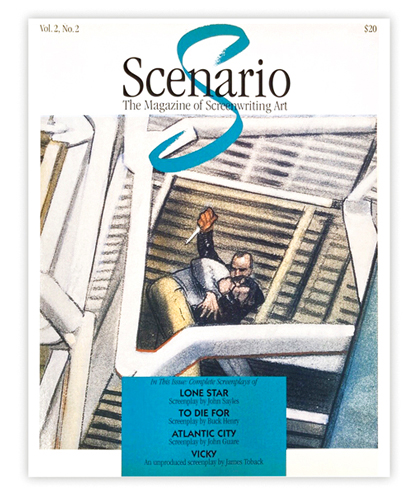
Originally published in Scenario: The Magazine of Screenwriting Art, Vol. 2, No. 2 (Summer 1996), pp. 186–191

Tod Lippy: How did Atlantic City come about?
John Guare: Well, in 1979, the Canadian government instituted a plan allowing every dollar spent in film production that year to be 100 percent tax-deductible. This rabbi from Winnipeg had raised a bunch of money, and asked Louis Malle to direct a thriller with Susan Sarandon and a bankable male star. The script that they had started on had just not worked out, and Louis, whom I had met only a couple of times, and really didn’t know, had seen a play of mine at The Public Theater called Landscape of the Body, so he called me and said he had a problem, and asked if he could come to New York and see me.
He came down on July 27, 1979, and explained that they had $7.5 million and no script, and he did not want to let the money go to waste—did I have any ideas? I had been very interested in Atlantic City, because when I was a kid, our neighbor was a man named Tony Ray, who had worked at the Waldorf and was my parents’ friend. He had more recently moved down there to take over this old hotel, Chalfonte-Haddon Hall. Atlantic City was going bust, it was dying, and he was the man who was instrumental in bringing gambling to the town. My mother talked to his wife all the time about how things were going down there—in fact, she even bought me stock in Resorts International—I mean, ten dollars’ worth—and I kept reading about it in the paper. Was this going to happen? Was this city going to come back? There was something in the air about Atlantic City.
Knowing that Louis was a documentary filmmaker—he’d made some extraordinary films about India, like Calcutta—I said to him that I felt the world of Atlantic City just sounded photographically interesting. I called Tony Ray that day, and I asked him if we could come down to see him, and he said to come down the following morning. Louis said, “I’m going to France tomorrow morning,” and I convinced him to put it off a day. So we went down on July 28. As we were leaving New York, there was a big Indian parade going on, I mean, like, giant Buddhas everywhere—I’ve never seen anything like it since—and horrible traffic jams. It was almost impossible to get out of town, and Louis said, “Ah. It’s like Calcutta: this is a good sign.”
So we finally got down to Atlantic City, and if it hadn’t been for Tony Ray, we wouldn’t have been able to find our way into it. Tony took us all through Atlantic City: we walked into the old hotel he taken over, which was now Resorts International, and we saw right away this oyster bar where these young girls were working. And Tony said, “You see, you have to work here a number of months while you’re taking lessons to be a dealer; you have to do the menial job to prove yourself.” And immediately, we saw that that’s what Susan [Sarandon] would be doing. We were there about eight hours, and had dinner with Tony, writing everything down. We learned that it was all a place of rules. I’d also found an Atlantic City picture book, and in it we saw that in 1929, there was a gangsters’ convention, and there was a photo with Al Capone sitting in the front. In the back, there was a boy—a young man, a teenage hood—and we said, “That’s our man.” Also, we knew we had to find a bankable male star—I don’t know how it is today but at that time “bankable” meant an older actor, who could guarantee the investment of whichever insurance company was putting up the money for the film—so when we saw this boy from 1929, we knew he would be our character Lou, who had stayed in Atlantic City.
Also, we saw this crummy apartment house on the boardwalk, and we knew that would be the spot where these two characters, Sally and Lou, would live, where they would meet. The rules of the town started to inform us—we stayed up all night talking. There was one caveat, however—in order to qualify for the tax dollars, the picture had to be made by December 31, 1979. And it was already the end of July. I said, “Well, we’ll do it.” Fearless. Crazy. But it was just too good of a thing to pass up; we were too excited. So Louis went back to France, and I promised to visit him there about 10 days later with the first draft.
And I did. I remember my wife and I were riding on the train down to Toulouse, where he was going to pick us up, and I suddenly said to her, “I don’t even remember what he looks like. What have I gotten into?” It was the first time I had relaxed in ten days. It was night, and we pulled into the station, and I saw someone waiting for the train, holding a book, who I was pretty sure was Louis. We went up to him, and I asked what he was reading. He said, “Oh, it’s this book, Les Mystères de Paris, by Eugene Sue.” And I took out the English translation of the same book, which I’d been reading on the way there, and he said, “This is another sign. First Calcutta, now this.” It was like that. We had a remarkable time.
How close was this first draft you’d written to the shooting script?
That first draft really went on. In that one, Chrissie had the baby, and Lou and Grace got stuck with it at the end. It was much longer, like almost 200 pages. Atlantic City was just so interesting. And once I got to France we just keep writing and writing—we didn’t know where to cut—and finally Louis said, “This should be 100 pages,” and he turned to page 100 and said, “This is it. This kid is never born. Forget this kid.” Our model for the picture, strangely, was Nashville. One of the things we’d both loved about that film was that, against a very strong sense of place, it had a number of very simple stories, but when all twined together it provided this great narrative model. Like Nashville, we wanted to have a very simple arc. So when we decided to end the action around page 100, we took events that had happened later and brought them forward, that kind of thing.
You’ve also spoken about another inspiration for the story, namely that of the Bellini opera Norma, which Sally plays on her portable tape player in the script and film.
Both Louis and I loved opera, and the minute we knew that she was going to work at the oyster bar, it seemed appropriate. And also, my mother-in-law had sent me a book of Heloise’s Household Hints, and I looked up the book to see what Heloise had to say about fish odors, and she recommended, “Just squirt lemon,” so suddenly that opening image of her cleaning herself with the lemon—Susan being so phenomenally beautiful and voluptuous—it just seemed to be right. And I decided that that would have to be the first time we saw her—she would be this unattainable goddess in that first image. And then we’d find out more about her later. The idea was to accompany that with the aria “Casta Diva”—chaste goddess—from Norma. But it was phony and pretentious if you just put it on the soundtrack. On the other hand, though, why would she listen to opera; how do you justify that? So we thought, “She’s trying to better herself by listening to opera.” And then, “So who’s trying to teach her opera?” Well, obviously, her croupier teacher! And then, she wants to go to Europe, to Monte Carlo, etc. So out of that one image—a beautiful girl working at an oyster bar—everything starts to multiply, and you begin to let the character tell you the story.
Speaking of letting the character communicate to you, I remember reading an anecdote of yours, that’s applicable to this, about an experience in a motel room—
In New Orleans. I was hitchhiking across the country—I just got out of the Air Force—and I ended up in New Orleans in this real fleabag called the Senate Hotel, like a dollar a night. I remember I was really zonked, and went right to bed. But on the other side of the wall, I suddenly heard the scratching noise, and a frail voice saying, “Help me… help me….” And I asked, “Are you all right?” And they just kept saying, “Help me....” I got scared, but I didn’t want to go next door—this was a terrible place—and finally, I fell asleep. The next morning, I saw a woman in the bathroom at the end of the hall, washing her baby, and I’d wondered if that was her, although I didn’t ask her. But that seemed to me to be how a writer approaches character: it doesn’t come fully grown. You hear it on the other side of the wall—scratching, scratching—and the more you work, the more the wall becomes a scrim, and then finally, you can see it. But it’s about asking the question, “Who are you? What do you want?” And not being me in the bed, frightened and not wanting to get involved. It’s exactly the opposite. So there was a lot of play in Atlantic City about that. I had known Susan for quite some time, and was so impressed by her. Her beauty was remarkable, and also she was so down-to-earth, as she still is today. So part of the story had to be Burt [Lancaster] finding her and asking her about her life. So that’s what created the story.
What about the other characters? How did Grace evolve?
I had an aunt—my uncle had married a terrible woman who had come to New York in a Mary Pickford look-alike contest—and Grace was pretty much modeled on her. My terrible Aunt Peggy—she was a shrew. But then, from there, I thought, “She’s a gangster’s moll,” and again, from that I had to figure out her connection to Lou. “Of course, he was a protection man!” And then I thought, “But he was a protection man who never protected anybody.” So that was the way everybody was realized, just playing with those images: a gangster who was a cowardly lion, or a chaste goddess, who happens to be from Moose Jaw, Saskatchewan. One of the great things about working with Lewis was that there was never any censorship. Lewis would follow anything: “Say more. Say more. More! More!” Sometimes you might waste days following something, but there was no strand that he wouldn’t have as much play with as possible, because something would always come out of it. And even if it didn’t work, we knew why it came to a dead end. That was the best thing about him: he trusted the writer to say, “I don’t know where I’m going, but let me follow this, let’s see if there’s anything here.” It was never that automatic “No. I don’t like it.” You never felt the sense of being straitjacketed.
So this all took place during this trip to France?
Yes, we took this first draft, and we had prepare something to give to the producers so that they would continue with it. So we prepared a “backer’s audition.” Almost like a musical, we did all the big scenes from it. Then they gave us the go-ahead. It was not the end of August. So in order to finish by December 31, we had to start shooting by the middle of October. Oh, and also, because it was a French-Canadian film, all the interiors had to be shot in Montreal, and the crew had to be Canadian.
I’m assuming that Sally and Dave’s being from Saskatchewan had something to do with the backers as well?
That’s all because of that, yes. I literally got out a map and looked for funny places to come from in Canada. “Moose Jaw.” “Saskatchewan.” If it had been an American-financed picture, it would have been Altoona, or someplace like that.
How did you come up with the characters of Dave and Chrissie?
It would be Sally’s nightmare. She wanted to start a new life. One of the Atlantic City rules we found out about was that the casinos would not hire anyone without doing a family check, and if you had any gangster connections, or bad connections of any kind, you were punished for your relatives’ jobs. That had to be, then, where she was vulnerable. She’s a girl who’s come from another country, trying to start anew, trying to improve herself, and everything’s fine as long as her past is kept secret.
In your directions, you describe her apartment as eliciting “the feeling of a woman who has thrown away everything she has ever owned and is completely starting from scratch.”
That’s right. The minute we had from Tony Ray that if you were married or related to someone who’s a con, or criminal of some sort, “we don’t want you here, because of the people you might attract,” we knew there had to be somebody who not only would represent this past she was trying to escape, but who would put her future in peril.
What’s interesting here is that, although Sally’s past materializes in the form of these two characters, there is never any particularly direct reference to what, in fact, actually happened in Saskatchewan, or Las Vegas, to make her want to escape in the first place.
That’s all you need to know. What’s most important about her is her dreams. That she wants to get out of there; she’s been saddled with this guy and she wants to flee.
This screenplay is fairly specific in terms of camera directions; were these the result of Malle’s input as director?
What we wanted to do—and this was working with Louis—was make sure that no scene would take place in a neutral space. It’s not so much that it’s camera-specific it’s just that it’s very site-specific. One of the things I learned from Louis was that you can write back, because the camera will take care of a lot of it. And it was then that I realized that working with a good director—a confident director—is like working with a good composer. When you’re writing a musical, there are certain things you don’t have to write, because the music will take care of it. Louise wanted to make sure that wherever the scene was, it was not in a neutral space.
Many reviews have mentioned that Atlantic City itself almost acts as another character in this film. That must have been a bit of a new experience for you, because most of your plays, like most theater, only suggest location, background. Here, as you’ve mentioned, it’s a primary force, a dramatic presence.
That’s right. Well, that’s one of the things that a movie does best. I think the theater is basically a poem, a metaphor. You can have a bare stage. l always remember an experience with an actress, Mildred Dunnock—she’d been the original wife in Death of a Salesman—up at Yale at the Story Theater. She must have been in her 70s at the time, and she came out onstage and said, “l am 15 years old, I am a princess and I am the prettiest girl in the kingdom.” And you know what? You believed it. I mean, you can have a great battle scene in theater with only four people on the stage. The movies, what they do best is tell the truth, show the truth. And that’s what happened here: that documentary quality of film was really able to devour, suck up the energy of that remarkable place. By the way, the good thing was that we shot all of the Atlantic City exteriors first, and that really infused the rest of the shoot in Montreal. The entire city was under construction at that point; you were tripping over atmosphere, it was so profound.
As you mentioned, this film was originally going to be a thriller. Although it’s hardly that, there is one scene here that calls up that genre: the chase scene in the parking garage which ends with Dave’s murder. Was that something you envisioned doing from the very beginning?
We had an entirely different conception of that originally. The chase scene was going to be much more matter-of-fact, it was going to be very simple: the kid was going to come out, see the gangsters, and run—almost incidental. And then we were walking up the boardwalk, and we came upon Parkmobile, and knew we had to use it, it was just right. What was thrilling about it was that it gave people this sense of striving, climbing. And it was so beautiful at the top: it was the most beautiful view in all of Atlantic City. That was another example of being influenced by the place. I mean, we were down there, and we had gone into production, but every day we were taking advantage of accidents. Like the Michel Piccoli [Joseph] scene: I knew I was going to have to write a big scene for him, but it wasn’t until I went to the dealer classes that I came up with it.
His speech in that scene, where be talks about how “Everybody hates the dealer,” is like some kind of existential lament. Was this from the classes, or off the top of your head?
That all came from things that were said in the classes.
When did you come up with the bus scene, in which Sally convinces the bus driver that Lou is actually her senile father?
That one I knew from the beginning. It came out of the vast age difference of the two leads. You had to justify the love story. You had to mention somewhere that she was young enough to be his daughter. It’s as simple as that. They had fallen in love, but the only way to make it believable would be to have it stated. It was just irresistible to have her say to the bus driver, “That man is my father. Get him off the bus.” And then have the old man say, “But I made love to this girl today,” and the bus driver says, “Don’t be naughty.” That’s the kind of stuff where you knew you were home.
Was Burt Lancaster your first choice?
No, he wasn’t. We wanted an actor with a profound aura, like the city itself. Our first choice was Henry Fonda. And when you say that you want to have a bankable star, they literally punch into an insurance computer, and for Fonda they said, “Oh, he can only work 45 minutes at a time and then has to rest, and there can be no walking, etc.” So he was out. Then we started dreaming high, and since I’d worked in the theater and all, we decided to go to Laurence Olivier. Again, he could only work attended by a nurse; he had some health problems. There was Jimmy Stewart, but he had a heart condition. We were looking for a very American type. We went to another actor who shall remain nameless, who had made gangster pictures. He said, “I’ve just had a face-lift, and I’m playing 45 now.” His hair was dyed, too. The next one on the list was Burt Lancaster. We had resisted him because we felt he was a very hammy actor, but it got to be that A) the script was sent to him and he loved it, and B) he was in perfect condition, looked great, and had no vanity, strangely. His hair was white, but he was prepared to color it any color we wanted. He was shocked that we actually wanted it his natural color. He would take his shirt off—he was in great physical condition. We didn’t realize until after the first reading, in Canada—the week before we went down to Atlantic City to start shooting—that we had stumbled onto something great. It had been a mistake to want the Americana of Henry Fonda or Jimmy Stewart, or the Britishness of Olivier, or even James Mason. Burt was closer to the character because of his work as a gangster in films like The Killers.
Once he committed to the film, did you have to do a lot of rewriting, or did the role fit him pretty well as written? He seems made for the part.
Well, he loved the script, and the other men who read it never even gave us any feedback on it. Burt loved the romance with the young girl, all of it. But then he started to act, and he really gave this nightmare performance. And Louis kept saying, “Pull it down. Pull it down.” And Burt would say, “Okay. We’ll do it two ways. We’ll do it once for the little froggy, and then we’ll do it the way it should be done.” He’d give his performance first: “Oh, the Atlantic Ocean! You shoulda seen it! My girl, my love!” And then he would throw away the performance for Louis. At one point Louis said, “I should destroy this man’s career and release the performance that he wanted to give.” However, as it went along, Burt realized that simpler was better. I would have had to do much more rewriting had we been able to cast one of the other actors, pulling back from the sexual involvement and the physicality of the character, because there would have been some frailty. There was no frailty with Burt, none at all. He was at his peak, really.
When production started, did you have a presence on the set?
Yes. Louis wanted me there all the time, because he was paying great attention to the text—I didn’t realize that that was an anomaly at the time. Burt told me that I was the first writer he’d met on a movie set in 15 years. I remember the producers came down and were furious because I was being paid a per diem to be there throughout the shoot—what was I doing there? And Louis responded to them with the immortal words, “If you have somebody here for the hair, why wouldn’t you have somebody here for the words?” I’ve learned that a confident director likes the writer around, because it’s just one more bit of help.
His respect for the text seems much more like the attitude of a theater director.
Well, Louis and I both hated the ragged improvisational stuff that can sometimes take the air right out of a scene. Something we both admired were Marcel Ophuls’ films—that formality, that heightened sense of text. Other directors are very different: when I worked with Milos Forman on Taking Off, he wouldn’t let the actors even see the script. He would read it to them. He’d say to Buck Henry and Lynn Carlin, the two leads, “Okay, now, Buck, you say, ‘Why do you think she ran away,’ and Lynn, you say, ‘Because she would have phoned, she always phoned.’ Got that? Roll it!” That was very much a sense of the director manipulating the actors, creating a vulnerability that was appropriate to the film. That was one way to work. But this was different, and wonderful. The night before every scene Louis and I would go to the location, and the two of us would act out the scene with all the parts, figure out the camera moves, everything. That was what I thought every experience would be like.
Did you do a lot of rewriting during production?
We’d take advantage of things by watching dailies every night. For instance, if Susan would burst out laughing in a take, and we wanted to keep that, we’d write something to make her laugh, to take advantage of the life that was in the frame. But the most important thing occurred in the scene where Lou and Sally come back into their building after being roughed up by the gangsters, and Sally learns that the reason Lou has so much money is that he’s been selling the drugs that Dave stole. Well, it was a nightmare to put together. We couldn’t figure out how to keep the action going, the information going; how to make it apparent that Lou would know that Sally was getting this information from Chrissie. How could he hear what she was saying? We were watching dailies, and through sheer accident, in one of the takes Sally’s apartment door had been left open by mistake, and we realized that we could use that and just keep the sound going in that scene. It allowed us to reduce everything.
When was the film finished?
December 31,1979.
How long was the first assembly?
Only about ten minutes longer than the final cut. It was very tight; there were only a few other scenes that were cut. I think Lou might have met a couple more people from the old days, and in the very beginning, after Dave steals the drugs from the telephone booth, there was a scene of Dave and Chrissie driving in their car which breaks down—that led into the scene of them walking along the road, hitchhiking. Louis decided in the editing room to cut directly from the drug deal to the walking scene, which worked well. And then, also, Michel Legrand, the composer, had written a full score for one cut of the film. Louis and I just hated it. The music was beautiful, but it just wasn’t right. There was actually a soundtrack album that was released with Legrand’s score, but most of it didn’t end up in the film. We realized that the music in the movie only worked when it was source music.
A lot of that source music is not referenced in the script, but it plays such an important role in establishing the tone of many of the scenes. I’m thinking of the Muzak that underlies the scene in the flower shop, or the one in the diner after they leave the hospital. You wrote a play, Muzeeka, about a man who works for “the biggest largest piped-in music company in the whole wide world.” Did you have some input into the music selection?
We just felt that the music should represent all parts of the country, from, you know, “Casta Diva” to Robert Goulet—who’s also Canadian, by the way.
What about the moment in the film where Grace, waiting for Lou to arrive, changes channels on the TV and reacts to each new program? That wasn’t in the script, either.
You want to know something? Louis’s brother, Vincent, got us a tape of source stuff that wouldn’t cost anything—it was copyright-free—so we used that there. The minute that we had Kate Reid for that part, we wanted to give her more to do, because she’s such a terrific actress. By the way, that was another part we had trouble casting. We sent it first to Ginger Rogers, and she was furious. She said, “How dare you send me this filth!” She was a Christian Scientist or something: “I have to say all these foul, dirty things, I have to lay in bed the whole time….” Kate was only in her 40s, believe it or not—and also Canadian. We wanted her to have a moment alone, where she could just react to the television, where she’s not just dumbly watching, but reacting. It’s easy enough to just show someone sitting there watching, but Kate was like, “What am I watching? A quiz show? Is it scary? What do you want?” That was just Kate being available, and we felt she should exhibit every emotion in that scene.
Compared to your work for the theater, Atlantic City seems gentler, less extreme—or violent—in its imagery. I’m thinking, for instance, of Landscape of the Body, where the character of Betty is accused of decapitating her son, or Bosoms and Neglect, in which a woman bas been so neglectful of her body that one of her cancer-ridden breasts has a hole in it, into which she stuffs a Kotex. Do you agree with that, and if so, does it have something to do with it being a different medium?
But I’ll tell you something: l think the imagery in this film is violent, like the destruction of the city, for instance—it literally opens with a building being demolished. The same with the scene at Parkmobile, and the constant presence of the gangsters. I’d seen that telephone booth thing happen many times in Times Square—I used to love sitting in a coffee shop on 46th Street, watching people do it. And I think Sally is very much like the character of Betty in Landscape of the Body—she’s coming from a small town to find a new life—the outsider. Grace is very much like Bunny in House of Blue Leaves. As a matter of fact, Kate Reid played the mother in Bosoms and Neglect. And the scene with Robert Goulet, when Sally has to identify Dave’s body and he sings to her, that seems to be right out of Blue Leaves or Landscape of the Body. They had actually been two separate scenes, originally, and when I put them together, that’s when it started to find its own texture.
In the preface to the published version of House of Blue Leaves, you say, “I’m not interested so much in how people survive as in how they avoid humiliation.”
Well, that’s what everybody in this story shares. I mean, Sally’s trying to avoid the humiliation of Dave and the fact that he ran off with her sister, and Lou’s secret shame is that he never protected anybody. You don’t do that consciously, but you look back and say, “Oh, yeah.”
You’ve also treated the theme of old age in your other work. A line from Something I’ll Tell You Tuesday, spoken by its elderly protagonist, reminds me a bit of the character of Lou: “The worst part about getting old is not having the energy to fight.”
I’m fascinated by people who just find themselves being old. I mean my father was a lot of Lou. I’d go down to Long Beach with my parents, and I’d walk down the boardwalk with my father, who lived very much in the past. He would always say, “You should have seen it then.” Nothing today was any good.
Another hallmark of your characters is their resiliency. However vulnerable they may be, whatever weaknesses they have, they never seem to buckle under.
Why would you want to buckle under? There’d be no story.You can’t have them buckle.
Although you’re known primarily as a playwright, you’ve written several other screenplays, including a few adaptations of your work for the theater.
I’d written a play called Cop Out which a producer asked me to adapt. But I couldn’t do it—I can’t remember what happened there. Also, Carlo Ponti bought The House of Blue Leaves, and I wrote a screenplay for that. But that was never made, thank God: he wanted to make it with Elizabeth Taylor, Richard Burton and Sophia Loren.
Sophia Loren as Bunny?
No. As Bananas, the little sick wife. Elizabeth Taylor was going to play the girlfriend. I mean, it was a nightmare.That was the definition of a play that should not be a movie, that belongs on the stage, because there’s so much addressing of the audience.
Is the direct address of an audience something you’ve ever considered using in your work for film? Others have done it, like Woody Allen in Annie Hall.
No. I don’t like that, I don’t like to be talked to. I always remember the beginning of Equus, with that fantastic first speech: “We’re talking about a horse named Nugget….” And when Richard Burton did the movie, and we’re suddenly in a doctor’s office and he looks up like he’s in a headache commercial and says: “We’re talking about a horse named Nugget,” I was, like, “Why is he talking to me?” In my play Six Degrees of Separation, the characters were constantly talking to the audience. However, the secret of that was that the audience was given a very clear role: of being at a dinner party, or on the other end of the telephone. When I was adapting the play for the film, what was out in front of the audience became dramatized; we would literally see them dining out on the story. Annie Hall works in spite of itself because Woody Allen is a stand-up comic, and when he does it, we know where we are: we’re in a New York cabaret, where he’s allowed to do that with us, he’s confiding in us. In the case of Atlantic City, it was actually thrilling for me to write something without any audience address.
Speaking of audiences, how did your friend Tony Ray respond to the finished film of Atlantic City?
He and his wife were horrified at the movie. We never spoke again. They said, “How could you show Atlantic City in this light?” I said, “Well, you saw where the cameras were—” They said, “That’s nobody’s business.” I remember during filming we went to another casino, when it looked like we wouldn’t be able to shoot at Resorts International, and they said no. When we asked why, they said, “This movie is completely inaccurate.” So we asked, “Inaccurate in what way?” And they said, “It is inaccurate to our image of ourselves.” And that’s exactly how Tony and the people at Resorts International responded to the film. He said, “We couldn’t believe it; you had Burt Lancaster and Susan Sarandon, these wonderful stars—why wouldn’t you show how beautiful Atlantic City is?” And we replied, “Where is it?” He said, “That’s our business, it’s not anybody else’s business.” They expected we were just going to show the new front of Resorts International. Tony’s wife said, “You and Louis are so talented, why don’t you do a wonderful musical together, like Grease in outer space—that’s what people want to see.” Louis said, “She’s probably right.” [Laughs.]
(The interview with John Guare was conducted by Tod Lippy at Guare’s apartment in New York City.)