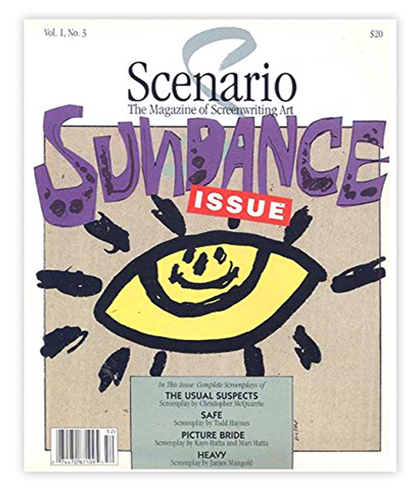
Originally published in Scenario: The Magazine of Screenwriting Art, Vol. 1, No. 3 (Summer 1995), pp. 184–191

Tod Lippy: How did you first become interested in environmental illness (El)?
Todd Haynes: I first heard about it on a TV magazine show, probably around 1990, during post-production on Poison. It was being referred to as “20th-Century Disease,” and I was immediately taken by the term. At that time, it was primarily housewives who were being afflicted by it—women surrounded by the chemicals in cleaning fluids, fabrics, fragrances. It hadn’t yet really become a problem in the workplace; it seemed to be more of a “domestic” issue. So, I thought the was very interesting. What I think mostly made it compelling to me was where these people were taken to—what kinds of treatments were being suggested at that time. Because it was not, like, “Let’s get out of the cities, let’s get away from chemicals, let’s commune with nature and camp out in the woods.” Instead, the women were moved to these arid desert spaces and put into trailer homes covered in plastic, where their lives were completely insulated and controlled. I found that to be the ultimate irony in the entire predicament. I think if there was an organic way out, I would have lost interest. And, of course, it tapped into a lot of issues that I’d already been exploring in my films related to AIDS.
How did you first go about researching this?
Whenever I had time in 1991, throughout the promotion of Poison, I tried to do research. I had heard about this little settlement of people in Wimberley, Texas—about 45 minutes outside of Austin—and while I was in Austin, visiting Richard Linklater [director of Slacker and Before Sunrise] and presenting Poison at the Dobie Theater, I met these two students with a connection to Wimberley through one of its residents, Susan Pitman. Susan, who produces a newsletter called “The Chemical Connection,” was a married woman with kids, well-educated, from Ohio, I think, and had come down with a severe case of EI. Her kids started to get it, too, so they moved to this little Texas town.
When she and her family first arrived, the locals thought they were out of their minds. I think she also came with a fairly educated outlook on health and women, with maybe some feminist information, and they all mistrusted her. At that time, a school was being built nearby where her kids were going to have to go, and she discovered that the most basic environmental restrictions regarding materials were being ignored by its builders; they were just doing it the cheapest way possible: no ventilation, formaldehyde-ridden everything, you name it. But the town wouldn’t listen to her protests, so it was built. And within an unbelievably short amount of time, students, teachers and custodians were all coming down with extreme physical symptoms.
This one boy whose mother I talked to had these dramatic, really horrible reactions: his whole face and body would swell up, and he wouldn’t be able to breathe. Once, when he encountered pesticides, his fingernails almost fell off, they were bleeding so badly. He would get a little better over the weekend, but then by the time Friday came, he’d be really bad again. He’d be screaming to go home, and the teachers just thought he was trying to get out of school, so they’d lock him up in the classroom during recess and lunch. The poor kid was getting worse and worse. After a while a lot of the women who had been so distrustful of Susan Pitman and all of her highfalutin discourse completely came around and together began organizing a series of protests.
Anyway, she invited me there for the day, and also invited several of these other women who lived in the area. People had built these open-air homes on stilts, using screens as walls, with dividers inside the rooms, and Susan and her husband had actually built this really magnificent home—sort of ’60s rustic, with extreme angles, pretty gorgeous. I have to say, it was talking to those women that day that really made me believe in EI, completely. I was probably most convinced when I heard the stories about the kids.
Some of those seemed to end up in the film.
Right, the quote about Chuck E. Cheese’s is a direct quote from one of these women. One woman who had been a custodian at this school was really sick, with the same symptoms as that little boy. She was quiet and unsure of herself, and very shy, but she loved being asked these questions, and when it was her turn to speak, she loved trying to communicate the group sentiment. I was really touched by her—she’s incorporated into the character of Carol. I saw in her a more working-class equivalent of Carol. I loved the way all of these women spoke, and I put a lot of their phrasing directly into the dialogue.
How long were you there?
Just one full day of recording them and being shown around. But I just continued reading all I could on the subject, and at the same time began researching the whole New Age phenomenon.
So after your visit to Texas, you continued writing?
Yeah, in fits and starts. Then, in the fall of 1991, at a friend’s place on Fishers Island, I took some time to work a lot of the material I’d collected into a script.
What did you do once you had a first draft?
Christine Vachon, my producer, was involved, as always, from the start. Basically, what I did for this script is what I usually do: get it to the point where I can handle the thought of showing it to a couple of friends. I usually start with Christine and Jim Lyons [editor of Poison and Safe], and then they read it and give me their feedback, and I do more work on it. And then I feel ready to show it to a wider circle of friends and colleagues and I get their feedback. It’s really not until after that process that I feel comfortable sending it out into the world. It’s hard to let it out to face that kind of perverse scrutiny; you really have no control over it at that point.
What happened after you sent it out?
Sony, Fine Line, Miramax, and Goldwyn got copies early on. No one leapt at the amazing opportunity, but then American Playhouse very quickly said they were interested. And very quickly after that they got their fiscal budget back from PBS and realized they were facing serious cuts. So they came back and said they were still interested in the project, but they didn’t have the money and they would have to wait. It was a series of situations like that. One of the hardest things, as Christine has said, is getting people to say no. To say, “Get out of here. There’s no way I’d be interested in doing this film.” Instead, they always say, “Well, maybe. We don’t really know what’s going to happen. Keep me posted. Let me see the next draft…” Everyone wanted somebody else to take the first step; only then would they feel a sense of security about it.
So the whole process to me was really eye-opening, and I guess sobering in some ways. After Poison, I had the maybe undue expectation that a budget of one million dollars was low enough of a risk to expect some creative freedom and final cut—that I’d be freed of a lot of the restrictions one faces in that context. For that amount of money, I thought, ‘”Okay, at least maybe I can do this.” Because Safe, unlike Poison, was the first film I’d made outside the world of artist’s grants. We knew it could not be made for less than that; I saw it conceptually from the whole as something that needed a certain look and a certain style, and a certain adherence to traditional forms.
So after American Playhouse said “maybe,” what did you do?
Well, due to the hounding of a few of the people there they came back around and reasserted interest in the film—maybe they had the money, after all, I don’t know—and we went to Cannes with them two years ago and tried to complete the financing. And after four sunny days, we got it together, or so we thought. Within a month, except for Playhouse and Channel 4 In England, everyone one pulled out, and we were basically back where we started. Luckily, l made Dottie Gets Spanked in 1993, so at least l could get back to work. And then I kept going back to the script and trying to look freshly at it and ask, “Okay, do I really want to do this?” And every time I read it, l was like, “Yes, I really do.” But it was hard at every stage. lt always is, but this one just felt tougher. My happiest moment was even before Sony took the film; it was after a rough-cut screening in New York when I finally felt that it was going to work. It made me feel like it was worth it. Directly following that screening, which distributors did not attend, there was some good word-of-mouth on the film. Sony and Goldwyn made offers, and we went with Sony. And they’ve been great; I’ve really enjoyed working with them so far.
When did Julianne Moore become involved in the project?
Not until after the script was finished. When we started casting the film in L.A., the casting agent, Jakki Fink, said, “You’ve gotta see Julianne Moore.” She also felt very strongly about Peter Friedman, who played Peter Dunning. I’d seen Julianne in The Hand That Rocks the Cradle—she was great in it, actually. Short Cuts hadn’t come out, but we managed to see a press screening of that, and I thought she was wonderful, but it wasn’t until she read for me that I knew she was really perfectly suited for the part.
Moore’s character, Carol, as you’ve said, is based at least partly on this woman you met in Texas. How did you go about taking that information and everything else and constructing Carol White?
You can really talk about that character in specific terms, because it’s so purposefully different from other kinds of central characters in movies. Most characters we are asked to identify with in films are not like Carol White. That was a very conscious strategy of mine, even before I met this woman in Texas. I wanted to see what it would be like to identify with a character who didn’t know who she was, and who I think represents how people really are in the world more accurately than most movies present them. I think most people carry out their lives without ever really examining who they are, and make choices in life where those kinds of questions don’t really arise. And compared to characters in movies, most people have a far more limited range of expression. Actors can express themselves very easily, and so they’re always doing that for us on screen, and we’re supposed to look to that, and see the ego-ideal expressing itself perfectly, humorously, beautifully, sexily—whatever—on screen. But I don’t think most people really know how to do that. So I was really interested in—not being “true-to-life,” necessarily, but asking something different from the audience’s identification because I felt, for one, that Karen Carpenter was not all that dissimilar a kind of character. Both Karen in Superstar and Carol In Safe are fragile personalities, each fairly overwhelmed by the circumstances facing them in their lives. And, in Superstar; the whole play of using Barbie dolls forced identification to cross over huge boundaries, to make this plastic doll whose lips didn’t move, in a very crude 45-minute movie, someone you could identify with.
My sense, from that film and all of the work you’ve done since, is that you’re pretty suspicious of this identification process. The use of Barbie dolls was a way to subvert it, yet people ended up identifying with the doll anyway. Were you surprised when that happened?
Not at all, and in fact, I’m not suspicious of the process; I’m totally fascinated by it. In each film I’ve made, identification is the focus of the experiment. By creating certain barriers, or boundaries, to the identification process and the easy access we usually have to central characters, the pleasure of identifying is not destroyed but revealed: it’s something that you can actually think about while you’re experiencing it. And I think that’s what happens in Superstar. It would have failed for me if people didn’t feel sad for the character, and at some point, go, “Oh my God, I’m identifying with a doll.” What I learned from Superstar is that people will identify at any cost. So I thought it would be interesting to see what it would be like to have a character who is pulled back from our access in a film in which the overall style is pulled back. I was feeling so sick of, and exhausted by, the acceleration of current film practice, particularly in Hollywood, to just get louder and faster and more heavy-handed and manipulative. I leave those movies numb, like an automaton, because all the work is being done for me. So I wanted to see what it would be like to tell a story very quietly, and create a film that gave you some space to fill in, some distance to cross as a viewer.
Was Los Angeles your first choice for a location?
I grew up there, and always did picture it taking place there. For one fleeting moment we considered a city like Dallas, but it just seemed like L.A. would be perfect, and probably a little easier place to shoot—although it wasn’t, really, in the long run.
Why not?
Well, I should begin by saying that casting in L.A. was the best casting experience I’ve ever had, and it was largely due to Jakki. Maybe my expectations were slightly raised by that. When it came to assembling a crew, however, we were really disappointed to discover what we were able to get for our budget. For the same amount we would be paying in New York for keys, for instance, we ended up with sexploitation movie-crew types. On the final day of shooting we had these middle-age guys with names like “Shark” show up on the set. In New York, you’d be working with people you’d want to hang out with afterwards, and talk to—at least you wouldn’t mind being seen walking down the street with them. [Laughs.] Anyway, it was very alienating. In New York people are willing to work on low-budget films like this because they’re into what you’re doing. That didn’t seem to be the incentive, most of the time, in L.A.
How long was your shooting schedule?
It was a six-week shoot, which was the longest I’d ever done. We had a very long pre-production time, too. I went out there in August 1993, and although we didn’t have all the money yet, it was looking better, so we decided we might as well just start. Often that really does help: people start to think, “Oh, it’s a real thing; it’s actually happening.” Our first hope was to try to shoot it before the Thanksgiving-Christmas-New Year’s chunk, but we realized, for a number of reasons to do with both financing and Julianne’s schedule, that we would have to wait until January.
Where did you find Carol and Greg’s house?
The living room, kitchen, breakfast nook and den were all from my uncle’s house in Malibu, which we transformed considerably. That whole greenish-wood thing over the fireplace was covering up a much earthier-looking stone wall, and we also brought in all of the ridiculous tchochkes. Carol and Greg’s bedroom and bathroom were from my grandparents’ house; that bathroom also served as the powder room Carol goes into at the baby shower. We transformed the exterior of their house to be the restaurant Carol and Greg walk out of after the client dinner, and their kitchen was used for the scene in Linda’s house. That was a multi-purpose place. And then my mother’s friend, Linda, gave us the use of her house for the shower at Barbara’s.
How about the exterior of the Whites’ house?
It’s one of those perfect things. When I first started thinking about Safe, I would drive up to the very top of my parents’ neighborhood where there was this huge monstrosity of a house somewhere between English Manor and Tudor—and I would sit there and listen to Sonic Youth and smoke some pot and think about how I was going to make this weird, creepy movie about people living in houses like that. And then we got the house.
And the Wrenwood section?
We shot at this Jewish summer camp for kids in L.A’s Simi Valley—Simi Valley is where the first Rodney King trial took place; it’s where many L.A.P.D. cops live—brand new, all white, very scary. Jurassic Park was shot there.
Something that is more apparent in the film than in the script, but which is absolutely essential to the success of Safe, I think, is your use of mise-en-scène. Could you talk a little bit about your use of the frame?
It’s funny, I don’t have a lot to say about this, because it’s said visually, and it’s probably said best visually. It was very thought-out on my part before picking a D.P., and after I found Alex, we both spent a lot of time thinking very, very carefully about the frame. Also about how to use camera movement In the most selective way. We do use the almost obligatory Hitchcock-Vertigo track-in/zoom-out, but in Safe, we do it so slowly you can barely tell it’s happening. We do it twice; when she’s drinking the milk in the kitchen, and when she goes to the living room in the middle of the film and she’s alone. I wanted a feeling that the walls were breathing almost. Beyond that, it seemed important to always include architecture in relation to how Carol is depicted, so that she’s always being defined and determined by her environment, as if she were just another one of its objects.
Does your background in painting inform this pictorial sense? At one point, you said the difference between painting and film is societal and political. Can you elaborate on that?
Well, just for me. When I was last really painting I was in college, and what I was beginning to deal with were figurative concepts and ideas. I guess it really goes back to being a kid and drawing constantly, learning how to render the world representatively and master the images I saw around me, particularly images of women. Because gradually what you learn is how representation is inherited, and the images that we master reflect the society around us. So in college, after trying to reject those images—making abstract paintings and experimental films—I began to feel like they were kind of inescapable. And that my ideas and convictions had to do with ambivalence toward those images, a love/hate relationship to narrative in general. So reincorporating them into my painting was the first step. But it wasn’t long before I felt that film, which had always been an interest of mine, was the perfect medium, in its history, for dealing with societally informed representations of ourselves. Representations that both reflect us and inform us. For me, nothing felt as innately cultural as narrative film.
On the surface, Safe is rather conventional. It is a very linear film, certainly for you. Superstar, as we’ve discussed, utilized dolls to underscore the identification process, and Poison featured an untraditional, concept-driven narrative structure. Safe does, however, share a feature that is evident in all of your films—the veering back and forth between a slightly mocking, even campy tone, and a more naturalistic, sympathetic one. I think of the parodic feel of the baby shower, for instance, compared with the extremely moving final speech of Carol’s at her birthday party. Do you agree?
Not particularly. People have responded, especially when reading the script, to that baby shower scene as funny, and fun, and as the campiest in the film—all the good stuff about camp that I do love. But it wasn’t my intention, actually. It’s still a really sad scene to me. I mean, you can laugh and it can be sad, of course. But although I was describing a world that is very different from mine, it’s still a world that I know through friends of family, and it was never my intention to make fun of them. It’s like making fun of New Age. My challenge was not to ridicule this world, but to look at nouveau-riche Los Angeles in 1987: what fills up Carol White’s day. Yes, getting a couch the wrong color is laughable, but it seems like the worst thing that can happen to her, or at least a big pain in the ass in her life.That was my challenge: not to make it laughable, or dismissable—but strangely tragic. I think you can still laugh at worlds that are different—I mean, I hope people laugh at Wrenwood, for instance—but ultimately know that that’s not the final position the film is taking, and that all of the women who surround Carol are worthy of the same compassion that we give her, even if she’s a little more quiet, a little more fragile, than they are.
There’s this interesting piece about Poison by Maurice Berger in Artforum, in which he sort of takes you to task for “hindering meaning and distancing the viewer.” He goes on to say, “The voices of the left must find better ways of better reaching people without compromising artistic or theoretical rigor.”
He’ll love Safe. [Laughs.] For one thing, I will never be comfortable with prescriptive kinds of filmmaking, with political position-taking in films. I’m happy to do a critique of something I feel uncomfortable with, but I have a very hard time with presenting an alternative to that, creating “the revolution” on film, and giving it to you in that form. Some people—although this probably doesn’t pertain to Maurice Berger—won’t really feel like you’re being “political” or “clear” until you do give them a solution, or present a thesis. So, for those people, I don’t think my films will ever be particularly satisfying. But I think Safe is maybe the most subtle kind of critique, and in that way, more accurate a critique, of aspects of the failings of the left. I don’t think it’s a film “by the left.” I think it takes a more radical position—it’s looking at the left critically, looking at how it’s failed, particularly in relation to the New Age influence. I feel that there has been a shift in a general consensus among the left from looking outward—being political and looking at a culture from a critical perspective—to a turning inward. Whether or not this is the result of people feeling that the movement has become completely powerless, I don’t know. But the left has sort of imploded onto ideas like the Self as the all-powerful being that can get you out of anything. I kept coming upon this over and over again in the research I was doing on the New Age, particularly in reading books like Gloria Steinem’s Revolution from Within, which is coming from someone who comes out of practical leftist thinking, who represents this change. Ultimate faith in the all-encompassing self. It’s a disturbing sight.
Let’s talk about the relation of New Age thought to the Wrenwood segment of the script and film. Was this kind of retreat environment based on anything?
It mostly comes from a visit I made to a yoga retreat in Lenox, Massachusetts. It probably started out as this really great place set in lush mountains, but the actual edifice was a renovated prison: this long, brick building, with weird low carpets, and paneling, and a very institutional feel, despite hanging plants and bad paintings. Many of the creepiest specifics of Wrenwood came from here, including the rules about sex and dress, the seating of women on one side of the room and men on the other.
Are Peter Dunning’s speeches based on things you heard there?
They probably came less directly from speeches being made there and more directly from stuff I was reading. But things like the workshop Carol does, that was something they did there.
There is a faction of psychiatrists and traditional doctors who really do believe EI is entirely psychosomatic, and this difference of opinion seems integrated into the film. For instance, Carol reacts violently to the chemicals being sprayed in the dry cleaners, but she also has trouble breathing around her mother.
I don’t think any of these ideas are absolutely put to rest in the film. I don’t think I ever make an absolute division between chemically induced physical ailments and emotionally induced physical ailments. I think that people can legitimately become susceptible to chemicals. We see the adverse effects they have on the environment, so why wouldn’t our bodies be affected by them? And yet the film is designed to encourage you to read into Carol White; to search for psychological answers. Only at Wrenwood do we see this very procedure as an abusive—or at least repressive—act, as Peter Dunning summarily blames each sufferer for his or her illness.
Can you talk about this film in relation to the specter of AIDS? There are subtle and not-so-subtle references to it throughout the film.
AIDS was the deciding factor in making the film; it wouldn’t exist otherwise. Once again, I’ve chosen to make a film about AIDS that isn’t about AIDS. Why do I do that? I guess because I like forcing people to consider AIDS separately from the specific cultural biases and stigma that are placed on it, which I think often give people a way to dismiss it, or at least not necessarily apply it to themselves. I wanted to do this by placing it in as “safe” a place as you can imagine, as far away as possible from the worlds we usually associate with AIDS. But it’s also specifically about the trend in the 1980s in which many gay men turned to people like Louise Hay and other New Age writers for spiritual guidance. I wanted to learn why people subject themselves to a sense of blame, and how that can be consoling on some level.
The “pollution” in this film is not only chemical: there is the constant appearance of radio and TV white noise—chat shows, morning news programs, soap operas—into the visual and aural realms.
Even more in the script than in the film. The point was that information is part of our chemical contamination. The film is ultimately trying to critique what happens when meaning is something we strive to fill every open space with—I mean, in a funny way, the film creates all of these surfaces that we’re supposed to fill in, and give depth to; you know, Carol can be seen as this kind of blank character, and the viewers are going to sit there and think, “Oh, maybe she’s insecure and she had a bad childhood and her mother didn’t love her”—that kind of thing—you keep filling in what is almost set up as a challenge of surface or shallowness. Ultimately, I think the more you fill it in—the more you deepen it and provide meaning—the more trouble you get into, and the more Carol is buried alive.
Let’s talk about some differences between the script version published here and the final film…
Overall, I should just say, since it might become a recurring answer to all of these questions, that even now the film is long—almost two hours—so I had to cut out wonderful actors, wonderful scenes, wonderful moments. lt was very rare that I edited anything out because it didn’t work. I would just feel that the film was working better as a whole without it.
First of all, throughout this script there appear intertitles: “immune,” “safe,” “freezing,” and the like. Whey didn’t those end up in the film?
For the rough-cut screening that we had last summer, we just had red leader where the titles would go; we told the audience what they were beforehand. And I think that we all felt afterward that they weren’t necessary, and that there was a way in which they made a film that was already pretty arty, pretty refined, even more so. You only want to go so far with that shit.
There’s a distinctly “visual” scene in this script that takes place in the furniture store, with the bank of televisions broadcasting the soap opera character’s speech about mistaken identity: “I don’t know who you are anymore…”
I know, I know. We had it in; but the biggest change we made, which you might be coming to, affected that scene. We moved the whole garage reaction scene to earlier in the film. It had a much more drastic effect than just switching around scenes often does, because what happens is, you witness one of Carol’s most dramatic reactions, and she doesn’t tell anybody about it. So the more public reactions that follow are seen as her “coming out” to the world around her. It also served to better explain a fairly long sequence of scenes that follow of her completely alone at night. You know, she wakes up in front of the TV, then she goes out and stands by the pool, all that stuff. In the script directions, it’s mentioned that she’s starting to feel kind of dizzy, but all of this dwelling on her alone, and her being cut off from everything, wasn’t really explained in the film. I felt really strongly about those scenes, and wanted them to be fueled by a little more information, so Jim and I put the garage scene earlier.
What about the question-and-answer scene in the script that takes place after the first instructional videotape Carol sees?
That repeated information. Again, I have pangs of regret. We had some non-actors from my dad’s office stand up and ask questions. His amazing assistant, Olivia, this gorgeous Latino woman, did the best job, and I felt so bad because we had to cut it out. But it was just too much information. What’s funny is that in the film, especially, there isn’t really tons of El jargon although I guess it’s a lot in accumulation.
That’s actually another interesting point. It seems like all of that didactic information is relayed by either television, radio, tapes, or speakers: all voice of “authority.”
It’s always a really hard thing to write without sounding so hokey, like putting it into the guise of a normal conversation. The closest we get is the scene, which always sounded to me like the most traditional scene from this kind of film—even a little bit like an adventure movie scene—where the allergist gives her all of the injections. “What we’re doing now is testing one of the blah blah…” And when she reacts, he exclaims, “Nurse! Can we have—” It was very conventional, but I sort of liked it because it was so corny.
There’s a scene after Peter’s first speech in the chapel at Wrenwood when Carol is coming outside and meets the character of Chris for the first time. In the directions, you describe a “smooth backtrack” as she and the others have a conversation. What happened to that one?
That was a cut after the Sundance screening, when we shortened the film. I was never happy with the way it came out. Because the whole place was earthquake-compromised after the 1993 quake, we couldn’t shoot people coming out of that building.
Did the earthquake occur during production?
Right smack in the middle of our production schedule. We were shooting the entire Wrenwood section through a series of aftershocks. I remember the night we were shooting that final group scene, where everyone toasts Carol in the dining hall. We were doing the reaction shot of Peter and Claire and all of the other actors listening to Carol give her speech. Julianne was feeding them her lines off-camera: “We have to be aware of it…reading labels…going into—” and all of the sudden we got a really serious aftershock. Kate McGregor Stewart, the actress who played Claire, just put one hand on the table to steady herself, never changing her expression, and all of the other actors somehow managed to keep perfectly in character. When the aftershock subsided, Julianne says in this very quiet voice: “buildings.” [Laughs.] That’s the take we used in the film. They’re in true fake-face mode.
So how did the damage from the quake affect the shot in which Carol meets Chris?
We had originally planned a long, slow track out from the building itself, directly out the front door on this nice ramp. It was a beautiful, symmetrical shot, and Alex and I had it all planned out, so when things changed at the last minute, we had to stay so far away from the characters—they were like little peas—it was like Superstar. Aesthetically, it didn’t please me. and it had a kind of clunky expository quality to it: “So, do you know your way back from here? It’s just down there…”
Did you direct James LeGros to play Chris is such a goofy way?
Mostly. Chris was, in some ways, the most challenging character, because he’s such a plant, and there’s such an expectation and desire for him to close the film happily as some sort of hopeful future for Carol. The game plan from the start—and Julianne was so cool about this, so personally invested in it—was that there would be no sexual magnetism between Carol and Chris. Most actors would say, “Can’t there be a little something there, just to make people feel better about me as the character?” And Julianne was like, “No way.” We offered James the part, and I didn’t think he’d take it because, you know, he stars in movies all the time. But he did, and he literally put on weight, a little belly, for the role, and wore that stupid rugby shirt. He also played it up quite effeminately, and I’d never said, “Your character’s gay,” because I thought that would be too easy.
He’s more of a generic dweeb.
That’s what I thought, and that’s exactly how I wanted that character to be read, but some people thought he was gay. I saw him as a dweeby guy who lives so far away from other people that he doesn’t realize he’s being kind of effeminate. He doesn’t see himself. Speaking of that cut—the one in which he’s introduced—now the transition really works from the scene in which Carol is in the chapel, where you’re wondering what she’s making of all of the singing and everything. Instead of going to the long shot with all of the conversation, it goes directly to the scene of her walking by herself in the dark woods, approaching her cabin, where she breaks down and cries, which is so much stronger.
Why was Carol’s visit to her mother in Texas cut?
We shot the scene and it came out beautifully. We had a great actress play the mom, who actually bore an uncanny resemblance to Julianne, but when we showed it at that rough-cut screening, it was just unanimous: people felt like, you’re at Wrenwood, and you want to know what’s going to happen. I personally would’ve felt like you’d want a break from Wrenwood at that point. Also, the logistics of how she got there were disturbing to people.
Cutting that scene led to another shifting around of the final part of the film. If you just took that scene out, and followed the script order, which we did until late in the cutting, it would go from the scene after the final chapel scene, when Carol, Greg and Rory are walking outside, see Peter’s house and hear Nell crying, directly into the Carol-moving-into-the-safe-house/goodbye scene. And then, finally, the healing-circle scene. Which makes sense, because you don’t know where Greg and Rory are during that scene, and in the script, they’ve already left. But we decided to switch those around in the film: the circle scene appears before Carol moves into the safe-house and says goodbye to Greg and Rory. I think what the circle scene did was take the place of the mother scene as a kind of final screw in Carol’s eventual surrender to the safe-house and Wrenwood, because it was this kind of intense, very disturbing scene. You just assume Greg and Rory are busying themselves during the day, and Carol has to do her workshop things. I think it works well that way. It’s also very sad when you see Lester walking by, and then Carol, marching sadly, safe-house bound.
After the Sundance screening, I know you added a brief shot of Peter’s house, in the scene in which Carol and Greg are walking back lo her cabin. Was that in your rough cut? In the script, the house is described as “adobe”-style; in the film, it’s quite different.
Peter’s house on the hill was something that was always there, from the first draft. The idea was to point out that the kinds of houses that define Carol and Greg’s life in L.A. also define success in this world; to imply that the value systems were not so adversarial. But of course, given the fact that we were a very low-budget movie on a very tight schedule, you take what you can get, and the only house we could find in a comparable landscape was this huge, white mausoleum.
When we showed it at our rough-cut screening, everyone broke into hysterics. It was a uniformly noted point in people’s comments that it was not necessary. You get it: Peter’s creepy enough. I felt the same way, and so did Jim Lyons. He thought it was very neat to have the characters mentioning it without showing it; he liked the aesthetic simplicity. But ultimately it wasn’t an aesthetic choice, it was about introducing a piece of evidence or information about this character that played very strongly in a film as subtly balanced as Safe is.
Where did you find the source music for the film? It’s a perfect organic accompaniment.
Well, the Kenny Loggins/Stevie Nicks song is in the script. When Carol’s out on the deck, she sings it as a sort of foreshadowing thing. Actually, a close friend of mine once went through “Lifespring”—it’s sort of a cult, an EST-y type thing—and I went to his “graduation” ceremony, and it was very strange. It was in New York, in this huge hotel ballroom, and all of the people who’d gone through the program were arm-in-am, with their eyes closed, in a huge circle. You walked into the middle of the circle, and it was dim, and they were playing the Kenny Loggins song “Come Celebrate Me Home” really loud, and everyone coming in to greet their friend was holding a light-up plastic rose—I don’t know why this didn’t get into Safe—and as you walked in you heard a voice say, “Come in! Find your friend! Stand opposite your friend and wait for them to open their eyes and see you!” And we found our friend and he looked like a wax replica of the person we’d known.
So the use of pop music in a New Age context struck a chord?
Yeah, I’m very proud of my selection of music throughout. [Laughs.] Safe is so bravely uncool; almost every element of it. That’s one thing I can say conceitedly.
Let’s talk about the ending. Variety called it ambiguous, and said it “merely left the viewer hanging.”
Well, you have to realize that the person who wrote that review also called the film “preachy.” Tell me that I’m wrong, tell me if l’m misinterpreting this, but the only way you could take the film as preachy is if you took the Wrenwood segment seriously. If the film were preachy, then it would be on the side of Peter Dunning. That says a lot about how he could take the ending as inconclusive.
The two final words in the script are “nothing happens.”
What I wanted to do with Safe was to create a story in which you watch your own narrative expectations drive this woman into repression.The film is about belonging to groups, and that’s where identity comes in. In the beginning, she’s part of a group—these upper-middle-class suburban women—and she has this sort of unexamined sense of who she is. The illness forces her to look at that, and all of a sudden realize that the group has problems, and she has problems, and the world has problems—things aren’t working, and that’s why she’s getting sick. But identity is there to not be thought about; we feel like we know who we are when we’re not thinking about who we are. As soon as we think about it, and look at it—it slips through our fingers. So she wants to get back to that point where it’s not thought about anymore, where it’s just a given. So Wrenwood with its group becomes a place that offers that safety in exchange for complete adherence to its own set of rules and logic.
So the film almost pairs these two groups; they both share a great resemblance to one another. She moves from one to the next with this series of chaotic questions in the middle. And this epitome of looking at yourself in the mirror and proclaiming your love for yourself, I mean, it’s such an empty way of acting out, proving your identity. And it should feel false; nothing does happen. Her cysts don’t clear up on cue.
But I always wanted to counter that with some sense of—not happiness—but…relief. It’s like, this is how movies end. They end when the character “finds” herself. But what has she found? And what does “finding yourself” ever mean? Most movies never give you any indication that endings like this are really not very happy, except Douglas Sirk’s. And that’s the best model I can think of. It’s a false happy ending; it’s an ending to a situation that you’ve learned enough about to know why it doesn’t work—to know it rings untrue—but you’re still getting everything you’re “supposed to get” from the end of a movie.
There’s an interesting organic relationship between the film and El, which is anything but clear-cut...
That’s what’s funny about disease movies, because you can’t resolve diseases. Affliction movies ostensibly tell you about an illness but eventually shift the emphasis to the personal, and the character’s job, basically, is to come to some sort of transcendent understanding of themselves or their world that the disease teaches them. But the responsibility is basically on them to solve these conflicts. They could die at the end, the disease could be cured, or not be cured, it could be about telling their children—any number of things can happen—but this understanding is the one thing that’s consistent from one to the next. So Safe does the same thing, it takes up those terms, but with such huge obviousness, like: Here we have an Institute of Transcendent Resolution that enters the movie at the appropriate time. It’s like a machine, it lays it on so thick about how this transcendent closure should be achieved. It just takes these forms and expectations and makes them omnipresent, but at the same time, chips away at them. You see the cruelty of it, and the personal tolls these kinds of resolutions take on people. Claire might have said “I love you” in the mirror and got better and better, but you see Carol through all of Wrenwood gelling worse and worse, and ending up in this tomb, this mausoleum, this pre-made grave that someone just died in. It’s sort of a death, in a way. A lot of people say the movie is very clear at the end: she dies, whether it’s a physical death or not.
(The interview with Todd Haynes was conducted by Tod Lippy at Scenario’s offices in New York City.)