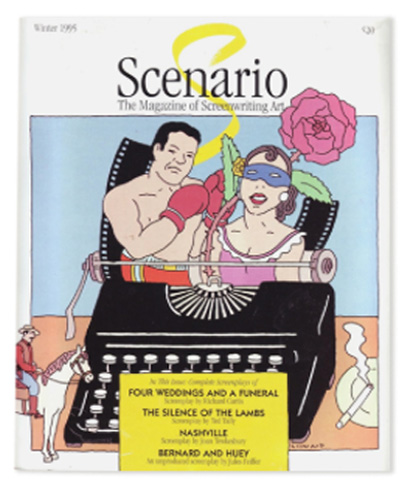
Originally published in Scenario: The Magazine of Screenwriting Art, Vol. 1, No. 1 (Winter 1995), pp. 105–109, 205

Tod Lippy: There’s a great story about how you originally hooked up with Robert Altman.
Joan Tewkesbury: Right. He’d seen a play I’d directed in 1969, and had apparently liked it, so I figured, why not? I went to his office and asked if I could work with him. He gave me the script supervisor job on McCabe and Mrs. Miller because he wanted to use the Canadian script supervisor as one of the whores.
That must have been a good way to learn about how to construct a screenplay.
Yes, but it was the hardest job I ever had. I’d adapted books for the theater before, but with film, each scene is like a whole little play inside of a play. In the case of watching people do McCabe and Mrs. Miller, you realized that there was the essential play, and then anybody who came to participate in that play added their play on top of that play, so it mushroomed into this multidimensional thing that got its picture taken.
After that you wrote a screenplay called “After, Ever After” for Geraldine Chaplin. You approached Altman for help in producing it?
Well, I showed it to Bob and he said he’d try to produce it. He’d never met Geraldine—neither had I, for that matter; I just wanted her to play the part—so he brought her from Spain and we all met. Ultimately, he couldn’t raise a nickel on me as a director, so that’s when he asked if I minded not starting at the top, and would I adapt Edward Anderson’s novel Thieves Like Us.
How did you handle that adaptation?
Well, all the dialogue was there. I mean it was absolutely there in the novel, and Bob knew exactly who he wanted to cast. I’d met all of these actors on McCabe and Mrs. Miller, so I knew their idiosyncrasies, and you could marry those with what was going on in the book, so it was like writing songs for people you know. It felt very comfortable to me.
That obviously came back into play for Nashville.
Yeah, very much so.
How did you get involved with this project?
Nashville was already the center for country-western music, but everybody else was exploring coming to Nashville to record because it wasn’t so formal. They could gather people together and be very spontaneous about playing and improvising their way through things, and that appealed to everyone. The biggest industry in Nashville was Bible printing, not country-western music. The Grand Ole Opry was a wonderful old hall that didn’t seat very many people—it sort of looked like your old high school auditorium. Someone had approached Bob to do a film about Nashville. He asked me if I knew anything about country-western music and I said I didn’t, and he said, “Would you like to learn?” And I said, “Sure, fine.” So Bill and Taffy Danoff, singers and songwriters who at that point were part of the Starland Vocal Band, helped arrange for me to go down there and link up with the ASCAP people. I got the official tour—you know, the museum that shows you Patsy Cline’s hairpins and somebody else’s guitar pick. It was all very nice, very pristine, and I remember thinking, “No, no, this is really bullshit.” There was no “there” there. I was shown all the historical sites, and everybody was really nice, and I stayed three days and went back to the office. It was about that time that Loretta Lynn’s picture was on the cover of Time or Newsweek.
Then Nashville had its first drug bust; and String Bean, who had been a regular at the Grand Ole Opry, was murdered, and it was like, suddenly Nashville wasn’t so rarefied anymore. It had been invaded by all of these outsiders who brought their worlds with them. By 1972, ’73, recreational drugs were interfacing with alcohol and uppers. It was confusing for a lot of the regulars; it was the beginning of a different time. So while we were in Mississippi shooting Thieves, I went back and made arrangements with a booking secretary I’d met who gave me the times and places of recording sessions. And just like Opal, I walked into recording studios with this dumb, big, yellow legal pad, but unlike Opal, I’d sit and watch, try to fit in. I met some recording engineers who recorded gospel music. lt was astounding, like the lid lifted off your brain. I was having intense musical experiences inside of recording studios, watching people get high on their own sound. Then I got in the car and drove up and down streets, looked at rented rooms, went to stores that sold weird western clothing, and ended up eavesdropping in a lot of restaurants.
I stayed at the King of the Road hotel, where the room rugs were thick shag—red or blue or orange—and every morning the maids came in and raked them with a rake—no vacuuming, just raking—and I thought, “My God, this is great, but what’s the story?” Then I began to notice that if I’d see somebody in the morning, I’d usually see them at least one other time during the day, because the town is built on a circle, and there were only so many places to go, and everybody’s paths kept crossing. l began to wonder what that guy I saw at one point did between three and five o’clock, or five and ten. Then somebody told me that the best place in town for music was the Exit Inn, an after-hours place.
The night I went, the Barefoot Jerry was performing, and there was a radio station in the club, so anything that played inside was going out onto the airwaves. And there was a girl—I don’t know what she had taken—who passed out on the table in front of me, where I was sitting. Then this Black man came up to me and said, “Hi, how are you,” shook my hand and slid a joint up my wrist. He said that he had just gotten out of jail on premeditated murder—he killed the man his wife had been involved with, and he’d been in jail for 26 years and studied law to help get himself out. He told me he was working three different shifts at the hospital and he didn’t like to sleep, felt it was a waste of time. After work, he’d come to the Exit Inn and stay there until it closed.
Well, all the time this was going on the Barefoot Jerry was singing “The Words to This Song Don’t Mean Anything at All” and I was separated from my kids for the first time and I was missing them, and then finally I realized this was exactly what the movie was about. A person comes to a town like this, and it doesn’t matter whether you’re in the movie business, the Bible business, or you’re a traveling salesman. You come to town and these are the things you experience in the present while your past is running this other movie in your head simultaneously, and pretty soon serendipity takes over and starts combining what’s real with what’s made up, and you lose track. I interfaced with a number of people during that week who I didn’t know, but who reminded me of people I did know, so they became the characters.
I read somewhere that the Danoffs were the template for Bill and Mary.
Yeah, and then there would be a character like a Loretta or a Patsy or a Dolly or a movie star. Those archetypes are constant—I mean, they’re the same today. You could go to Nashville and construct something similar, only now maybe their hair would be green, or they’d have a ring in their nose. And then added to that, I’d been with Altman at the Cannes Film Festival with Thieves Like Us and watched the press literally assault Geraldine Chaplin wherever she went, so we thought it would be interesting to have one of these foreign press types—you know, an “I’m here for the experience” kind of a groupie—so I combined that idea with “the groupie” Opal, and Geraldine got to be her own worst press package. The Tricycle Man was based on a guy who was working for Bob during Thieves Like Us. He was a Hell’s Angel, and a bit more sinister-looking, and his magic had a little bit more to do with serendipity, rather than with the actual event of making magic. This guy had ice-blue eyes and yellow sun goggles. He wore a beaded beret and rode this tricycle across the United States. He would ride into town and people would run in the opposite direction.
Tell me about your first draft, the one you completed upon returning from your trip to Nashville.
The first draft was 18 characters. Off of that draft, we then went to the draft that is published here, with the first overlay of the politics, the beginnings of the character of Triplette, and substantially altering Haven Hamilton’s character. So instead of subtracting things, I just kept pushing stuff in, so the screenplay became huge. All of this was the source of what was done later for the political speeches and all of that.
The political speeches in the film were all written by Thomas Hal Phillip, the novelist?
Yes, they were. His brother had run for governor in the state of Mississippi, and Thomas we had met when we were shooting Thieves. He was a lovely, genteel southern man. Now, those speeches seem like a cross between Al Gore and Ross Perot. They are so smartly dumb you can get caught up in them before you realize it.
From what I understand, this version of the script was given to all of the actors to read.
Right. and then Bob said, “Don’t read the script.” [Laughs.] but it served as a bible. And oddly enough, when you go back and see the film, a lot of the stuff may not be there, but it’s in there.
I think that that’s at least partly a result of your particular way of writing directions. One journalist called it “well-ventilated characterization.” You manage to evoke the essence of a character by suggesting something that may have happened in the character’s past, or by describing his or her actions in such a way as to “position” them. The description I remember best is where you characterize Opal as “writing down everything, therefore missing a lot,” which is the absolute essence of that character in the final film. As you said, the screenplay is very different from the film, but if you read carefully, almost everything has its origin in the script.
The great thing was to be able to watch it shape itself. For instance, Barbara Baxley, who played Lady Pearl, brought in a dozen or so pages of what she thought her character would talk about, then I’d hone it down.
So you were doing constant rewrites on the set?
They’d write, I’d read. You know, I’d sit there and watch. It usually never went too far afield. If it did, you’d offer another possibility. But for the most part, it was fine. We’d talk: we did a lot of talking.
Did you write character histories for each character? It seems like there are short ones written into the directions of this draft.
Yeah. I’d talk to the actors, and then Bob talked to them, and then we’d all talk some more. It was like repertory theater. Actors incorporate stuff for themselves. It was very important, especially in a piece like this, where 85,000 things were happening at once, that you be pretty clear about who you were.
For instance, Geraldine had a different life experience from any of us, so she was encouraged to write her impressions as honestly as she wanted to. Political poems with a twist. Barbara Baxley wrote reruns of material. Her speech in the film about working for the Kennedy boys was stunning, and conveyed the moment in a woman’s life when she has firmly committed herself to something that takes her life over, and she’s never the same after that.
In this version of the screenplay, Lady Pearl is a pretty insignificant character, and not at all connected to Haven Hamilton. How did that come about?
Because we figured that Haven would have a mistress; those kinds of guys usually do. We decided to take all of the elements of Lady Pearl having that bar and joining up with Haven because his wife wasn’t around. It was really to compress the material. You began to see where you could tie some knots—in this case, it just made a lot of sense.
Most of the actors wrote their own songs, didn’t they?
Yeah, they were all very busy doing that. Keith Carradine [Tom] had already written his—
“I’m Easy” and “It Don’t Worry Me” are both mentioned in this draft.
Yes. He came in and played those songs for Bob. They were perfect. And Richard Baskin [Frog] and Henry Gibson [Haven] wrote some of the best dumb songs I’d ever imagined. But the one song, “There’s Trouble in the U.S.A.,” at the very end of the movie, touches me to this day. It seems to sum up that point in time. All those songs became a sort of subtext for everything else that was going on.
How many parts in the film were cast when you were writing this draft?
I think by this time, we sort of knew who was going to play all of the characters, except for Ronee Blakley. We thought Barbara Jean was going to be played by Susan Anspach.
There are some scenes, or subplots, that appear in this draft of the screenplay that didn’t make it into the final film. One substantial one is the opening scene in the script in which Tom is in the New York record company office. What happened there?
When the political campaign went into high gear, it was dropped. It was decided to make this not just about the music business anymore but really to make the metaphor larger. So it became about another form of entertainment business coming to Nashville. namely politics.
The change works well in the final film, because the action never leaves Nashville; there are allusions made in phone calls and spoken references to “outside,” but the film is permeated with that environment—
Absolutely, it works better. That scene had been done to show that Nashville might represent the king of the heartland and all of that, but dollars and cents were all in New York, the epicenter of the business world.
Another subplot here that didn’t make it to the final film was the string of unsolved murders in the Nashville area.
That was true: that was going on there at the time. String Bean had been murdered, and they never found his killers. It was the first murder of a famous person in Nashville. It was like stepping into virgin territory, and devastating to that community. A lot of people thought that nothing like that would ever happen there. So I used the resonance. Later, it just got refocused to the end.
In the original draft, from what I understand, there was no assassination in the end, and even in this version, it’s handled quite differently.
It wasn’t part of the first script, but it seemed the country had assassination fever, and we got to talking about why and how and then Bob said, “What if it happened to a woman…?”
Why did you pick Barbara Jean as the “fall guy?”
Altman decided she was the most visible target. At first it was hard for me to justify, it seemed so arbitrary. But given the events of the last several years, it unfortunately doesn’t seem that way anymore. The person who was getting the most attention being destroyed by the one who’s getting none. You know, shooting at the symbol of what’s supposed to take care of you and nurture you, not unlike the guy shooting at the White House recently.
And how did you decide who was going to kill her?
Kenny was a fairly innocuous character, so as we began to lay the groundwork. I said, “Okay, the nicest, most in-control person will be the real nut,” like the guy who went up in the tower in Texas and shot 14 women, or like Oswald, or like all the others who came afterward.
I understand that at one point you were not even sure you wanted the killer’s identity to be revealed at the end.
Revealed, but more confusing. Glenn was pretty weird. He’d sort of paved the way for that kind of outburst, so I thought there ought to be a real fight between the two men, between Glenn and Kenny, so you thought that Kenny was trying to save Barbara Jean until you realized that wasn’t the case at all.
Also, in the final scene of this draft, we finally get to meet Hal Phillip Walker.
It was decided that in the film you would never get to see him, which I love. I love that. It’s so much better. You know he’s in the car, waiting it out in the air-conditioning. And then, at the very end, those cars are out of there in a matter of seconds like a bunch of black crows fleeing doomsday and poor ol’ Delbert is left holding the bag.
In this script, Joan is pregnant, and there is a scene in which Tom is apparently paying for an abortion for her.
Oh, yeah, I forgot about that. Yeah, he did. But again, a lot of things like that got the axe. There just wasn’t room.
There’s a scene in Ryman Auditorium in this script in which a preacher performs a sort of evangelical service between acts.
Yes, that was very much a part of the program at Ryman Auditorium. What happened was, by the time we got there to shoot, we couldn’t shoot in Ryman. They had built the new Grand Ole Opry, and they didn’t want to have the older auditorium be representative of Nashville. They didn’t do religious interludes in the new hall.
Did that somehow get transmogrified into the sequence of cutaways of church services in the film?
Probably, but it was also following the days of the week. You arrived in town on Thursday, and basically we were just showing what everybody was doing every day. So on Sunday, Linnea not only sang with the gospel singers professionally, she also sang in the choir. A lot of singers do sing in choirs around town. But it was a way to handle religion very succinctly.
There’s a scene between Star and Opal in the truck, fairly lengthy, which didn’t make it to the film. It seems like a lot of that dialogue ended up in other scenes in the film with Opal and other characters.
Yeah, it did. That was my version of Easy Rider. It was very much about the period. A young woman hitchhiking, who gets a ride from an old fart who stops for her, and all he’s got in his mind is finding his runaway wife, and getting his cow back to the barn.
Wim Wenders wrote an essay about Nashville years ago in which he calls it “a film about noise.” He talks about the constant use of traffic noise, concurrent dialogue, the political speeches, and most of all, music. In this version of the script, it’s very interesting, because you didn’t have the actual actors’ songs, and you couldn’t have known yet about Altman’s eight-track system, but there are still references everywhere in the script to background music. There’s more of an almost Wagnerian way of ascribing a musical motif to every character: For instance, in the scene in which Linnea talks to Tom on the phone, you write that in the background on her end we hear Menotti’s music from The Telephone, and on his end is Tammy Wynette’s “D-I-V-O-R-C-E.”
I forgot about that. When you were in Nashville, you never went anyplace without a constant soundtrack, and television noise, and the maid raking the rug. The whole city was about making music of some kind, and it wasn’t necessarily all country-western. There was a lot of classical music. It was this inundation. Wenders is right, it was like a wall of noise coming at you constantly. Like my experience at the Exit Inn. I was hearing this song performed live that was being broadcast over the airwaves, while these people were making their own kind of music at the table in front of me, and this guy beside me was singing his opera, all simultaneously.
That must have played directly into the scene in which Linnea goes to Tom’s show there.
That scene was exactly as I experienced it—I’m Lily Tomlin [Linnea] in that scene. And I am watching a variety of girls all look at this same guy, and I’m thinking about men l’ve known who have that kind of charisma, and there are at least four girls in the room who’ve been to bed with this one man. Only they don’t know it.
Nashville is a deeply cynical film—it’s almost astonishing how far it goes—but it contains an undercurrent of humanism, which seems to have its origin in the script. My sense is that the final film is a perfect marriage between Robert Altman’s fairly jaundiced political sensibility and your more personalized take on each of the characters, which is much more apparent in this draft.
It was a good marriage. The thing was designed so that you were the 25th character. You, the audience, are actually every single one of these people as well. And that’s why, if you go to the movie, and see it on several different occasions, you will identify with different people every time you see it, depending on where you are in your life at the moment.
There are several “outsiders” in the screenplay: Opal is the most obvious, but Triplette, and Tom and Mary and Bill, all offer running commentary. How much of your own experience as an outsider has to do with their characterizations?
Triplette is me working for Bob. It’s me trying to fulfill somebody’s needs, being the manipulator, trying to appease everybody, trying to get the goddamn troops to show up at the same time, making promises you know you can’t keep. It’s like when you don’t have the money in the bank and you postdate the check. Sometimes it works out, and sometimes it doesn’t. And the great thing about Triplette is, he moves slick and fast through life. He doesn’t stop to see if the bridge burned down in back of him or not.
During production, how often did you find yourself defending a scene from either excision or revision?
The only time my heart was in my throat was the morning that we shot Sueleen’s striptease. Her character was based on—I’d done nightclub work, and she was sort of a compilation of all these women I had worked with. This one girl I knew was a singer, and she could not sing for shit, but she had this kind of eternal optimism, and went to church every Sunday, so I sort of wrapped Sueleen’s character up with all that and a layer of ambition.
Could Gwen Welles actually sing?
Not a lick, as Ned Beatty [Delbert] would say, but she was trying, she was taking music lessons, and Bob kept saying, “Don’t get better, you’re perfect.”
Anyway, that morning, Ned came up to Bob and said, “This would never happen.” And I said, “If she comes prepared to do a striptease, that’s a whole different scene.” So Bob sat with Ned on one side and me on the other. I felt like if you didn’t do that particular scene in that way, with the gym socks stuffed in her bra, etc., it would be just like any other girl in a smoker getting up and taking all her clothes off, and finally, Thomas Hal was walking by, and Bob asked him if something like this could happen at a fundraiser, and Thomas said, “All the time, Bob, all the time.” So the scene stayed as it was. I think it was done with two cameras, twice. She takes off that hideous green dress, with socks in her bra—that was Gwen’s touch. Early on, Gwen thought Sueleen’s utter denial was more interesting than pasties and a G-string. So the point was, Sueleen wasn’t dressed for it: she thought she was going to get off scot-free. You know, we all feel like, “Oh, we won’t have to do the striptease part, we can come in and be so charming nobody will make us get our hands dirty.” She was, for me, the central metaphor of the whole extravaganza. That character really told you what the whole story was about. Anyway, at the end of the first take, the men watching stood up and spontaneously applauded, because the level of dignity that Gwen brought to that particular moment was spectacular. It still holds true. It is still the most humiliatingly dignified little moment in time I think l’ve ever seen an actress perform.
You say somewhere about handing over a script to a director or studio: “You might as well giggle and give in, and hope for some splendid surprises.”
Absolutely. The longer you’re in this business—and now that I’m directing, too—you realize that the end of the first stage is the script, and the minute you take that material to the next stage, you are doing a translation that you have to tum into visuals, and often the visuals afford you great economy; you don’t need all those words. The audience gets it.
In the past you’ve alluded to your training in dance and choreography as being invaluable to your work as a screenwriter. Would you explain?
Film is as much a piece of choreography as it is about what is being said. How you move, and what the spatial relationships are. When you’re working with a proscenium arch, you have a fixed set: there’s that imaginary fourth wall. But film takes you inside the wall, so that, yes, they’re saying the words, but how the actors are staged when they’re saying the words, and how the camera moves, becomes a dance. In Cold Sassy Tree, Faye Dunaway and Richard Widmark are having an intense discussion about their future. I put her in one room, and I put him on the stairs literally two rooms away. They are never in the frame at the same time and they never move, but they maintain eye contact throughout. What you get is incredible tension in the space between them, and you begin to feel how hard it will be for these two to get back together. In Nashville, at the Exit Inn, Bob’s choreography becomes very important. Tom is singing, and you’ve got four women looking at him, thinking, “It’s me he’s singing to.” By slowly zooming in on him, cutting around the room, then slowly moving in on Linnea, then cutting to all the other women looking around to see who he’s looking at, it’s like a dance. The emotions are played as you would dance with a partner in a ballet. Good dance is about economy: the most tension and the most emotion in a given construct of time and space. I’m grateful for all of the dance training.
What was your process for writing this screenplay, and organizing all of the information?
It was like weaving a rug. I set up a graph. The days of the week and the times of the day went vertically down the side, and all of the character names went horizontally. And I had to see the characters at least once during the day. So if you made the Tricycle Man really vivid, you didn’t have to see him too often, but you did have to see him once, so you wouldn’t forget him. It was that way for each character, so the whole thing became this weaving together—making something concrete out of something that really wasn’t at all.
And that was your last direct collaboration with Altman?
No. I worked for him as an actor in The Player, made up my own dialogue. It was great.
It seems like you’ve been working constantly, both as a screenwriter and a director, ever since.
Yes, thankfully. I’ve been fortunate and frustrated in equal parts. Like everyone else, I’d like to be working on my own material, but it’s a complicated climate out there. So, by Altman ’s example, I work because I love it and to stay in the game and to “Keep-a-Goin’” as the song goes.
(The interview with Joan Tewksebury was conducted by Tod Lippy at Scenario’s offices in New York City.)