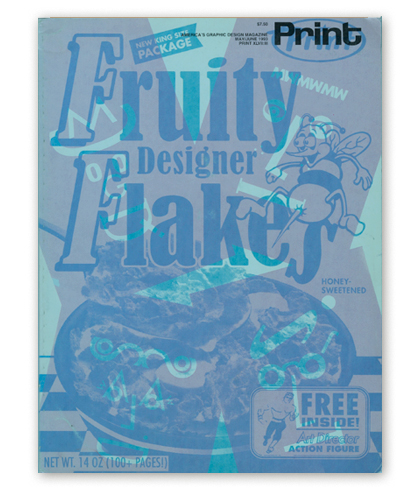
Originally published in Print XLVII:III (May/June 1993), pp. 70–80

Everyone has experienced the tedium associated with the daily postal ritual: the opening of the mailbox, the endless sifting through the usual junk mail and bills (and occasional personal letter), and the inevitable relegation of most of it to the trash bin. On one particular day, however, you might open an envelope to discover one of those tacky soft plastic key chains, ubiquitous in the 1970s, in the shape of a flower. Another direct-mail self-promotion? Well, sort of. Just as you’re about to send it into the waste stream, you decide to take a closer look. The red center reads: “Jim Isermann: Flowers,” and the flower’s yellow “petals” include the following information: “Gallery Hours: 11–5” and “Reception Sat., Jan 11, 3–5.” Isermann is a young artist from Los Angeles who is perhaps best known for his television viewing room at the American Museum of the Moving Image—a classic example of the artist’s fascination with ’70s kitsch. Although this is “just” another exhibition announcement, in a sense it’s as much a part of the artist’s oeuvre as his abstract shag carpet paintings.
Exhibition announcements like the Isermann piece effectively blur the distinctions between art, design, and promotion: Are they artworks? Advertisements? Pieces of a “corporate” (i.e., gallery or museum) identity? Should they be viewed as expressions of the exhibiting artist? Of the invitation’s designer?
Such questions were recently given public consideration at “The Design Show,” an exhibition at Exit Art/The First World, a nonprofit alternative space in New York City’s SoHo district. The exhibit featured over 300 announcements from American galleries, museums, and performance spaces, dating from 1940 to the present.
Exit Art, founded in 1982 by Jeanette Ingberman and Papo Colo, has since garnered a significant reputation for its ambitious group shows and one-person retrospectives. The grand scale of its physical dimensions (the gallery relocated late last year to a 17,000-square-foot space a block away from its original location on lower Broadway) is echoed by lngberman’s and Colo’s ambitious curatorial agenda. As a recent brochure announced: “In reinventing [our] public purposes and definitions, we serve as a prototype for the way different mediums and disciplines are combined, creating a new model to interpret this new period in our cultural history.”
Part of this new definition includes an active interest in integrating the usually segregated fields of fine art and graphic design, and “The Design Show” seemed to be a logical place to initiate such a venture. “We’re trying to break down the barriers between the contexts of art and design, and this show makes it apparent that all of the work selected falls within the art context,” asserts Ingberman. “Announcements are a sort of conceptual ornament,” adds Colo, who conceived the show. “In a sense, they’re a part of the exhibition, acting almost as appetizers.”
In the summer of 1991, Exit Art applied for a National Endowment for the Arts design grant to produce the show, which they received last year. Ingberman and Colo asked Jean-Noel Herlin, a bookseller and archivist, to organize the material. “We usually curate the shows here ourselves, but we wanted someone with a more complete knowledge of the subject, and Jean-Noel was the logical choice,” notes Ingberman.
The SoHo Weekly News once called Herlin “the best-kept secret of the New York art world.” The walls of his TriBeCa apartment are lined with shelves containing thousands of catalogs, artists’ books, press releases, and photographs, all organized in carefully labeled manila folders. What the shelves can’t contain finds its way onto one of several chairs, or the large coffee table in the living room, or the kitchen table, or the floor.
Herlin’s acquisitive impulse was formed early on: “I began collecting books when I was 15,” he recalls. Originally from France, he came to New York in the mid-’60s, forsaking law studies in Paris for a relationship with a New Yorker he had met in France. When the romance ended, Herlin decided to stay on, finding work with an antiquarian bookseller who specialized in selling back issues and sets of a wide range of periodicals. In the five or so years at the job, Herlin claims he sometimes processed thousands of volumes in a single day: “I acquired an enormous amount of knowledge,” he says. In 1971, he decided to open his own store, specializing in books covering 20th-century art, photography, film, and television. Much of the inventory was culled from his personal collection. Just six weeks after opening, the store was flooded, and most of his stock was ruined.
Undaunted, he relocated to a loft on 28th street, and began to acquire similar items, placing special emphasis on artists’ books and art catalogs. In the mid-’70s, the Museum of Modern Art offered to sell him a group of its artists’ files, which contained approximately 1500 exhibition announcements. “That was when the idea of creating an archive started,” he relates. “But it wasn’t until 1981 or ’82 that I really began to take it seriously, refusing to sell anything other than duplicates.”
Herlin’s archive now includes approximately 80,000 announcements—only about one-sixth the number of pieces looked at by Herlin and the Exit Art staff before the final 300 were selected for inclusion in the show. Other resources included the Museum of Modern Art’s library archive and a number of private collections. The final examples represent an excellent cross-section of the thousands of announcements that have gone through the mails in the last half-century.
Herlin makes an educated guess about the historical origin of these announcements, whose absence in today’s art world would be unthinkable. “In the 19th century, artists would often send out invitations to the vernissage (varnishing) of their paintings, which usually took place the day before an exhibition would be mounted.” Today, exhibition announcements are generated by most, if not all, galleries for every show of the season. They tend to be printed in editions of 2000 to 4000, depending on the size of the gallery’s mailing list, and are usually sent to anyone who has taken the time to put down a name and address in the gallery’s guestbook, besides being mailed to critics, collectors, museums, and other dealers.
When asked why “The Design Show” covers approximately a half-century of American exhibition announcements from the starting point of 1940, Herlin jokes, “I think it was a subconscious thing—it was the year I was born.” In actuality, Berlin recognized the need to limit the scope of the project, and felt that 1940 signaled the period in which this country began to show an increased interest in art. Art appreciation flourished especially in New York, thanks to the emigration and subsequent influence of a number of European artists, from Mondrian to Max Ernst. For example, Peggy Guggenheim’s gallery, Art of This Century, opened in 1942, and exhibited a number of European Surrealists, as well as giving first shows to many of the American artists who would come to be known as the Abstract Expressionists (Jackson Pollock had his first exhibit there in 1943).
Walking through the exhibition, one is amazed by the mind-boggling variety of solutions to the apparently simple problem of letting people know when and where a particular artist’s work would be on display. There are announcements designed to be worn, announcements designed to be peeled ’n’ stuck, even announcements designed to be eaten. They are printed on everything from slabs of rubber to Plexiglas, from the backside of a box of Sun-Maid raisins to a chunk of drywall.
Paper, however, is the most common support, appearing in a variety of forms. Several invitations are folded into airplanes (the most recent being Papo Colo’s design for a group show at Exit Art. Another repeated motif is what for lack of a better term could be called “origamization.” The most complex of these folded pieces in the show was designed, appropriately, by Shigeo Fukuda for an exhibit at the IBM Gallery in 1967 called “Toys and Things Japanese,” but a number of non-Japanese artists, from Peter Beard to Frank Stella, are represented in this category as well. Crumpled paper is featured in at least three announcements in the show, although its most famous, and probably most resonant, use was by Marcel Duchamp, for a Dada retrospective at the Sidney Janis Gallery in 1953. There are examples of mouth-watering opulence (one thinks specifically of Pace Gallery’s elegant announcement for Jean Dubuffet and of energetic, often confrontational, vulgarity (for example, any number of Xeroxed announcements for East Village performances in the ’80s). Announcement cards for Op artists cause visual overload, while those created for or by conceptual artists consist of a few simple lines of Helvetica text.
Many of the most intriguing pieces in the show are designed by the artists themselves. A particular standout in this regard is also one of the show’s earliest examples, a foldout announcement for a 1940 exhibit of work by the American Surrealist Joseph Cornell. As the piece is opened, the Watteau commedia dell’arte figure at its center continuously alters its form. More than a design solution, the announcement can be viewed as an extension of Cornell’s collages and sculptures, which frequently appropriated figures from art historical sources and often encouraged the spectator’s participation. It is, in effect, a part of his output as an artist. A similar analysis can be applied to announcements designed by the Pop artists Jim Dine and Claes Oldenburg in the 1960s.
When conceptual/performance artist Eleanor Antin organized an all-woman show in 1964 that traveled to various California libraries, she created an index card for each exhibiting artist (complete with a Library of Congress call number), and subsequently placed them in the libraries’ card catalogs. The spectator could then find the works installed near the spot on the bookshelves where he or she had been directed by the information on the card. Antin’s announcement for the show was in the form of another card, listing her as the “author,” and including the exhibition’s title (“Library Science”), location, and date. “The announcement was an essential part of the concept of the piece—in a way, it was the star of the show,” Antin remembers.
Gallerist Holly Solomon, whose roster of artists includes William Wegman, Laurie Anderson, and Robert Kushner, is especially pleased when artists take the design of the mailer into their own hands. “It doesn’t mean that one artist is better or worse at this than any other artist; it’s just that certain artists have a feeling for what they want to do, and other artists just don’t care.” Two of her younger artists have designed a number of their own announcements, including Izhar Patkin and Thomas Lanigan-Schmidt. Lanigan-Schmidt’s project, a 3-D religious icon, was expensive and time-consuming to fabricate, but ended up being wildly popular. Solomon recalls discovering one hanging on the wall of a curator’s office at the National Gallery in Tokyo: “I thought, ‘Isn’t this wonderful!’ I didn’t even know he was on my mailing list, and it must have been at least two or three years later.”
A number of announcements in the show might first appear to be creations of the exhibiting artist, but are in fact designed by others in a manner to evoke the artist’s style or focus. One of the ablest of these “interpreters” is Marcus Ratliff, who was responsible for a number of ingenious announcements for the galleries of Leo Castelli and Virginia Dwan in the ’60s. Though Ratliff, an artist himself, has since done a wide variety of designs for galleries, he is perhaps best known for these earlier pieces. He recalls the thinking of the art world with regard to announcements in that period: “There was a clear mandate to let the artist’s work provide all the answers to the design questions, so that one announcement was totally different from the other, as if they came from a different planet.” Two wonderful solutions by the designer include a 1968 announcement for the environmental artist Robert Smithson (a several-foot-long sliver of a map, with the exhibition information printed on the back, and a 1969 announcement for a group show of environmental artists. With the latter, Ratliff planned to use typography to call forth the terrestrial focus of the works included in the exhibition. He was stumped when it came to actually fabricating the piece, and consulted a silk-screen printer who devised a method for attaching grit to cardboard.
Ratliff calls attention to a change in his work in the late ’70s and ’80s. With the art boom of that period, a trend toward a more “corporate” look for galleries became prevalent. Perhaps the paradigmatic gallery of the time was Mary Boone’s, which opened in 1977. Boone quickly established herself as a major art world player by assembling a stable of artists who would become the “superstars” of the ’80s art world: Julian Schnabel, David Salle, Ross Bleckner, and Eric Fischl, most prominently. Although she designed her first announcements herself, she soon enlisted the help of her friend Anthony McCall, an experimental filmmaker who began a graphic design career to support himself in the late ’70s.
McCall has since become one of the most sought-after designers of art catalogs and announcements—he now does assignments for approximately 20 other galleries. He recalls when he first began designing announcements: “Nineteen seventy-nine or 1980 was a moment which marked the beginning of what I call the ‘professionalization’ of the art world. Suddenly, certain people were quite self-conscious about their careers. They were very goal-directed and ambitious.” Creating a recognizable identity for a gallery became more important than referencing the work of its artists. Explains McCall, “There’s a great economy to having a certain look, quite apart from it being a very efficient way to create an image or identity for yourself in a very crowded marketplace.” Many of McCall’s designs for Mary Boone contain subtle references to the exhibiting artist’s work (for example, an announcement for a David Salle exhibit in 1985 reproduces the artist’s name in lavender on queasy-green paper, two of Salle’s trademark colors), but all of them conform to the gallery’s esthetic with regard to dimensions, typeface (Copperplate Gothic), and layout.
Although such an approach has often been associated with the ’80s, an earlier precedent can be found in the “identity” devised by designer/artist George Maciunas for the Fluxus group in the ’60s and ’70s. Virtually every object, book, film, and announcement created by artists associated with Fluxus were designed and packaged by Maciunas, whose playful and often brilliant use of type is immediately recognizable. One might argue that while Maciunas’s intent was to stress the cooperative nature of the Fluxus phenomenon, many galleries in the ’80s seemed to be more concerned with creating an aura of power and prestige.
A number of well-known designers have also produced graphics for galleries and museums. Ivan Chermayeff and Thomas Geismar designed a series of announcements for the Howard Wise Gallery in the mid-’60s, all of which managed to call forth a particular artist’s style while also being signature pieces of their studio. Milton Glaser lent his talents to an announcement for an exhibition of illustrators in 1965 called “The Poison Pen.” Alvin Lustig and Elaine Lustig-Cohen both did a series of announcements, as well as exhibition catalogs, in the ’40s and ’50s. And Emil Antonucci is represented in the show by several announcements he designed for the Museum of Contemporary Crafts.
However, a significant portion of design for announcements has gone uncredited. In some cases, a designer was called in simply to execute an idea of the artist or gallerist; more often than not, the piece was a collaboration between all three.
One of the most interesting issues raised by the exhibition is the necessary relinquishing of any clearcut notion of authorship in many of the works displayed. Certain announcement cards seem to have been the result of a genuine collaboration between artist, designer, gallery director, and even, on occasion, the printer. Perhaps their very form—their “throw-away” status as mail allowed for the no-holds-barred cooperative efforts that have resulted in so many innovative announcements. Produced in a context where so much emphasis is placed on individuality (in terms of the artist’s style, or the gallery director’s particular focus), these cards often ended up generating the most enthusiastic responses.
Marcus Ratliff remembers such a collaboration taking place when he was working on an announcement for an exhibition of the paintings of Cy Twombly in 1967. He enlarged a detail of a particular photograph that he found to be reminiscent of the artist’s work, and then brought it to Twombly’s studio and asked him to draw on top of it. “I took down the print and showed it to him, and he sort of blinked his eyes and said, ‘Well, what am I supposed to do?’ And I said, ‘Well, if you could alter this in a way—you know, with a white crayon or something that you’ve got around...’ And it became a Twombly that was already started, in a way, by virtue of this photograph. He didn’t reject it, but at the same time, I probably wouldn’t do it now.”
Jeanette Ingberman and Papo Colo hope “The Design Show” will stimulate this kind of dialogue, producing examples on a par with those featured in the exhibit. As Ingberman says, “If you go back to the Bauhaus, or the Russian Constructivists, it’s plain to see that design has a tradition of being a vital part of the art world. It would be great if this show could encourage a whole new series of collaborations between artists and designers.”