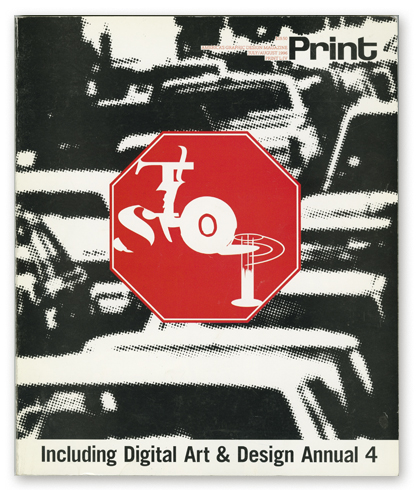
Originally published in Print L:VI (May/June 1995), pp. 232–234

Design Writing Research: Writing on Graphic Design
By Ellen Lupton and J. Abbott Miller
Introduction by Rick Poyner
Kiosk Books, New York
Distributed by Princeton Architectural Press
211 pages; 8 1/2 x 11"; over 300 illustrations; $45
Reviewed by Tod Lippy
There has been a recent spate of “self-generated” designer monographs—Dan Friedman’s Radical Modernism, David Carson’s The End of Print, and Rudy VanderLans and Zuzana Licko’s Emigre: Graphic Design into the Digital Realm—which, however valuable to students and practitioners for their representative samplings of the designers’ work and ideas, have tended to resemble self-promotions leavened with “objective,” i.e., laudatory, critical analyses of the subjects. What a pleasure, then, to read Design Writing Research: Writing on Graphic Design—the recent self-published effort of J. Abbott Miller and Ellen Lupton, co-founders of the multidisciplinary design studio of the same name. The book is a collection of their critical reflections on graphic design and visual culture, and is serious, considered, and provocative.
Miller and Lupton share impressive credits: Together they have curated—and written and designed the catalogs for—a number of exhibitions, including 1991’s The ABCs of ABC: The Bauhaus and Design Theory and 1993’s The Bathroom, The Kitchen, and the Aesthetics of Waste. Lupton is currently curator of contemporary design at Cooper-Hewitt, National Design Museum; and Miller, director of Design/Writing/Research, has, among other projects, art directed Dance Ink magazine since 1993. Apparent in all of their work is an interest in elucidating critical theory—including the work of Jacques Derrida, Michel Foucault, Roland Barthes, and Jean Baudrillard—to a design audience, as well as applying it, in a cogent, clear-minded way, to both their writing, curatorial, and design efforts. Design Writing Research serves as a welcome compendium of their collected and collective thought up to this point.
Divided into three sections—“Theory,” “Media,” and “History”—the book is mostly composed of articles Lupton and Miller wrote for publications like Eye, PRINT, and Emigre, as well as featuring work from a number of exhibition catalogs (most prominently, a condensed version of the design time-line from the Walker Art Center’s Graphic Design in America exhibition from 1989). Yet, even to anyone already familiar with the majority of the articles, the book will be of value—one of the true pleasures in reading it comes from the opportunity to absorb Lupton’s and Miller’s work as presented, or “re-presented,” in many cases, by Lupton and Miller themselves. Both have been emphatic about the importance of integrating verbal and visual information, and their arguments to that end are well-supported in the work reproduced here that originally appeared in design magazines with different art directors.
Because each of these magazines had to observe its own set of restrictions when it came to format, space allotment, etc., the message inherent in many of their essays was often diluted. Here, and in all of their work, text is not so much “illustrated” as “partnered” with image. A perfect example is the redesign of Miller’s piece on Quentin Fiore, which originally appeared in Eye, Vol. 2, no. 8. There, it conformed to that magazine’s smart, elegant template: a smattering of 20-odd spreads from the books, reproduced in different sizes, along with several of Fiore’s covers. Here, the authors reproduce in a diminutive size close to 40 covers and spreads from the books, which run across the center of each spread. Near the end of the piece, the reader turns the page to discover a full-bleed cropped and magnified image of the eye from a Medium is the Massage spread that has already been shown. Besides its being a visually arresting image, the strategy cleverly inverses Fiore’s practice in that book of repeating a spread’s visual in postage-stamp size on a following spread.
This rather seamless conjoining of form and content informs most of Design Writing Research. For instance in “Deconstruction and Graphic Design,” the opening essay, Lupton and Miller not only offer an utterly comprehensible breakdown of the development of poststructuralist theory from Ferdinand de Saussure’s Course in General Linguistics to the recent work of Derrida, they also investigate the ways in which “deconstruction” has devolved from an analytical tool with significant cultural and political implications into a fashionable “style”—a tic—in the hands of many designers (and the minds of many design critics). This text is superimposed over shifting black-and-white reproductions of open, empty book spreads—a handy way to visually reinforce the essay’s assertion that framing elements can harbor just as many ideological biases as language itself.
A similar ingenuity and integrity infuses most of the other essays, which range from analyses of stock photography (“Pictures for Rent”) to USA Today (“McPaper”) to images of African Americans in advertising (“White on Black on Gray”). Given the strength of these pieces, it’s hard to understand why Miller and Lupton would include something like “Disciplines of Design: Writing with Foucault,” a rather gimmicky alteration of a text from the late theorist’s The Archaeology of Knowledge, in which various terms evoking the codification of madness and illness are replaced with those relating to design practice (set in different color type). This essentially superficial exercise represents, however, only three pages out of 211, and is in fact only so noticeable because of the high quality of the rest of the enterprise.
Lupton and Miller’s work is closely related to the Conceptual art movement of the 1960s, in which artists like Hans Haacke (a teacher of, and acknowledged influence on, the two) and Joseph Kosuth employed both text and image in works that went beyond mere representation to an inquiry into representation. As Kosuth put it in a 1970 interview, “I think to be an artist now means to question the nature of art—that’s what being ‘creative’ means to me because that includes the whole responsibility of the artist as a person: the social and political as well as the cultural implications of his or her activity.” Although such an inquiry has since been taken up by any number of contemporary artists, one of the most exciting things about its adoption by designers as smart and committed as Lupton and Miller is the fact that they are working within, and speaking to, a community with a much greater potential to reach a general audience. As the two authors state in “Language of Vision,” near the end of the “Theory” section of the book, “By employing theory to connect rather than disengage visual and verbal expression, we can intensify and direct the cultural meaning of our work.” Such thoughtfulness and responsibility is commendable, and welcome, in the graphic design field, and makes Design Writing Research required reading for both students and professionals.