Scenario, Vol. 3, No. 2
Published by RC Publications, Inc., Spring 1997. Format: Perfect-bound magazine, 10.75 by 9 inches, 192 pages.
EDITOR’S NOTE
Upon finishing the manuscript to a novel, short story or poem, most writers can breathe a sigh of relief: the bulk of the work—the crushing process of dredging up the dramatic material, sifting through it, structuring it, restructuring it again and again—is over. Yet, when screenwriters arrive at that same point, they’re only at the beginning of what is usually the most onerous, frustrating part of their job. Subjected to the input of agents, actors, producers, directors and studio executives—not to mention test audiences—they must employ a nearly impossible flexibility in order to retain their connection and commitment to the work in question. While ideal circumstances, in the form of intelligent collaborators with a respect for the material, are key, what is most essential on the part of the writer is an unwavering belief in the dramatic potential of the work.
Back in 1990, Paul Attanasio wrote the first draft of Donnie Brasco, based on the memoirs of Joe Pistone, an undercover FBI agent who insinuated himself into a powerful position in the New York Mafia in the late ’70s. In fact, it was this script that cemented the writer’s longstanding relationship with Baltimore Pictures, for whom he has since written Quiz Show, Disclosure and the upcoming Sphere. But Attanasio didn’t simply view Donnie Brasco as a springboard to other projects; he was strongly attracted to the material, and felt a real responsibility to Pistone, who, in Attanasio’s words, “had only one life story, after all.” During a five-year period in which both directors and actors danced around the project for various reasons (including its superficial similarities to GoodFellas)—and during which, the writer wryly notes, he got married, had two children, and moved into two new houses—Attanasio returned again and again to the script, writing new drafts as much to keep it alive in his mind as to make it viable to interested parties. When director Mike Newell committed to the project several years ago, Attanasio was pleased to find that the two of them returned to his first draft for the bulk of the material for the shooting script, published here. The finished film, released earlier this year to a strong response from both critics and audiences, clearly reflects Attanasio’s longstanding involvement: as one critic remarked, its richly drawn, sublimely human characters are perfect examples of “the Attanasio principle.”
Robert Gordon’s involvement with Addicted to Love also goes back to its first incarnation—as a short script he wrote while in graduate film school in 1989. At the suggestion of one of his teachers, he expanded it into a feature-length screenplay, which was optioned by Outlaw Pictures (sex, lies, and videotape) almost immediately. It was an auspicious beginning, but things then slowed down considerably: In those ensuing six years, Gordon’s script, a carefully calibrated “unromantic comedy” about love, loss and obsession, was attached to one director after another (Alfonso Cuarón, Whit Stillman and P.J. Hogan, to name a few), requiring Gordon to write an almost equal number of drafts. As he puts it here, “Every scene in this movie I’ve written with twelve different approaches.” Then, last year, Griffin Dunne became interested in turning the script into his feature directorial debut, and enjoined actress Meg Ryan to play the central part of Maggie. Gordon retained an involvement with the project throughout the production process, working on-set through the entire shoot and providing input during post-production. This spring, he was able to see his script, which he had originally planned to shoot himself on Super 8 back in 1989, finally released as a major studio film.
In 1992, French filmmaker Claire Denis was approached by a European production company to make a film based on a real-life event. She was not particularly interested in the topic they’d chosen, however, so she proposed another: the Paulin murder case, in which a young black transvestite was tried and convicted in the early ’80s in Paris for murdering a number of elderly women. Denis became fascinated by the case mainly because it dovetailed with her strong interest in racial and cultural politics (a common thread connecting all of her films). She approached her writing partner, Jean-Pôl Fargeau, and the two began work on the screenplay for I Can’t Sleep [j’ai pas sommeil]. As their writing progressed, however, the company lost interest, asking Denis to work first on another film. Already absorbed in the project, Denis declined their offer, instead finishing the script with Fargeau and eventually finding another producer. The undeniable resonance of the script and the 1994 film—-arguably Denis’s best—illustrates a statement she made several years ago: “We too often associate the world of film with the world of success. But film should also be allowed to be part of a larger itinerary, part of a personal quest.”
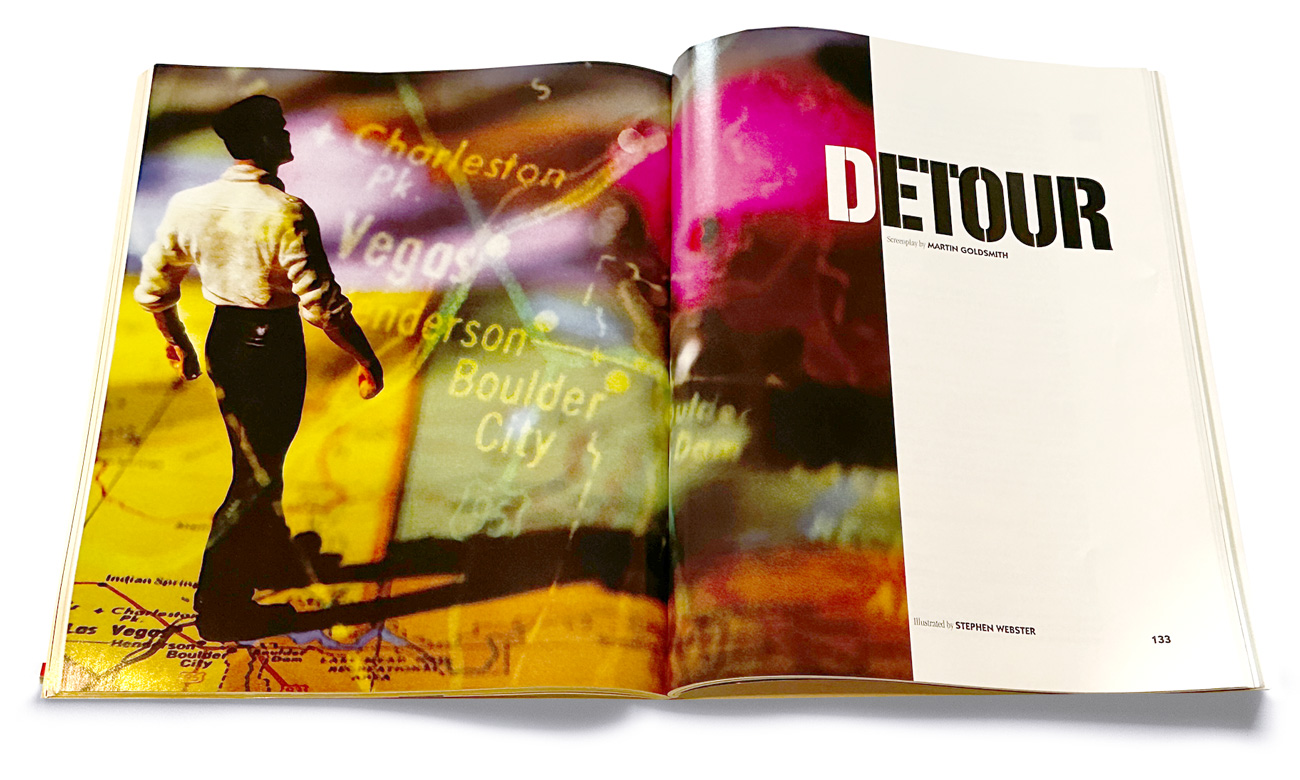
The evidence of a similar kind of personal quest closes the issue. In 1939, Martin Goldsmith wrote a novel called Detour, about a down-on-his-luck musician who crosses paths with a sharply rendered femme fatale named Vera. It seemed tailor-made as movie material for the burgeoning film noir genre. But before he would sell the book to Hollywood, Goldsmith had one requirement: whoever bought the film rights had to guarantee him the job of writing the adaptation. In 1944, “B”-movie giants PRC did just that, and the film was released the following year, under Edgar Ulmer’s direction. Over the years, Detour—since selected into the National Film Registry at the Library of Congress, and long considered a film noir classic—has come to be solely regarded as “A Film by Edgar Ulmer,” despite the fact that Goldsmith adapted the script from his own novel, and, significantly, wrote the shooting script before Ulmer was even hired to direct. The issue of mistaken attribution is explored in the essay “Auteur Detour” which follows the script along with some fascinating information about Goldsmith (he died in 1994), who seemed to apply equal passion and commitment to writing and life.
We hope you take inspiration from these writers, their stories and their determination, and we look forward, as always, to hearing your comments.—Tod Lippy
Related
SCENARIO VOL. 1, NO. 3 CONTENTS
Editor’s Note
By Tod Lippy
Donnie Brasco
Screenplay by Paul Attanasio
Writing Donnie Brasco
A Talk with Paul Attanasio
I Can’t Sleep
Screenplay by Claire Denis and Jean-Pol Fargeau
Writing & Directing I Can’t Sleep
A Talk with Claire Denis
Detour
Screenplay by Martin Goldsmith
Martin Goldsmith (1913–1994): A Biography
Auteur Detour
By Alyssa Gallin