Guadagnino’s “Queer”
Fri, Nov 29, 2024 10:00 PM

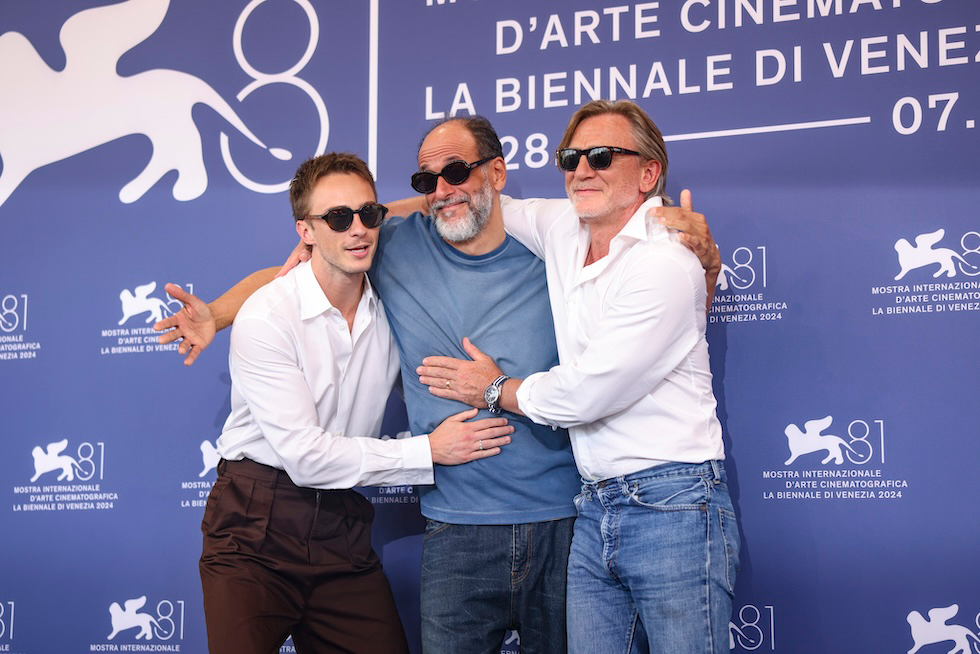
Detail of photo featuring Drew Starkey, Luca Guadagnino, and Daniel Craig at the 2024 Venice International Film Festival. (Vianney Le care/Invision/AP)
When I’ve seen a Luca Guadagnino project I really like—I Am Love, or Call Me by Your Name, or We Are Who We Are—I’m inclined to place him in the same category as truly great filmmakers like Pedro Almodóvar, Claire Denis, or Apichatpong Weerasethakul. The quirks and tics—a heavy dependence on pop music, the obsession with youth, the frictionless romanticism—feel organic, necessary.
I saw Queer last night and, well before it was over, experienced the same sinking feeling I had after watching Terence Malick’s ponderous To the Wonder (2012): all of the mannerisms that had made Malick’s previous work unique and powerful—like, for instance, those nearly unintelligible voiceovers (murmur-overs?) accompanying shots of, say, rustling trees—not only felt forced and cheap, their presence in an inferior film retroactively affected my feelings about his earlier work.
Guadagnino has a habit of using straight actors to play gay roles, and that’s more than fine with me (I can’t imagine a better, and more consequential, performance along those lines than that of Paul Mescal in Andrew Haigh’s All of Us Strangers). But, at least in Queer, it smacks of a kind of sophomoric wish fulfillment. Showing James Bond and the kid from Outer Banks having sex (which, by the way, is not explicit, despite all of the breathless PR suggesting otherwise) in this uneven film strikes me as the equivalent of a self-hating young gay kid (like myself, for instance) making his G.I. Joes kiss each other by knocking their heads together. It feels forced, and maybe even a little spiteful—look what I made these straight guys do! And it has made me inclined to go back to scenes in Guadagnino’s earlier films—like Challengers, in which Josh O’Connor and Mike Faist make out in front of Zendaya—with a bit more skepticism about his motives.
I didn't love Daniel Craig's performance, which felt effortful and kind of panicked, and the jukebox-y employment of contemporary music, even Nirvana’s “Come As You Are,” seemed cheap and easy. The final third of the film—revolving around an ayahuasca trip the two leads take in the jungle c/o the ever-brilliant Lesley Manville—was the strongest part of the movie, but it wasn’t enough, at least for me, to overcome its weaknesses.