Scenario, Vol. 1, No. 1
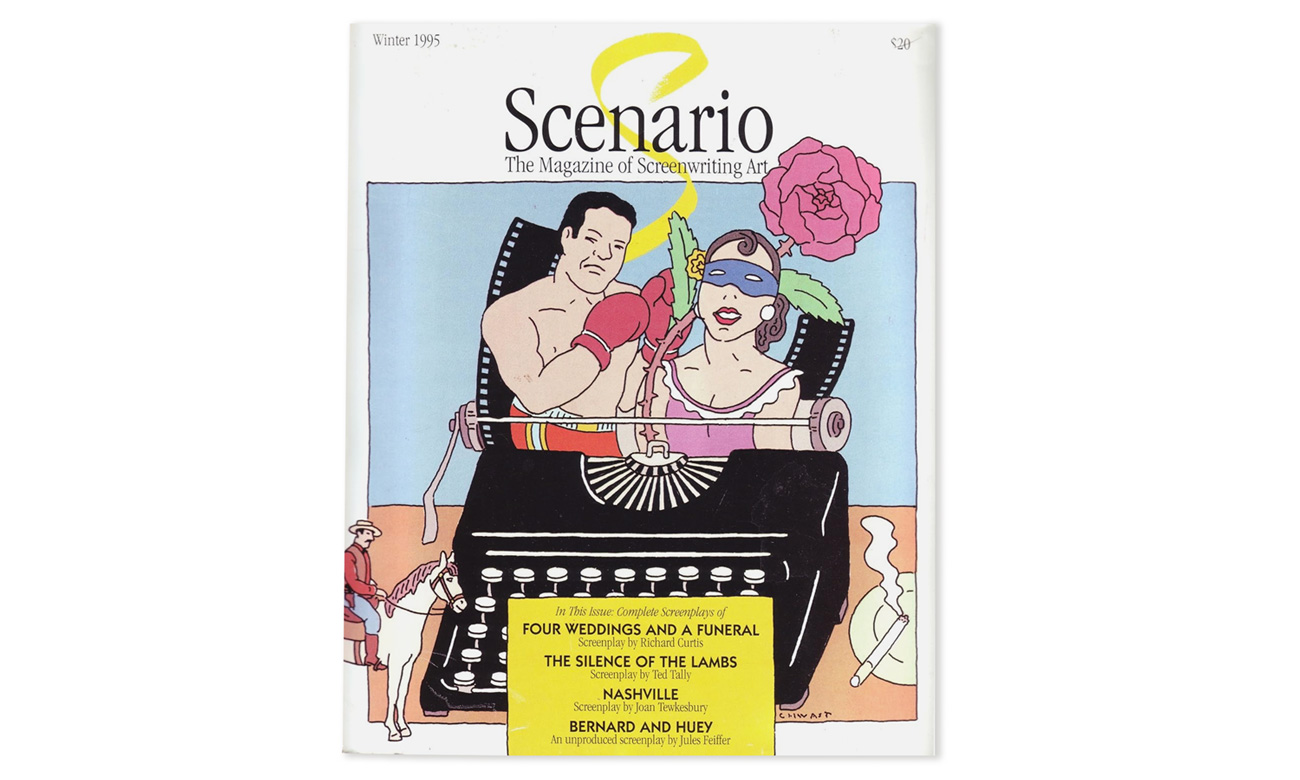
Published by RC Publications, Inc., Winter 1995. Format: Perfect-bound magazine, 10.75 by 9 inches, 208 pages.
EDITOR’S NOTE
“For the basic art of motion pictures is the screenplay; it is fundamental, with it there is nothing.”—Raymond Chandler
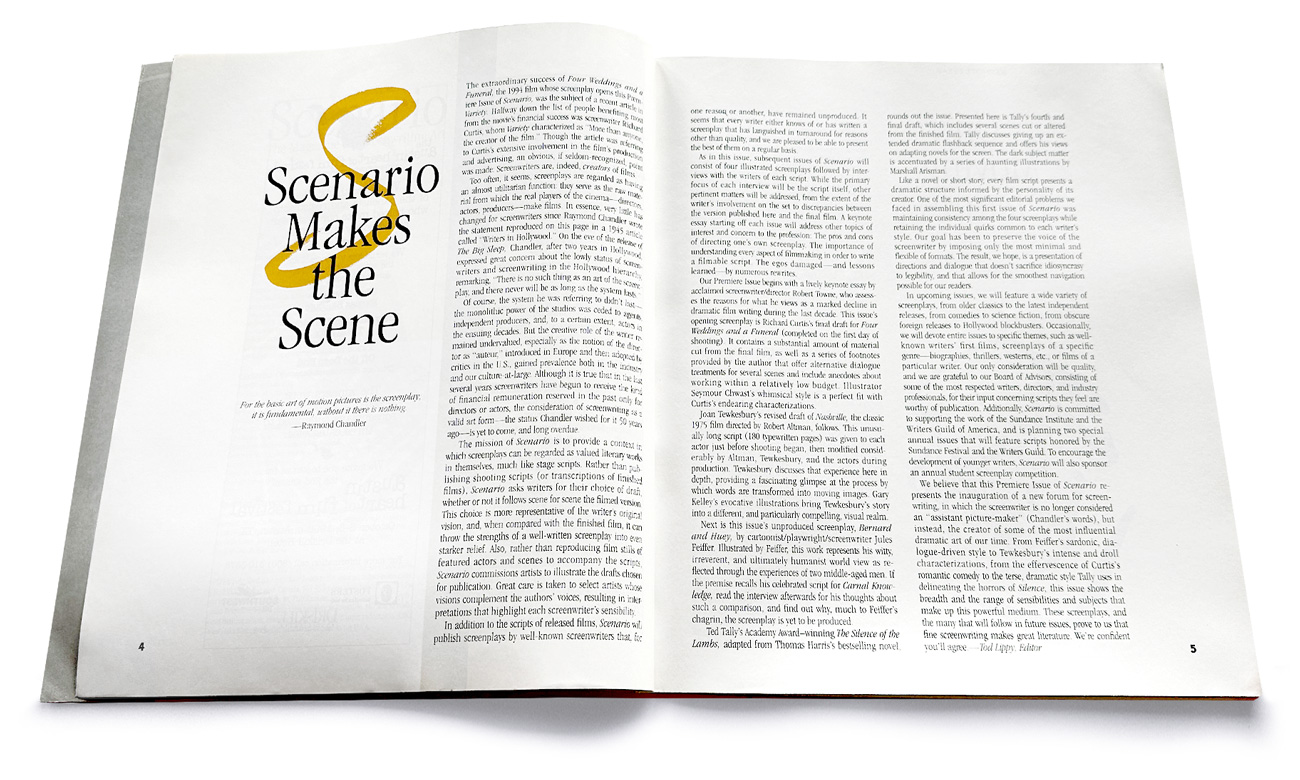
The extraordinary success of Four Weddings and a Funeral, the 1994 film whose screenplay opens this Premiere Issue of Scenario, was the subject of a recent article in Variety. Halfway down the list of people benefiting most from the movie’s financial sucess was screenwrlter Richard Curtis, whom Variety characterized as “More than anyone, the creator of the film.” Though the article was referring to Curtis’s extensive involvement In the film’s production and advertising, an obvious, if seldom-recognized, point was made: Screenwriters are, Indeed, creators of films.
Too often, it seems, screenplays are regarded as having an almost utilitarian function: they serve as the raw material from which the real players of the cinema—directors, actors, producers—make films. In essence, very little has changed for screenwriters since Raymond Chandler wrote the statement reproduced on this page in a 1945 article called “Writers in Hollywood.” On the eve of the release of The Big Sleep, Chandler, after two years in Hollywood, expressed great concern about the lowly status of screenwriters and screenwriting in the Hollywood hierarchy, remarking, “There is no such thing as an art of the screenplay, and there never will be as long as the system lasts.”
Of course, the system he was referring to didn’t last—the monolithic power of the studios was ceded to agents, independent producers, and, to a certain extent, actors in
the ensuing decades. But the creative role of the writer remained undervalued, especially as the notion of director as “auteur,” introduced in Europe and then adopted by critics in the U.S., gained prevalence both in the industry and our culture-at-large. Although it is true that in the last several years screenwriters have begun to receive the kind of financial remuneration reserved in the past only for directors or actors, the consideration of screenwriting as a valid art form—the status Chandler wished for it 50 years ago—is yet to come, and long overdue.
The mission of Scenario is to provide a context in which screenplays can be regarded as valued literary works in themselves, much like stage scripts. Rather than publishing shooting scripts (or transcriptions of finished films), Scenario asks writers for their choice of draft, whether or not it follows scene for scene the filmed version. This choice is more representative of the writer’s original vision, and, when compared with the finished film, it can throw the strengths of a well-written screenplay into even starker relief. Also, rather than reproducing film stills of featured actors and scenes to accompany the scripts, Scenario commissions artists to illustrate the drafts chosen for publication. Great care is taken to select artists whose visions complement the authors’ voices, resulting in interpretations that highlight each writer’s sensibility.
In addition to the scripts of released films, Scenario will publish screenplays by well-known screenwriters that, for one reason or another, have remained unproduced. It seems that every writer either knows of or has written a screenplay that has languished in turnaround for reasons other than quality, and we are pleased to be able to present the best of them on a regular basis.
As in this issue, subsequent issues of Scenario will consist of four illustrated screenplays followed by interviews with the writers of each script. While the primary focus of each interview will be the script itself, other pertinent matters will be addressed, from the extent of the writer's involvement on the set to discrepancies between the version published here and the final film. A keynote essay starting off each issue will address other topics of interest and concern to the profession: The pros and cons of directing one’s own screenplay. The importance of understanding every aspect of filmmaking in order to write a filmable script. The egos damaged—and lessons learned—by numerous rewrites.
Our Premiere Issue begins with a lively keynote essay by acclaimed screenwriter/director Robert Towne, who assesses the reasons for what he views as a marked decline in dramatic film writing during the last decade. This issue’s opening screenplay is Richard Curtis's final draft for Four Weddings and a Funeral (completed on the first day of shooting). It contains a substantial amount of material cut from the final film, as well as a series of footnotes provided by the author that offer alternative dialogue treatments for several scenes and include anecdotes about working within a relatively low budget. Illustrator Seymour Chwast's whimsical style is a perfect fit with Curtis’s endearing characterizations.
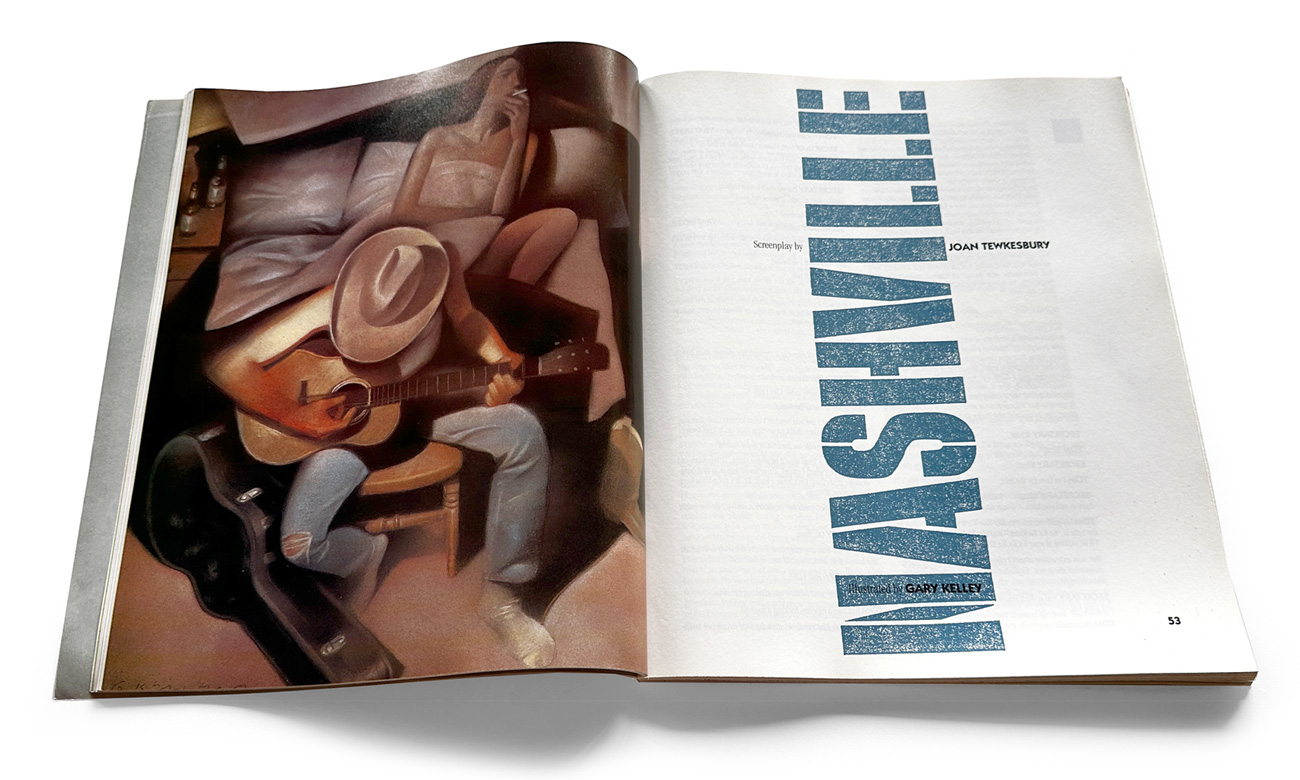
Joan Tewkesbury’s revised draft of Nashville, the classic 1975 film directed by Robert Altman, follows. This unusually long script (180 typewritten pages) was given to each actor just before shooting began, then modified considerably by Altman, Tewkesbury, and the actors during production. Tewkesbury discusses that experience here in depth, providing a fascinating glimpse at the process by which words are transformed into moving images. Gary Kelley’s evocative illustrations bring Tewkesbury’s story into a different, and particularly compelling, visual realm.
Next is this issue’s unproduced screenplay, Bernard and Huey, by cartoonist/playwright/screenwriter Jules Feiffer. Illustrated by Feiffer, this work represents his witty, irreverent, and ultimately humanist world view as reflected through the experiences of two middle-aged men. If the premise recalls his celebrated script for Carnal Knowledge, read the interview afterwards for his thoughts about such a comparison, and find out why, much to Feiffer's chagrin, the screenplay is yet to be produced.
Ted Tally's Academy Award-winning The Silence of the Lambs, adapted from Thomas Harris’s bestselling novel, rounds out the issue. Presented here is Tally’s fourth and final draft, which includes several scenes cut or altered from the finished film. Tally discusses giving up an extended dramatic flashback sequence and offers his views on adapting novels for the screen. The dark subject matter is accentuated by a series of haunting illustrations by Marshall Arisman.
Like a novel or short story, every film script presents a dramatic structure informed by the personality of its creator. One of the most significant editorial problems we faced in assembling this first issue of Scenario was maintaining consistency among the four screenplays while retaining the individual quirks common to each writer’s style. Our goal bas been to preserve the voice of the screenwriter by imposing only the most minimal and flexible of formats. The result, we hope, is a presentation of directions and dialogue that doesn’t sacrifice idiosyncrasy to legibility, and that allows for the smoothest navigation possible for our readers.
In upcoming issues, we will feature a wide variety of screenplays, from older classics to the latest independent releases, from comedies to science fiction, from obscure foreign releases to Hollywood blockbusters. Occasionally, we will devote entire issues to specific themes, such as well-known writers’ first films, screenplays of a specific genre—biographies, thrillers, westerns, etc., or films of a particular writer. Our only consideration will be quality, and we are grateful to our Board of Advisors, consisting of some of the most respected writers, directors, and industry professionals, for their input concerning scripts they feel are worthy of publication. Additionally, Scenario is committed to supporting the work of the Sundance Institute and the Writers Guild of America, and is planning two special annual issues that will feature scripts honored by the Sundance Festival and the Writers Guild. To encourage the development of younger writers, Scenario will also sponsor an annual student screenplay competition.
We believe that this Premiere Issue of Scenario represents the inauguration of a new forum for screenwriting, in which the screenwriter is no longer considered an “assistant picture-maker” (Chandler's words), but instead, the creator of some of the most influential dramatic art of our time. From Feiffer’s sardonic, dialogue-driven style to Tewkesbury’s intense and droll characterizations, from the effervescence of Curtis’s romantic comedy to the terse, dramatic style Tally uses in delineating the horrors of Silence, this issue shows the breadth and the range of sensibilities and subjects that make up this powerful medium. These screenplays, and the many that will follow in future issues, prove to us that fine screenwriting makes great literature. We’re confident you’ll agree.—Tod Lippy, Editor
Related
SCENARIO VOL. 1, NO. 1 CONTENTS
Editor's Introduction: Scenario Makes the Scene
By Tod Lippy
Keynote Essay: On Moving Pictures
By Robert Towne
Four Weddings and a Funeral
Screenplay by Richard Curtis
Writing Four Weddings and a Funeral
A Talk with Richard Curtis
Nashville
Screenplay by Joan Tewkesbury
Writing Nashville
A Talk with Joan Tewkesbury
Bernard and Huey
Screenplay by Jules Feiffer
Writing Bernard and Huey
A Talk with Jules Feiffer
The Silence of the Lambs
Screenplay by Ted Tally
Adapting The Silence of the Lambs
A Talk with Ted Tally