Published by RC Publications, Inc., Fall 1995. Format: Perfect-bound magazine, 10.75 by 9 inches, 228 pages.
EDITOR’S NOTE
Film is the unchallenged reality-based medium (the theater gave up the title generations ago). Whether one is speaking of a distant historical event or yesterday’s media sensation, it's almost a given that someone, at some point, will go about trying to turn it into a movie.
Of course, dramatizing factual material has its perils, especially in an artistic medium whose technology so closely approximates “real life.” It’s taken for granted that a certain distortion of fact will necessarily occur—time telescoped, characters dropped or combined. But is the distortion being done to emphasize a bias on the part of the filmmaker? To prettify or gloss over the facts? To salvage a reputation, or destroy it? Arguably the most successful reality-based films are those which, above all else, manage to get to the essential “truth” of the event in question, regardless of its complexity.
Three of the screenplays in this issue take their inspiration from real-life events, and each succeeds in this regard. Paul Attanasio’s Quiz Show (nominated for an Oscar) tackles the subject of the television quiz show scandals of the late ’50s. In constructing his screenplay, Attanasio chose to focus on the rigging of one show, “Twenty-One,” and the intersection of two of its contestants—Herbert Stempel, a graduate student from Queens, and Charles Van Doren, the scion of a well-known literary family—with Richard Goodwin, the congressional investigator on whose memoir the film is based. The result is a layered study of class, ethnicity and ambition, and the role of each in “the continual loss of innocence” Attanasio feels is endemic to American culture. Dramatizing an event from the recent past—with many of the participants still alive—necessitated a privileging on the part of the writer of “moral truth” over a more myopic attachment to, as Henry James once observed, “the fatal futility of Fact.” That painstaking, and soul-searching, process is discussed at length in the interview with Attanasio.
A similar problem faced Frances Walsh and Peter Jackson, the co-writers of Heavenly Creatures, also nominated for an Academy Award. The screenplay is based on the Parker-Hulme murder case, in which teenagers Pauline Parker and Juliet Hulme killed Parker’s mother in 1954 in Christchurch, New Zealand, after she threatened to separate them. After exhaustive research of court records, conversations with relatives and friends, and a careful reading of Pauline Parker’s diary, Walsh and Jackson (also the film’s director) were compelled to present a revisionist view of the girls and their friendship, brought into vivid relief against the repressive atmosphere of that place and that time. Walsh and Jackson talk at length about their desire to alter the public perception of the case in their native New Zealand, as well as their discomfort with the fact that one of the girls, now a well-known writer, was identified during the film’s production.
Both of these scripts happen to reference relatively contemporary events; the other reality-based screenplay in this issue, Harrow Alley, looks back more than 300 years for its inspiration. This meticulously drawn tale of daily life in London during the Black Plague by the late Walter Newman (Ace in the Hole, The Man with the Golden Arm) has spent all of its 30-odd years of existence this close to getting produced, with the involvement at one time or another of everyone from John Huston to the Royal Shakespeare Company. Although the script never shrinks from its subject matter—rarely has a story wallowed so completely in the specifics of a calamity—it still manages to relate a remarkably relevant (and, in the age of AIDS, contemporary) message about the ways in which human beings manage—or don't manage—to deal with overwhelming adversity. Harrow Alley was bought outright in 1968 by George C. Scott, who here discusses his efforts to produce it over the past quarter century. His comments follow William Froug’s insightful 1972 interview with Newman, in which the screenwriter talks about why he decided to write a script with the Plague as its theme, as well as how he went about researching the subject matter.
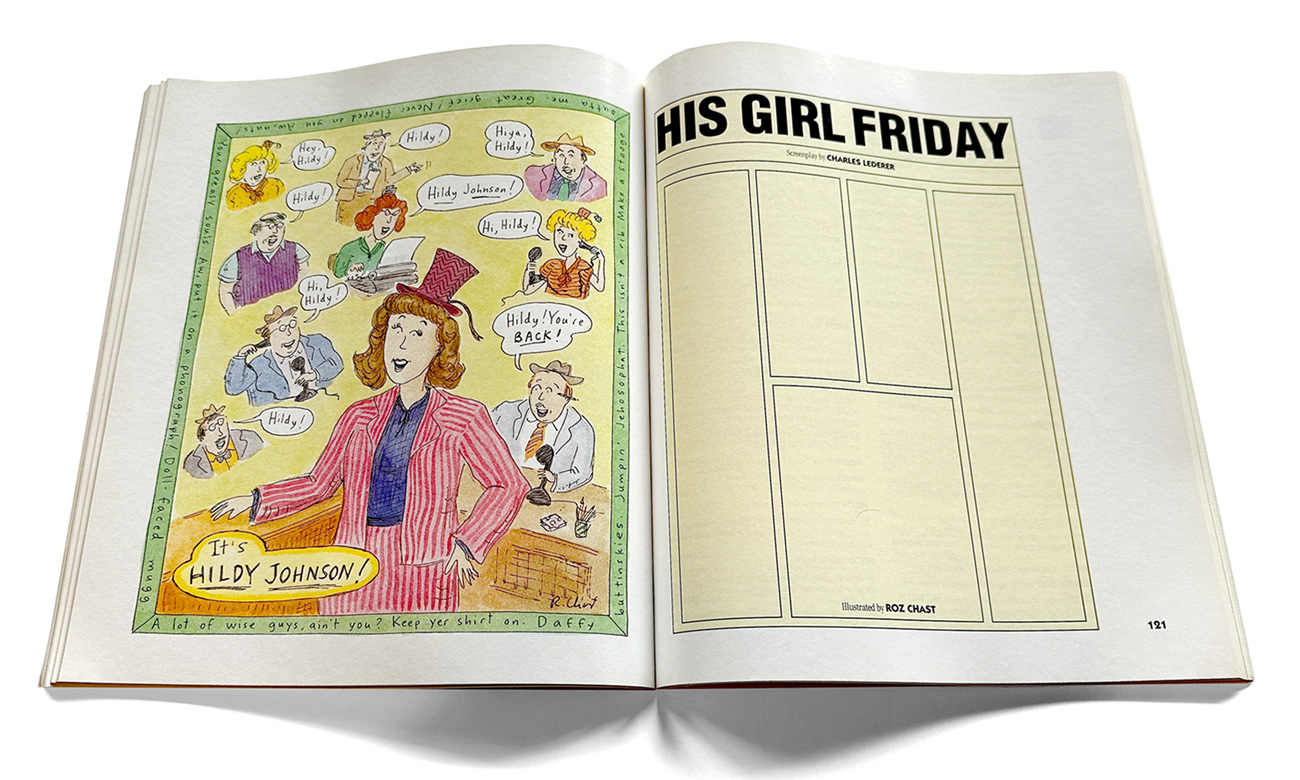
Our fourth script is the classic 1940 screwball comedy His Girl Friday, adapted by Charles Lederer (Gentlemen Prefer Blondes, The Spirit of St. Louis) from Ben Hecht and Charles MacArthur’s play The Front Page. Featured here is Lederer's 1939 revised final draft, containing the film’s famous rapid-fire dialogue—memorably executed on-screen by Cary Grant and Rosalind Russell in the lead roles of Walter Burns and Hildy Johnson—as well as several scenes that didn't appear in Howard Hawks’ film. In “Woman’s Work,” the essay that follows, film critic Molly Haskell discusses how His Girl Friday celebrates the notion of sexual equality in its depiction of Hildy and Walter as a truly modern couple.
This issue’s keynote essay deals with a different kind of screwiness. In “Smash Cut,” David Mamet muses on the elusive semantics of the film industry in general, and of screenwriting in particular. His characteristically incisive observations would make Walter Burns proud, and will be sure to strike a chord with anyone who’s ever pondered the absurdities of film industry jargon.
Two of the featured scripts in this issue—Quiz Show and Heavenly Creatures—share the distinction of being nominated for 1994 Writers Guild Awards, and a third, His Girl Friday, was recently selected to the National Film Registry at the Library of Congress by a panel which included Guild members. We’re naturally pleased to publish work that has been honored by what is truly a jury of one’s peers—the member of the WGA: it is an organization whose unflagging efforts on behalf of screenwriters we admire and respect, and for whose help and support we are continually grateful.—Tod Lippy
CONTENTS
Editor's Note
By Tod Lippy
Keynote Essay: Smash Cut
By David Mamet
Quiz Show
Screenplay by Paul Attanasio
Writing Quiz Show
A Talk with Paul Attanasio
Harrow Alley
Screenplay by Walter Brown Newman
Writing Harrow Alley
A 1972 Interview witth Walter Brown Newman
By William Froug
"It's Kept Me Alive All These Years"
A Talk with George C. Scott about Harrow Alley
His Girl Friday
Screenplay by Charles Lederer
From The Front Page to His Girl Friday
By Alyssa Gallin
Woman's Work: The Proto-Feminism of His Girl Friday
By Molly Haskell
Heavenly Creatures
Screenplay by Frances Walsh and Peter Jackson
Writing & Directing Heavenly Creatures
A Talk with Frances Walsh and Peter Jackson